How a village became famous for hanging baskets
Champion of Champions, twice
Broughshane started entering the Ulster in Bloom competition in the early 1990s. The Broughshane Improvement Group — a volunteer body that began with a few residents tidying verges — got organised, got serious, and got methodical. Ulster in Bloom wins came first. Then Britain in Bloom category wins, year after year. Then, in 2007, Broughshane won the Britain in Bloom Champion of Champions award — the prize handed to the single best entry from across the previous five years of category winners across the United Kingdom. The village won it again in 2012, the only Northern Ireland community to take it twice. Along the way it also won the European Entente Florale gold and, in February 2018, Channel 4's UK Village of the Year, presented by Penelope Keith, with a £10,000 prize. The judges that year highlighted that close to two-thirds of residents were involved in village voluntary work. Drive into Broughshane in July and you see what thirty years of organised civic pride looks like. It is not a tourism set-piece. It is what the village does because it decided to.
Field Marshal, Ladysmith, Broughshane churchyard
Sir George White VC
George Stuart White was born in Portstewart in 1835 but the family home was in Broughshane and he is buried in Broughshane First Presbyterian churchyard, with a monument on the village street to mark him. He won the Victoria Cross at the Battle of Charasiab in Afghanistan in 1879 for leading a small force up a hill against a much larger Afghan position. The fame, though, came twenty years later. In late 1899, at the start of the Second Boer War, White was the British commander besieged at Ladysmith. The siege lasted 118 days. Ladysmith held. White was made a peer, became Governor of Gibraltar, and was promoted to Field Marshal in 1903 — the highest rank in the British Army. He died in 1912 and was brought home to be buried in the Presbyterian churchyard in his village. The Broughshane Community Museum on Main Street tells the story in more detail; it is run by volunteers and opens at limited hours, so check before you visit.
The shepherd, the mountain, the 17th of March
Slemish and St Patrick
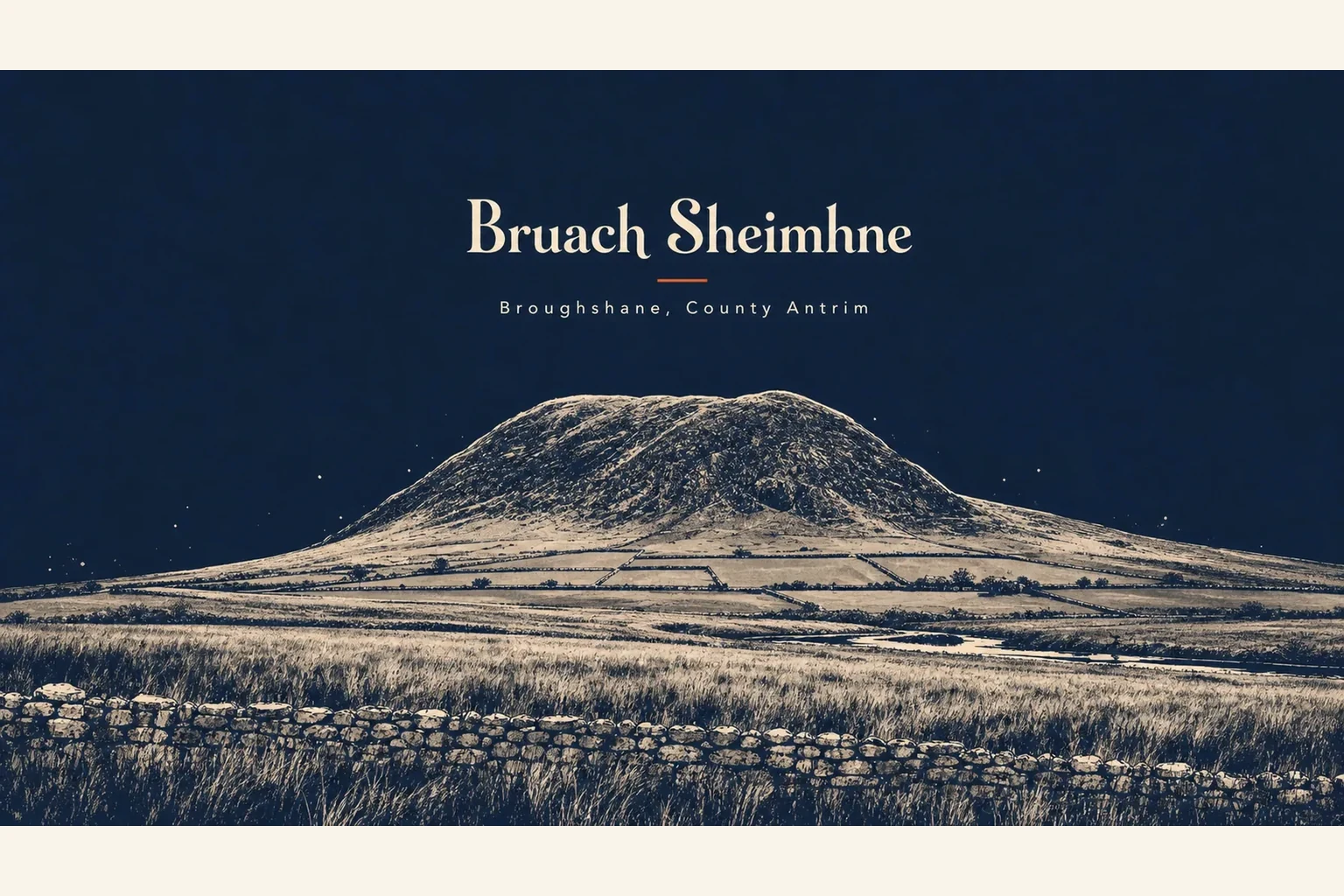
Tradition has it that the boy who became St Patrick was brought as a slave from Roman Britain around the year 405 and sold to a man named Milchu, who set him to keep sheep on Slemish mountain east of Broughshane. He spent six years on the mountain — cold, hungry, praying — before escaping back to Britain, becoming a priest, and returning to convert the Irish. Whether or not the details hold up, Slemish has been the focus of the Patrick story in the north-east for over a thousand years. It is a sharp, distinctive cone of a mountain — really the eroded plug of an extinct volcano — 437 metres high, visible across half of mid-Antrim. The path up is steep, rocky, and short: a kilometre and a half round, an hour up and down, no shelter at the top. On St Patrick's Day, the 17th of March, around three thousand people climb it. The car park fills early, the local Civil Defence run a tea van, and the line of climbers goes up the cone like a slow procession. Broughshane is the closest village; most pilgrims pass through.