County Antrim Ireland · Co. Antrim · Doagh Save · Share
POSTED FROM
DOAGH
CO. ANTRIM · IE

Doagh
Dumhach

STOP 06 / 06
Dumhach · Co. Antrim

A Bronze Age stone with a hole in it, and a village that grew up around the road past it.

Doagh is a small village in mid-Antrim, in the valley of the Sixmilewater, about two miles south-west of Ballyclare and seven miles east of Antrim town. Fourteen hundred people at the last census, give or take. A main street, a square, two churches, a primary school, a GAA pitch, a pub-restaurant. The Irish name is Dumhach — a mound — and there is enough Iron Age and Bronze Age archaeology in the surrounding townlands to suggest people have been farming this valley for a very long time. The thing in the field above the village is older than the village by about three thousand years.

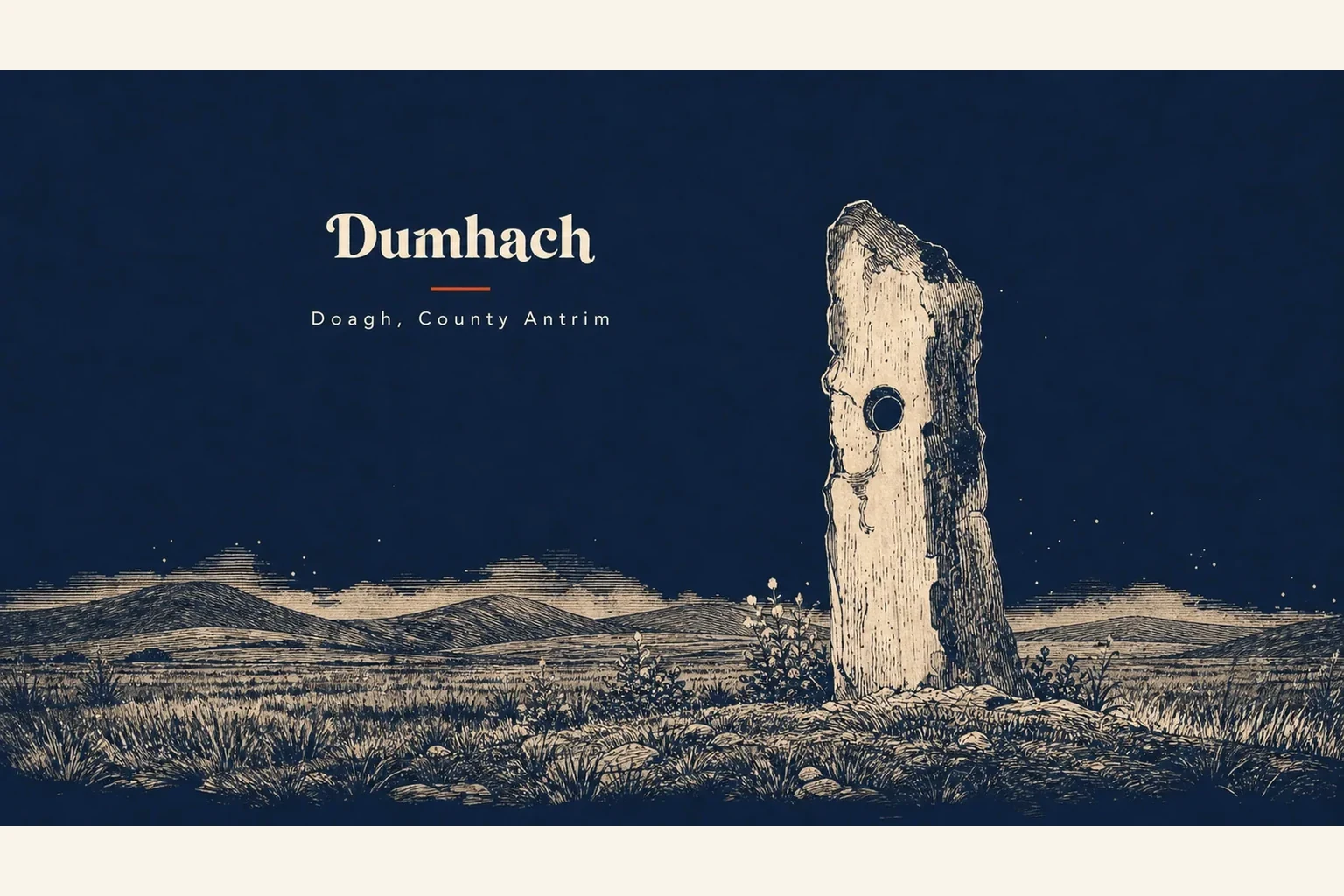
That thing is the Holestone — a five-foot whinstone megalith with a perforation through it, the hole worn smooth and funnel-shaped and just wide enough for a woman's hand. It is one of the best-preserved standing stones of its kind in Ireland. Sometime in the early nineteenth century — the convention is dated to around 1830 — couples started using it to promise marriage, the woman putting her hand through one side and her man taking it on the other. The tradition was still alive in the twentieth century and is not entirely dead now. There is no plaque, no centre, no fee. It is a stone in a field above the village. Walk up and have a look.

The other thing Doagh is known for in the histories is 1798. The village was solid United Irish country in the run-up to the Ulster rising, and many of its men were out on 7 June for the Battle of Antrim under Henry Joy McCracken. They lost. Government troops came back through the village afterwards and did what was done to villages in 1798. The opening of the nineteenth century in Doagh was about recovering from that. Walk the main street and you are walking ground that was emptied and refilled.

Population
1,404 (2021 census)
Coords
54.7389° N, 6.0425° W
01 / 06

At a glance.

Three things every local will eventually mention. Read these and you've already understood more than most day-trippers do.

02 / 06

The pubs.

None of these are themed Irish pubs, because they don't need to be. A few that earn the trip:

McConnells of Doagh

Family-run, locals, lunch
Pub & restaurant

4 Main Street. The pub-restaurant of the village. Lunches Monday to Saturday, food off a proper kitchen, closed Sundays. If you are coming to see the Holestone, eat here before or after.

03 / 06

Stories & lore.

The reason to come back. The things every local will eventually tell you about, usually after the second pint.

Bronze Age, still in use

The Holestone

A mile north of the village, in a field on a low rocky outcrop, stands a five-foot block of whinstone with a hole pierced through it. The stone is reckoned Bronze Age. The hole is smooth and funnel-shaped, tapering inwards to about ten centimetres on the narrower side — wide enough for a woman's hand, not wide enough for a man's. Sometime in the early nineteenth century — the practice is traceable to about 1830 and is probably older — couples in the district started using the stone to promise marriage. The woman put her hand through; her man on the other side closed his around it; the troth was plighted. The Holestone outlived the chapels and the dissenters' meeting houses around it. It was never Christianised — there is no cross cut into it — and the church never quite managed to disapprove it out of existence. People still go up. Some still clasp hands. There is no plaque and no fee. Park considerately on the road and walk the lane.

Sixmilewater, the road, the mill

The valley and the village

The Sixmilewater river drains the Antrim hills west into Lough Neagh, and a string of villages — Doagh, Ballyclare, Templepatrick, Antrim — grew up along the valley road. Doagh is the smallest of them. In the nineteenth century it had a mill on the river, a corn market, two churches, a Sunday school that locals claimed (without firm evidence) was the first in Ireland, set up in 1770 on the site where the Methodist church was later built in 1844. The 1901 census put a little over five hundred people in Doagh and its townland; by 2001 it was 1,130; by 2021 it was 1,404. The village has grown into a Ballyclare commuter belt without losing the shape of a Sixmilewater village. The square is the square. The main street runs through. The river goes on to Lough Neagh.

United Irishmen and the Battle of Antrim

1798 in Doagh

South Antrim in the 1790s was United Irish country — Presbyterian, dissenting, republican, organised — and Doagh was deep inside it. When the rebellion finally broke in Ulster on 7 June 1798, men from the village were among the four thousand or so who came down out of the Antrim hills with Henry Joy McCracken to attack Antrim town. They were beaten by reinforcements. McCracken was hanged in Belfast a month later. The reprisals on the villages that had risen were severe; Doagh spent the opening years of the new century rebuilding what the army had broken on its way through. There is no monument to it in the village. The history is in the stones of the houses and in the names on the gravestones.

04 / 06

When to go.

There is no bad time. There are different times.

Spring
Mar–May

The valley is at its best. Walk the lane up to the Holestone in a cold dry morning — the views back over the Sixmilewater are worth the climb.

◉ Go
Summer
Jun–Aug

Long evenings, the GAA pitch in use, the road through busy with Ballyclare commuters. McConnells does lunch through the week.

◉ Go
Autumn
Sep–Oct

Hedges turning, river running high, the Holestone in low autumn light. The quiet half of the year starts.

◉ Go
Winter
Nov–Feb

Short days, the lane up to the stone can be muddy, the village is at its own fireside by five. Ring ahead for food.

◐ Mind yourself
05 / 06

What to skip.

Honestly? Don't bother.

If a local was sitting beside you, this is the bit where they'd lean in.

×
Confusing this with the Doagh Famine Village

That is in Inishowen, Co. Donegal — a tourist attraction about the Great Hunger built on a different Doagh entirely. This Doagh has no famine village, no visitor centre, no plaque. It has a stone in a field and a pub on the main street.

×
Driving up to the Holestone in a big car

The lane is narrow and a working farm road. Park on the verge of the minor road and walk the last bit. It is five minutes.

×
Treating the Holestone as a photo opportunity

People still come here to plight troths. If a couple is at the stone when you arrive, give them their few minutes and walk back down the field.

+

Getting there.

By car

Off the B59 between Ballyclare (3km north-east) and Parkgate / Antrim (10km west). Belfast is 25km / 30 minutes via the M2 and Ballyclare. The Holestone is signposted off a minor road north of the village.

By bus

Translink Ulsterbus 109 runs Belfast–Doagh–Ballyclare a few times a day Monday to Saturday. Sundays are thin. Check the Translink site before you set out.

By air

Belfast International (BFS) is 15km / 20 minutes. Belfast City (BHD) is 35km / 40 minutes.