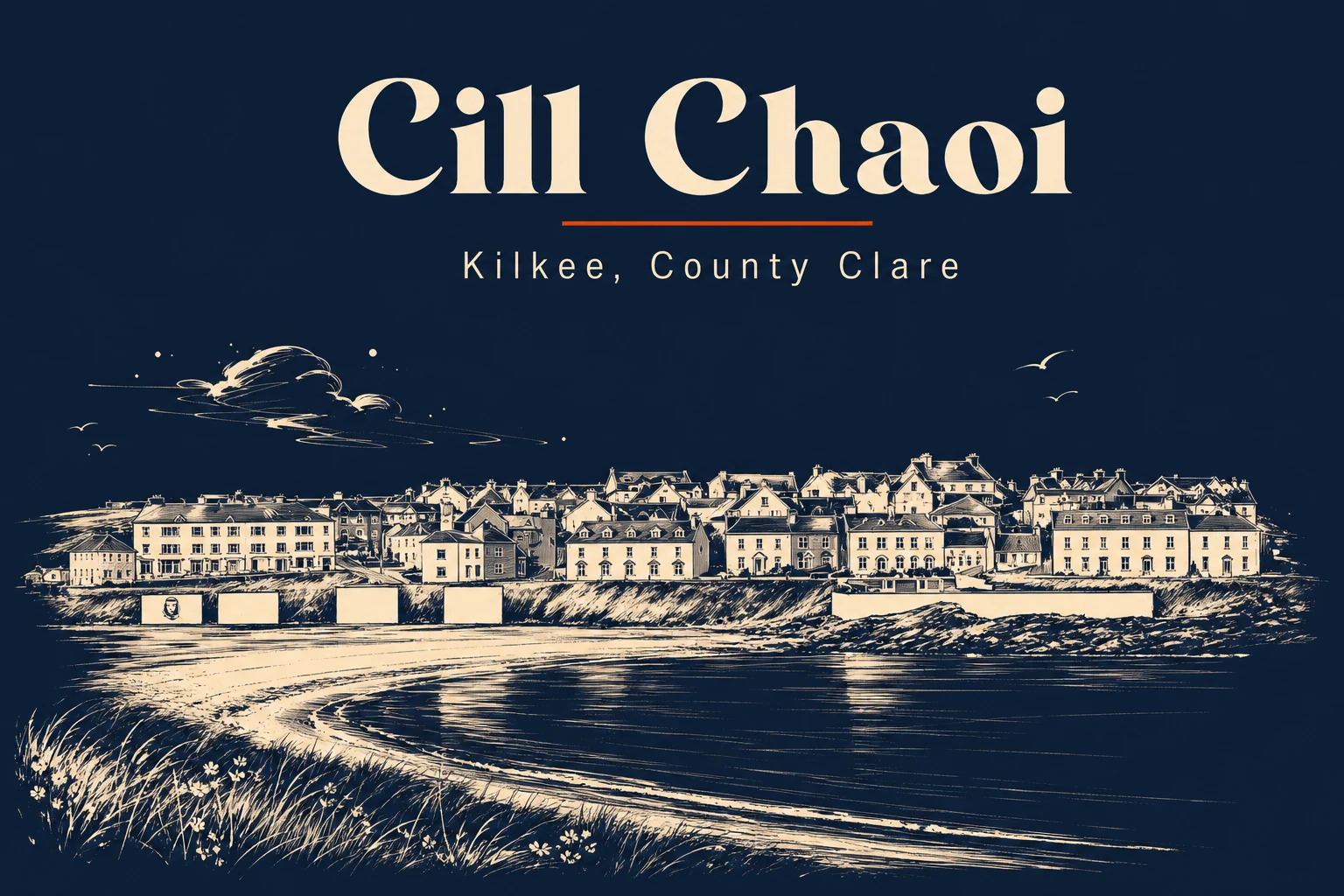
Cill Chaoi · Co. Clare
A horseshoe bay that faces America and doesn't pretend otherwise.
Kilkee is the largest town on the Loop Head peninsula, which is not saying much - the peninsula trails off into the Atlantic like a sentence that forgets where it started. But the bay is real and specific: a horseshoe of sand and flat rock, protected by the Duggerna Reef, enclosed by low cliffs on both sides, open to the west. The Victorian hotels knew what they were doing when they set up here.
The resort arrived with the paddle steamers in the 1820s. Tennyson came. Tennyson left. Charlotte Brontë came on honeymoon with her husband Arthur Nicholls - he was from Banagher, County Offaly, and knew the west of Ireland - though she died within the year. She left enthusiastic letters about the scenery - writing that some parts had exceeded all she ever imagined. Percy French arrived in 1896 to perform, four and a half hours late, because the West Clare Railway had decided not to hurry. He sued the company, won £10 at the Ennis Quarter Sessions, and wrote a song about it that made the railway more famous than the railway ever managed on its own.
Richard Harris is the other name that attaches itself to this town. He was from Limerick, not Kilkee, but he won the Tivoli Cup - a racquetball competition played against the sandstone walls of the West End - four consecutive years from 1948 to 1951. In 2006, Russell Crowe flew over to unveil a bronze statue of Harris at eighteen, mallet in hand. It stands near the seafront. People photograph it.
Come in June or July and the town fills. Come in September and the town returns to itself - a working town on a peninsula that has no through road, no shortcut, and no particular interest in pretending to be anywhere else.