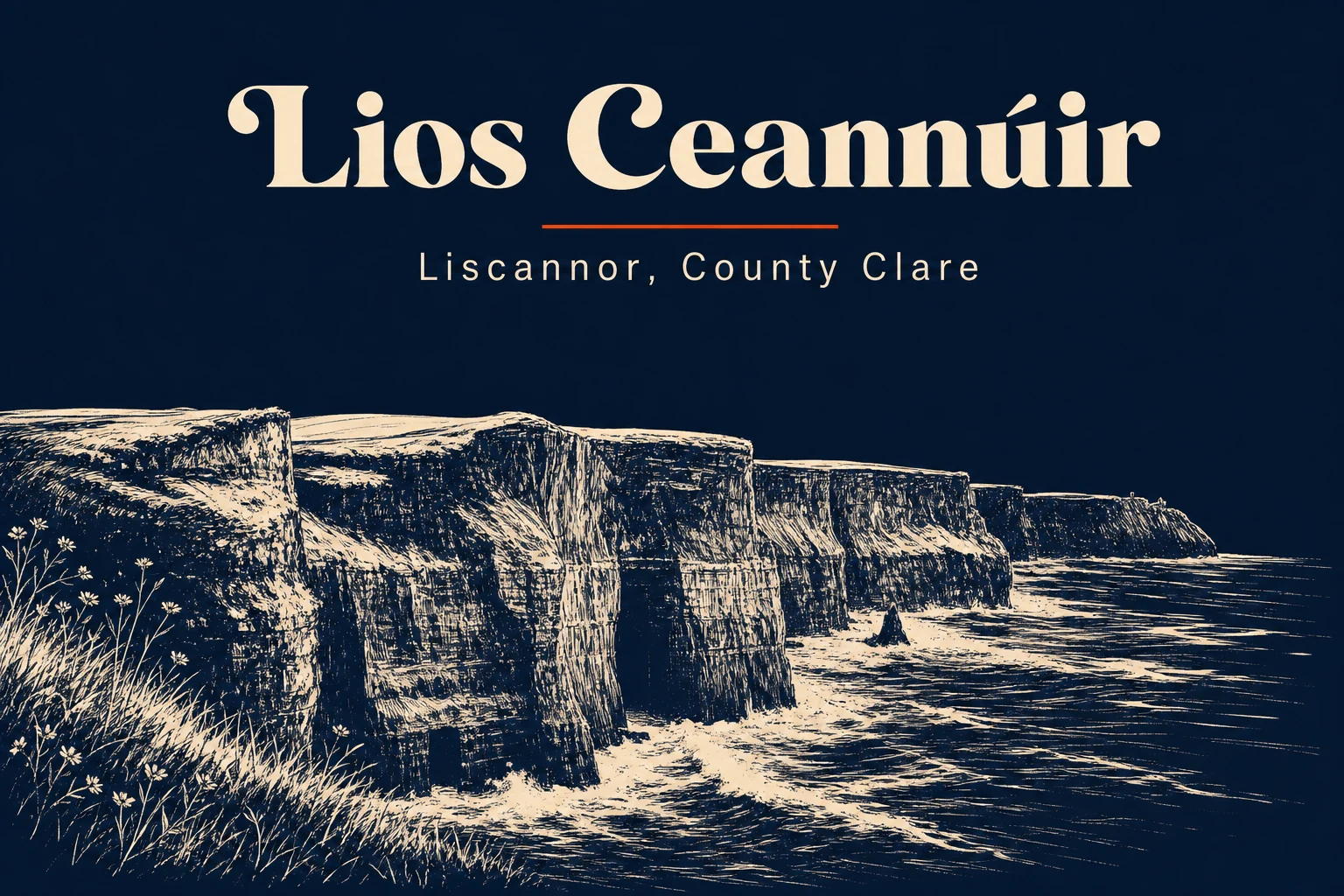
Lios Ceannúir · Co. Clare
A working pier, a coastguard cottage, and the back path to the Cliffs of Moher.
Liscannor is the village the bus from Galway drives past on its way to the Cliffs of Moher visitor centre. Eight kilometres south of the centre, on the coast road from Lahinch, it sits at the back end of the cliff walk and at the front end of a working pier. The official Cliffs of Moher signage barely acknowledges that the cliff trail comes through here. Walkers from Doolin who do the full route end up in Liscannor; tour buses do not.
The village proper is a pier, a single street, three pubs, a couple of B&Bs, and the Holland plaque. The wider parish stretches up to St Brigid's Well and out to Hag's Head. Liscannor flagstone - the dark, fossil-marked Liscannor slate - was quarried up the road for over a century and ended up on roofs and floors across Munster. The quarries are still there, mostly idle.
John Philip Holland was born in a coastguard cottage in Liscannor in 1841. His father was in the Royal Coastguard Service. Holland trained as a Christian Brother, taught school in Cork and Drogheda, sailed for America in 1873, spent the next quarter-century building submarines on the Hudson and the Passaic, and watched the US Navy acquire Holland VI in April 1900; it was formally commissioned as USS Holland on 12 October 1900. He died in Newark in 1914 and never came home. The local pride in him is real; the village marker is small.
Don't try to do Liscannor as a base for the Cliffs of Moher visitor centre. Do it as a base for the cliffs without the visitor centre - Hag's Head north, Doolin north of that, the long quiet route the buses can't reach. Stay at Vaughan's, eat the seafood, walk out before breakfast, come back wet, dry out by the fire.