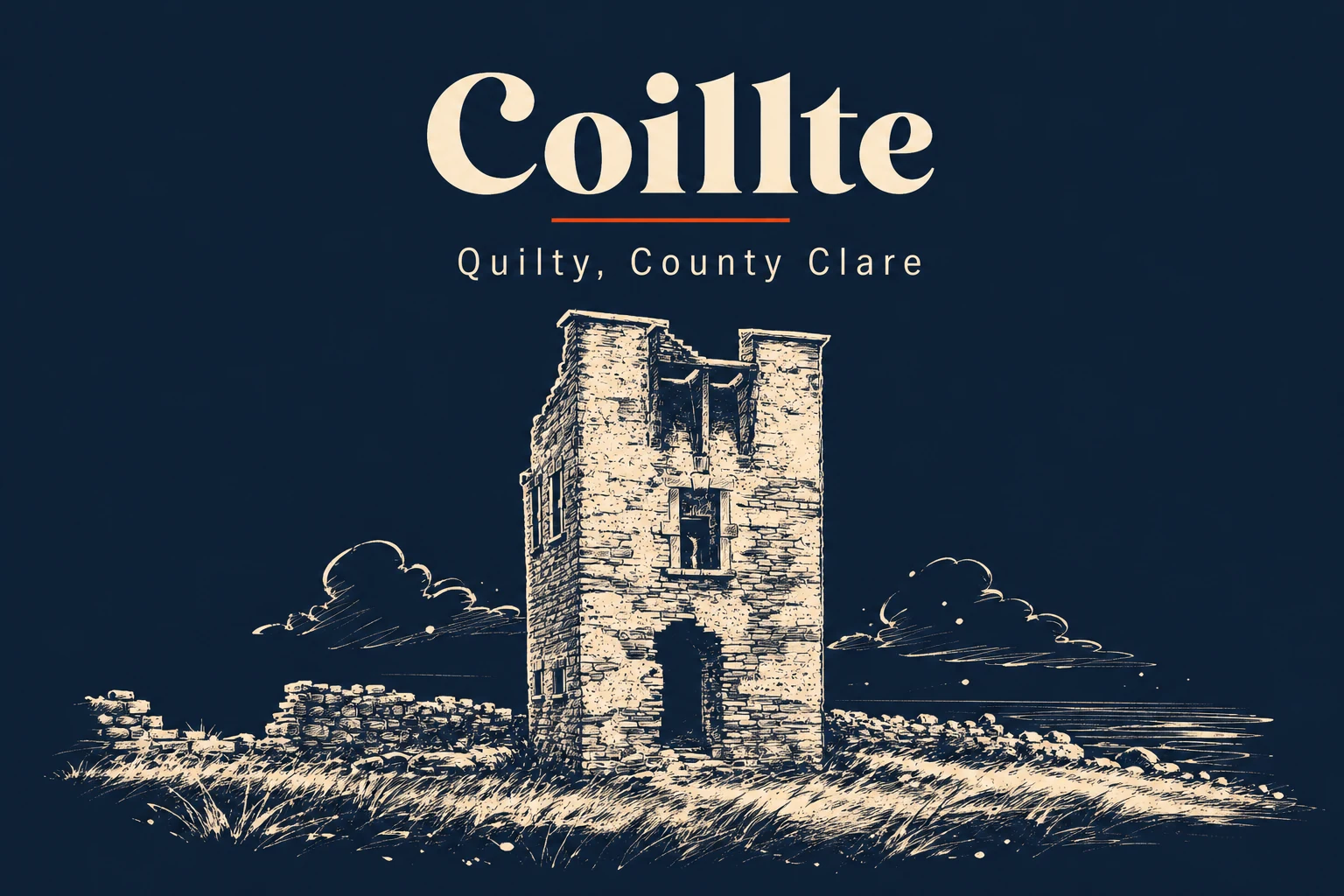
Coillte · Co. Clare
A working fishing village where currach men once rowed out into a gale to save a wrecked crew, and a church got built to remember it.
Quilty is a working fishing village on the west Clare coast, strung along the N67 between Miltown Malbay and Doonbeg. Two hundred and eleven people at the last count. It has a church, a pub, a shop, a post office, and the Atlantic coming in hard across a low, rocky shore. This was Irish-speaking ground, classed as part of the west Clare Gaeltacht until 1956.
The thing to know about Quilty is the boats. At the turn of the last century the men rowed four or five miles out in currachs for haddock, ling, cod and mackerel, and the whole place lived off the sea and a bit of farming behind it. Seaweed was the other half of the living. Families gathered it off the rocks and dried it in long rows, and Quilty became one of the largest kelp producers on the west coast, beaten only by a stretch up in Sligo.
On 2 October 1907 a French three-masted ship, the Leon XIII, carrying wheat from Oregon to Limerick, lost her rudder off Mutton Island and was driven onto the reefs in Quilty Bay. The local fishermen took those same currachs out into an equinoctial gale and rescued the crew. A fund was raised to thank them, and the result is the Star of the Sea church with its round tower, finished in 1911. The ship's bell still stands inside it.
Do not come to Quilty for a surf beach or a row of cafes. The sand and the surf school are at Spanish Point, a few minutes north. Quilty is the quieter, harder-working neighbour - a pier, a beach or two at Seafield, big skies, and the Aran Islands and the Cliffs of Moher away to the north on a clear day. Stop at the pier for five minutes and you have understood the place.