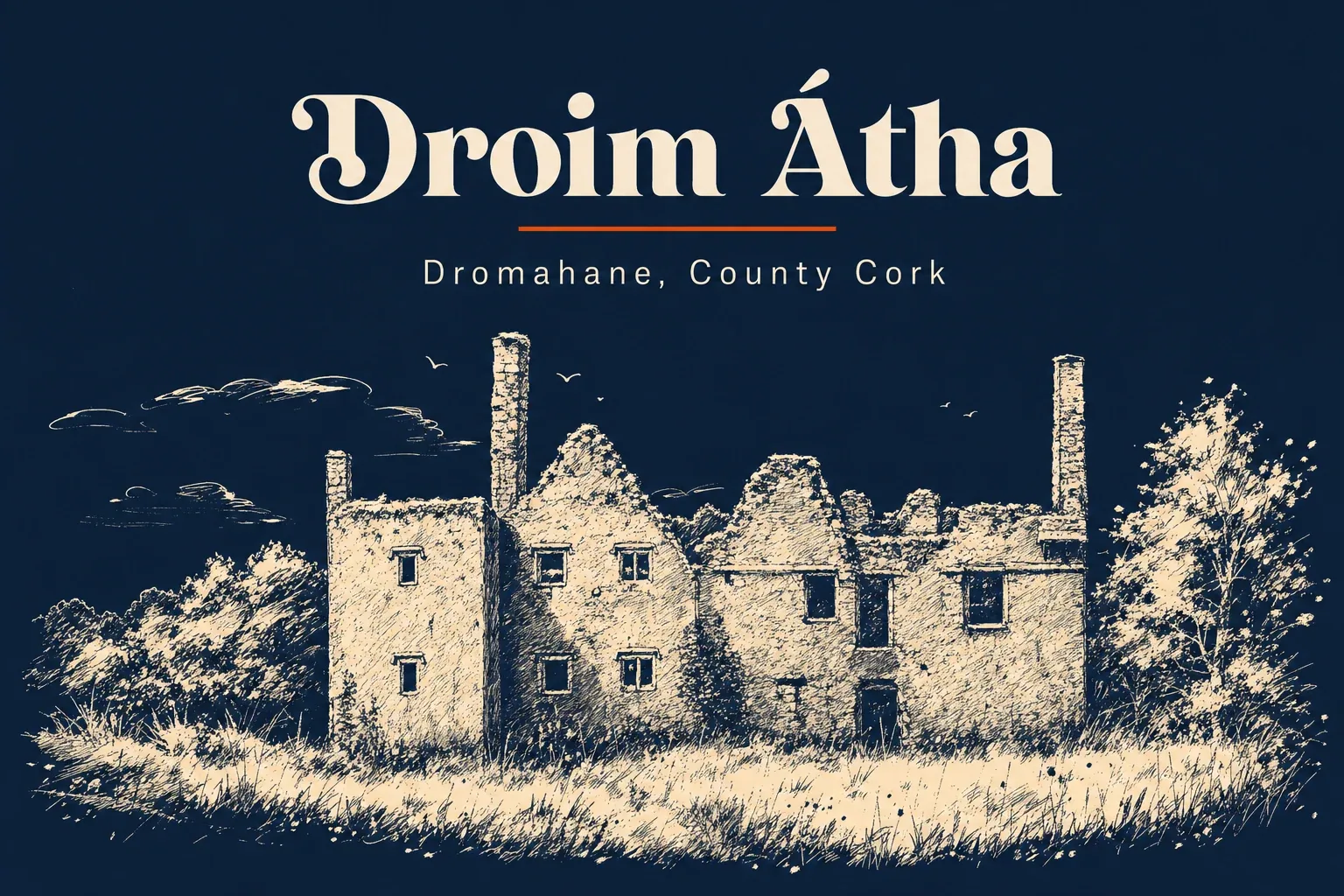
Droim Átha · Co. Cork
A crossroads village above the Blackwater that gave the country a 1798 rebel, a graveyard full of famous bones, and the man Croke Park is named after.
Dromahane is a crossroads village above the Blackwater Valley, five kilometres southwest of Mallow on the R619. Just under a thousand people in the 2022 census, which makes it a real village rather than a hamlet, but the shape of the place is still a junction with a church, a pub, a shop, a school and the workshops of people who do practical things - a joinery, a printers, electricians, an agri-contractor. This is dairy and tillage country, and the village works for the farms around it.
It is in the civil parish of Kilshannig, and the parish punches well above its weight in Irish history. Thomas Russell, founder member of the United Irishmen and the rebel hanged in 1803, was born here in 1767. Up at the old Kilshannig graveyard north of the village lie the maternal ancestors of Daniel O'Connell and the parents of Thomas Croke, the archbishop the GAA named its stadium after. Three of the bigger names in the nineteenth-century story of Irish nationalism have roots in one small north Cork parish.
There is no reason to base yourself here. Mallow is ten minutes east and has the hotels, the restaurants and the train station. What Dromahane offers is the unhurried version: a pint in Corkery's, a walk down to the river, a look at Dromaneen Castle on the Blackwater, and the Dromore point-to-point south of the village when the racing is on - a day that pulls crowds in from across Munster and then empties the village again by dark.
Come for the river and the history, not the high street. The Blackwater here runs cold and clean through some of the best agricultural ground in Cork, and the valley is quietly handsome. If you have come to fish, to trace a Kilshannig grave, or simply to get off the main road between Mallow and Kanturk, Dromahane is a good place to slow down.