County Donegal Ireland · Co. Donegal · Glencolmcille Save · Share
POSTED FROM
GLENCOLMCILLE
CO. DONEGAL · IE

Glencolmcille
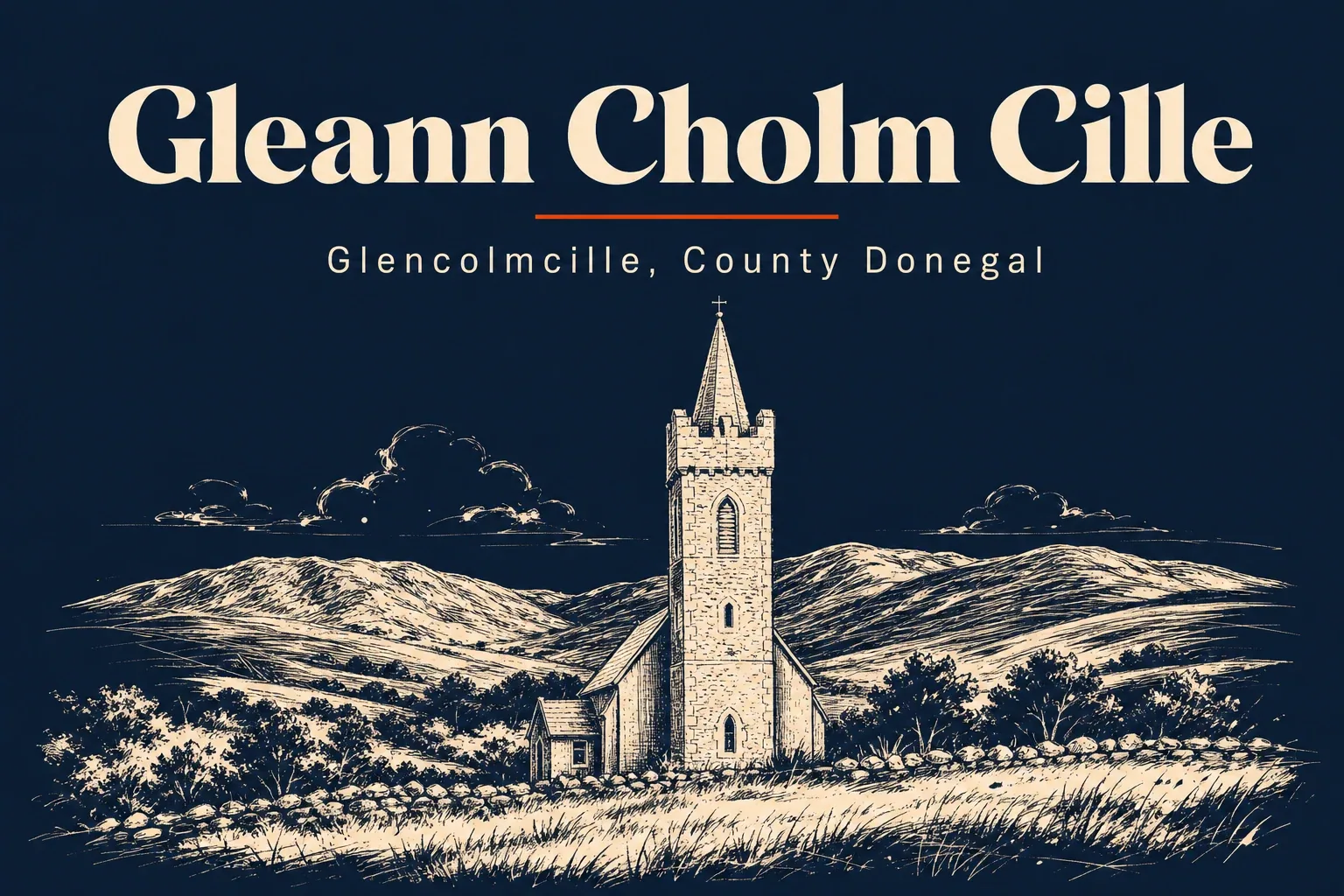
Gleann Cholm Cille

The Wild Atlantic Way
Wild Atlantic Way
Gleann Cholm Cille · Co. Donegal

Remote Gaeltacht valley where Saint Columba walked and a barefoot pilgrimage still happens at dawn.

Glencolmcille sits at the western edge of Donegal, a glacial valley that opens directly to the Atlantic. Population 200. One main road. Two pubs. Nowhere to rush. In the 6th century, Saint Columba established a monastery here, and the valley has never quite stopped being sacred. The Turas—the pilgrimage that bears his name—has been walked barefoot at midnight every June for over 1,400 years. You can join it.

The village is Gaeltacht. Irish is spoken naturally. Children grow up bilingual. Oideas Gael, an Irish-language learning center, brings students from around the world to live this way. This isn't heritage tourism; it's a working community that happens to have inherited remarkable traditions.

Father James McDyer arrived as parish priest in 1951 to find the valley dying from emigration. Instead of accepting decline, he organized cooperative enterprises—a knitwear factory, a craft shop, a Folk Village Museum with replica cottages spanning three centuries. He showed rural Ireland it could control its own destiny. The village is still here because of him.

Come for the remoteness. Stay for the Turas if it's June 9th. The Slieve League cliffs are 25 minutes away. The coast from here south is undefended and wild.
Population
~200
Pubs
2and counting
Walk score
Village in 10 minutes
Founded
6th century (monastery of Saint Columba)
Coords
54.7364° N, 8.6908° W
01 / 09

At a glance.

Three things every local will eventually mention. Read these and you've already understood more than most day-trippers do.

02 / 09

The pubs.

None of these are themed Irish pubs, because they don't need to be. A few that earn the trip:

An Chúirt Hotel bar

Central, sessions sometimes
Hotel bar & restaurant

The main gathering place. Food available. Occasional traditional music. If there's a session happening, it'll be here. This is the village social hub.

Biddy's Bar

Quiet, regulars
Local pub

Smaller, more intimate. Less music, more conversation. The kind of place where you might hear Irish spoken at the bar. Come for the atmosphere, stay for the connection.

03 / 09

Where to eat.

PlaceTypeLocal note
Folk Village Tea House Traditional fare Home-baked bread, Irish stew, cakes made from generations-old recipes. The menu changes based on what's seasonal and available. This is where locals eat.
An Chúirt Hotel Restaurant €€ The most substantial food option in the village. Local fish when the boats are in. Decent soup. Open to non-guests.
Village café Light meals Coffee, sandwiches, basic supplies. Not fancy. Adequate.
04 / 09

Where to sleep.

PlaceTypeLocal note
An Chúirt Hotel Hotel The main accommodation. Comfortable rooms, restaurant, bar. Central location. Book ahead during summer and especially around June 9th.
Aras BnB Guesthouse 20 rooms, family-run, 5 minutes from the village. Valley views. Full Irish breakfast. Genuine hospitality.
Dolmen Cottage Self-catering Sea views from the terrace. Simple, comfortable, independent. Ideal if you want to cook your own food and watch the Atlantic at sunrise.
Local B&Bs B&B Several family-run guesthouses throughout the valley. Ask at An Chúirt or in the Folk Village for current options. Quality is consistent.
05 / 09

Stories & lore.

The reason to come back. The things every local will eventually tell you about, usually after the second pint.

The pilgrimage that never stopped

Turas Cholmcille

Every June 9th, participants walk barefoot through the pre-dawn darkness visiting fifteen stations scattered across the valley. The route follows paths established in the 6th century, connecting standing stones, holy wells, cairns, and the ruins of Columba's church. The full journey is five kilometers and takes three hours. What makes it extraordinary is that it hasn't been invented for tourists—it's a living religious tradition maintained by local families, performed the same way for 1,400 years. The stations are modest: stones, wells, places where legend says Columba slept or prayed. The power is in continuity.

The priest who refused decline

Father James McDyer

When McDyer arrived as parish priest in 1951, Glencolmcille was bleeding people to America. The response could have been prayer. Instead, he organized. He established cooperative enterprises—a knitwear factory employing local knitters, a craft shop selling local work, a Folk Village Museum housing replica cottages that documented how Irish families actually lived across three centuries. The Folk Village opened in 1967. McDyer died in 1987, but the cooperatives survived. The village survived. His model influenced rural development policy across Ireland. He proved that tradition didn't require stasis—it required economic reality.

A museum that wasn't nostalgic—it was political

The Folk Village

McDyer didn't build the Folk Village as a tourist attraction first. He built it as a statement that rural Irish life was worth preserving, understanding, and celebrating. The cottages represent three centuries of how people lived—furnished, detailed, honest about hardship and comfort in equal measure. The tea house serves traditional foods from the valley's own recipes. The craft shop sells work made by local artisans using traditional methods. It's tourism with substance because it wasn't built primarily for tourists—it was built for the community to say: "This matters."

Where Irish isn't a museum exhibit

The Gaeltacht

Glencolmcille remains a Gaeltacht—an officially Irish-speaking area. This means Irish is the community language, spoken naturally at the bar, in the shop, at home. Children learn through Irish. It's not enforced; it's inherited. The establishment of Oideas Gael in 1984 brought the language learning center that attracts students from around the world seeking immersion in Irish culture and language. The valley became valuable to global Irish diaspora and language learners precisely because it remained itself: a place where Irish was alive, not archived.

06 / 09

Things to do outside.

Wear waterproofs. Bring a sandwich. Tell someone where you're going if it's the mountain.

Turas Cholmcille (partial) You don't need to walk it barefoot at midnight, though you can. The fifteen stations are marked, paths are clear (mostly). The route winds through the valley—Atlantic views, standing stones, wild landscape. Start at the Folk Village or near An Chúirt. Walking guides are available locally.
5 km loopdistance
2–3 hourstime
Slieve League (from Glencolmcille) Drive 25 minutes to the Slieve League carpark. From there, the walk climbs to the clifftop ridge—1,000 metres of ocean cliff. The views span the coast for miles. Exposed, windy, absolutely worth it. Good shoes essential.
12 km returndistance
4–5 hourstime
Glencolomkille Coastal Path Follows the coast southward with views of cliffs and Atlantic swell. Paths can be muddy. The landscape is raw and exposed. Bring waterproofs.
8 km one-waydistance
2–3 hourstime
The valley floor Simply walking the main road and turning down farm tracks reveals hidden beaches, stone walls, views that photographers travel far to capture. No set route—just wander and see what opens.
Variousdistance
Your timetime
07 / 09

When to go.

There is no bad time. There are different times.

Spring
Mar–May

Quiet, lambs in the fields, the light is extraordinary. Weather is unpredictable but often clear enough for the walks.

◉ Go
Summer
Jun–Aug

Busier, especially mid-June around the Turas and festival season. Book accommodation well ahead. Long days for walking and exploring.

◐ Mind yourself
Autumn
Sep–Oct

Locals' favourite. Fewer tourists, dramatic Atlantic storms building offshore, the light is golden. The Gaeltacht feels most itself.

◉ Go
Winter
Nov–Feb

Remote and quiet. Some services reduce hours. The landscape is stark, the Atlantic is serious, and the pubs feel like refuge. Storms can be spectacular.

◉ Go
08 / 09

What to skip.

Honestly? Don't bother.

If a local was sitting beside you, this is the bit where they'd lean in.

×
Expecting the Folk Village to feel like a "real village"

It's a museum. The cottages are reconstructions, the tea house is in a museum building, it's all intentionally preserved and displayed. That's the point. What's real is the valley itself and the people living in it now.

×
Visiting in June expecting the Turas to be casual

The Turas is a barefoot midnight pilgrimage, not a scenic walk. If you're not prepared for that—boots left behind, three hours in darkness, spiritual intention—wait for another June or just walk the stations during daylight on any other day.

×
Driving to Glencolmcille when the weather is unreadable

The valley is remote. The roads are narrow and winding. Bad weather means you could be stuck or driving in genuinely poor visibility. Check the forecast. Come back when it clears.

×
Assuming there's nightlife or restaurant culture

There isn't. There are two pubs. There's food at An Chúirt and the Folk Village tea house. That's it. Plan accordingly. Come for what's here, not what you wish was here.

+

Getting there.

By car

From Ardara, the R230 climbs through the Glengesh Pass (20 km, 25 minutes)—one of Ireland's most dramatic mountain roads. From Donegal Town via Killybegs and Carrick, about 50 minutes. The roads are narrow and winding but well-maintained.

By bus

Bus Éireann operates limited services, primarily summer months. Journey from Killybegs takes about 45 minutes. Frequency is low—having a car gives you vastly more freedom.

By train

Nearest station is Donegal Town. Then bus.

By air

Nearest airport is Donegal (50 km). Cork and Shannon are 2+ hours.