County Donegal Ireland · Co. Donegal · Kilclooney Save · Share
POSTED FROM
KILCLOONEY
CO. DONEGAL · IE

Kilclooney
Cill Chluanadh

The Wild Atlantic Way
STOP 04 / 04
Cill Chluanadh · Co. Donegal

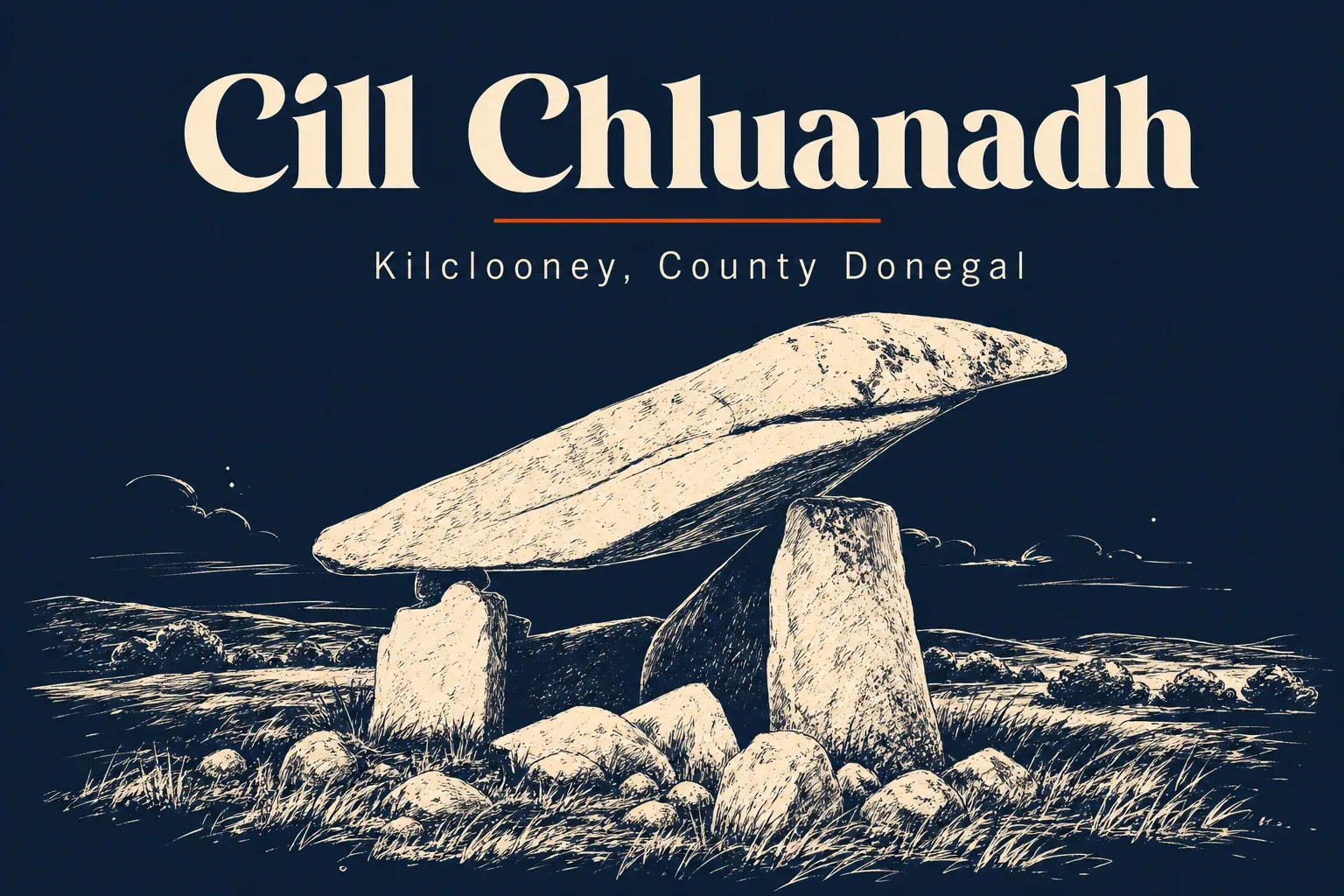
A Neolithic dolmen with a capstone the size of a house. That is the whole story.

Kilclooney More is a townland in southwest Donegal, 7 kilometres north of Ardara. It contains a Neolithic dolmen — a portal tomb built around 3500 BC. The dolmen is a single massive capstone balanced on uprights, shaped roughly 4 metres long and weighing around 40 tonnes. It has been there for 5,500 years. It will be there for another 5,500 years.

There is no village here. No pub, no shop, no café, no hotel. What you get is the dolmen, farmland that doesn't care about tourists, and the question that everyone asks: how did people move that stone? The answer — leverage, ramps, hundreds of hands, patience across generations — doesn't make it less impossible. You will stand in front of it and the practical problem will refuse to resolve. That is the visit.

Founded
c. 3500 BC (Neolithic)
Coords
54.8364° N, 8.3097° W
01 / 04

At a glance.

Three things every local will eventually mention. Read these and you've already understood more than most day-trippers do.

02 / 04

Stories & lore.

The reason to come back. The things every local will eventually tell you about, usually after the second pint.

Neolithic engineering

The Kilclooney Dolmen

The dolmen dates to approximately 3500 BC, early Neolithic period. The capstone is balanced on uprights with no mortar, no modern aids. Archaeological digs have found Neolithic pottery sherds — now in the National Museum of Ireland — suggesting the chamber was used for burial and ritual across multiple generations. The site sits within a broader Neolithic landscape at Kilclooney: a court tomb stands approximately 700 metres away. Both monuments signal a successful farming community with the resources and coordination to build lasting monuments. The monuments also signal something else — a culture that needed to communicate across centuries. These structures are not functional. They are messages from people 5,500 years dead, and they worked.

Why here

The landscape

During the Neolithic, this area was warmer and drier than today — fertile grazing land. The monuments would have been visible from considerable distances, territorial markers announcing the presence of a prosperous community. The climate then shifted. Bogland formed. The landscape turned to rough pasture and bog. That environmental change meant later societies didn't farm here, didn't develop the land, didn't knock the monuments down for stone walls. The bog, the very thing that made Neolithic farming difficult, is the reason the dolmen survived.

03 / 04

Things to do outside.

Wear waterproofs. Bring a sandwich. Tell someone where you're going if it's the mountain.

To the dolmen Start at the road near the church landmark. Cross farmland—ask permission first. The path is marked informally by farmers' routes. Bring boots; the fields are often muddy. The dolmen is not signposted militarily. You will find it when the stone suddenly looks impossible.
1–2 km returndistance
20–40 mintime
+

Getting there.

By car

Kilclooney sits on the R261 between Narin and Ardara. From Ardara, drive north on the R261 for approximately 7 kilometres. From Donegal Town, take the N56 west toward Ardara (20 minutes), then follow the R261 north. There is rough parking near the road and near the church.

By bus

Bus Éireann 490 runs between Donegal Town and Dungloe via Ardara. From Ardara, Kilclooney is 7 kilometres north by road (ask a taxi, or walk if you have three hours). Locals sometimes stop for hitchhikers on the R261.

By train

Nearest station is in Donegal Town. Then bus or taxi.

By air

Closest airport is Donegal (30 km away). Shannon is 2 hours. Dublin is 4 hours.