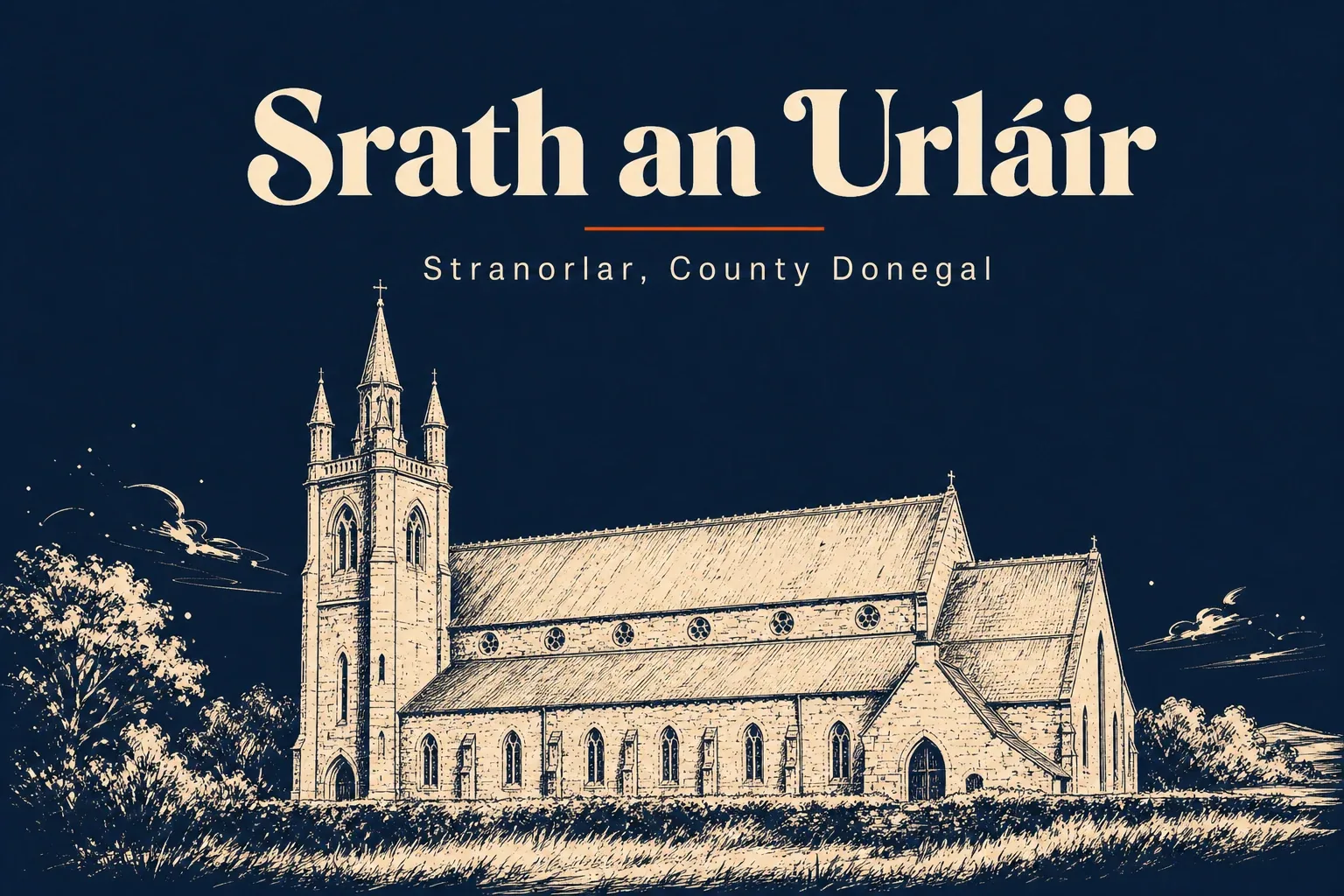
County Donegal Ireland · Co. Donegal · Stranorlar Save · Share
POSTED FROM
STRANORLAR
CO. DONEGAL · IE

Stranorlar
Srath an Urláir

The Finn Valley
STOP 06 / 06
Srath an Urláir · Co. Donegal

One town, two names, one river, a football club that punches above its weight.

Stranorlar and Ballybofey are functionally one town split by the River Finn. Stranorlar is the older settlement — it had a market and a courthouse while Ballybofey was still fields. Ballybofey has more of the commercial centre now. The distinction matters mainly to locals and to people who need a postal address.

The Finn Valley towns sit at a crossroads: the road from Letterkenny to Donegal Town, the road from the border to the Atlantic coast. They serve a large rural hinterland and have the infrastructure that comes with that — supermarkets, a hospital, secondary schools. What they have less of is the tourist trade that the coastal towns get. That is not entirely a disadvantage.

Population
1,500
Coords
54.8019° N, 7.7267° W
01 / 06

At a glance.

Three things every local will eventually mention. Read these and you've already understood more than most day-trippers do.

02 / 06

Stories & lore.

The reason to come back. The things every local will eventually tell you about, usually after the second pint.

The club that kept going

Finn Harps

Finn Harps FC were founded in 1954 in Ballybofey and have competed in the League of Ireland ever since — an unusual feat for a club from a town of this size. They won the FAI Cup in 1974. They have yo-yoed between the Premier Division and the First Division for most of their history, but they keep coming back. Home games at Finn Park are a fixture of Donegal life for people who follow the game.

A salmon river and a border

The River Finn

The Finn rises in the Blue Stack Mountains and runs east through the valley to join the Mourne at Lifford, where it becomes the Foyle. For most of its length it is a good game-fishing river — salmon and sea trout, mainly. The angling tradition in the Finn Valley is old and well-organised. The river also forms the practical boundary between the two halves of the twin towns.

The railway that climbed the Barnesmore Gap

The Narrow Gauge

The Finn Valley Railway connected Stranorlar to Strabane from 1863, and was later extended west via the Donegal Railway to reach Killybegs and Ballyshannon. It ran on a narrow gauge of 3 feet. The whole system closed in 1960, a casualty of the car and the bus. The Railway Heritage Museum in Donegal Town holds the memory of it.

03 / 06

Things to do outside.

Wear waterproofs. Bring a sandwich. Tell someone where you're going if it's the mountain.

Finn Valley Way The Finn Valley has waymarked walking along the river corridor. Good for a flat riverside walk without needing to climb anything.
Variable sectionsdistance
Half day to full daytime
04 / 06

When to go.

There is no bad time. There are different times.

Spring
Mar–May

River fishing season opens. The valley is green and quiet.

◉ Go
Summer
Jun–Aug

Football season, market days. Functional rather than scenic.

◉ Go
Autumn
Sep–Oct

Salmon running. Good walking weather.

◉ Go
Winter
Nov–Feb

A working town in winter. Not a reason to travel but not unpleasant if you are.

◐ Mind yourself
05 / 06

What to skip.

Honestly? Don't bother.

If a local was sitting beside you, this is the bit where they'd lean in.

×
Treating it as a stop on the way to somewhere better

The twin towns function as a service hub. If you treat them that way — stop, refuel, eat — they do the job well. If you come expecting a destination, you will be disappointed.

×
Confusing which side of the bridge you want

Most of the cafés and shops are in Ballybofey. Finn Park and the older streetscape are in Stranorlar. The bridge takes thirty seconds to cross.

+

Getting there.

By car

Letterkenny to Stranorlar is 35 minutes on the N13/N15. Donegal Town is 35 minutes west on the N15.

By bus

Bus Éireann and Feda O'Donnell coaches run through the twin towns on the Letterkenny–Donegal Town corridor.

By train

No train. Nearest stations are Derry (1 hour) or Sligo (1.5 hours).