County Dublin Ireland · Co. Dublin · Ballyboghil Save · Share
POSTED FROM
BALLYBOGHIL
CO. DUBLIN · IE

Ballyboghil
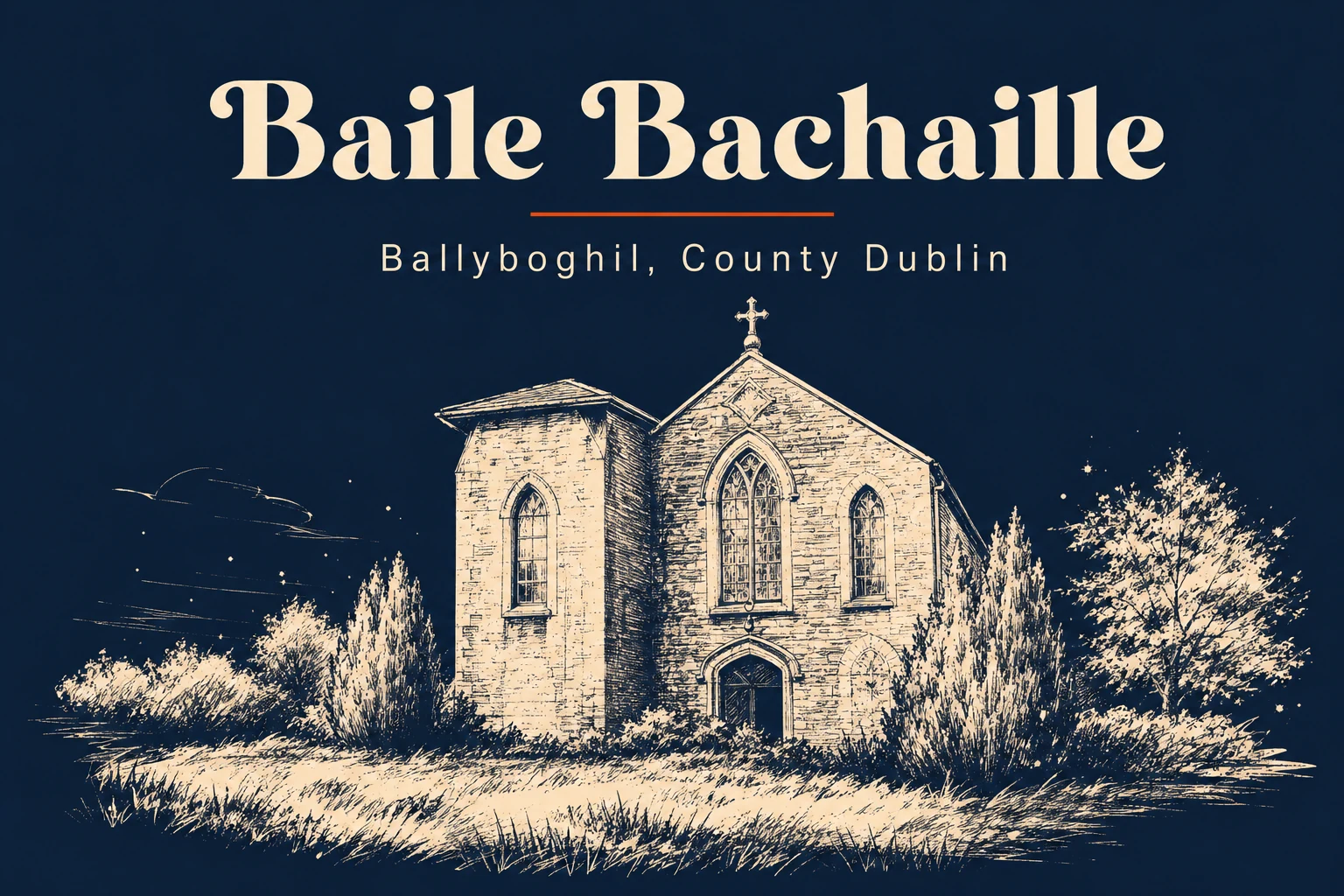
Baile Bachaille, Co. Dublin

The Fingal
STOP 07 / 07
Baile Bachaille · Co. Dublin

St Patrick's staff was kept here before Strongbow took it to Dublin in 1172. The village has been quiet ever since, and now it is best known for its hedgerows.

The name means the town of the staff - bachall in Irish - because the Bachal Isu, the staff said to be St Patrick's own, was kept in the church here through the medieval period. There was a monastery on the spot before the Normans came. In 1172 Strongbow seized the village and had the relic carried to Christ Church Cathedral in Dublin, where it stayed a pilgrimage object until it was burned during the Reformation in 1538. That is the big history, and it left the place when the staff did.

What is left is a scatter of houses around a crossroads, a church built in 1836, a GAA pitch, a pitch-and-putt club, and the flat agricultural north Fingal landscape rolling out toward Oldtown, the Naul and Lusk in every direction. The Ballyboughal River runs through the middle, rises at Tobergregan, and empties into the Rogerstown Estuary. There is one pub, the Village Inn. There is no cafe and no visitor infrastructure to speak of.

The thing worth knowing is that this small village made a name for itself by planting hedges. The Ballyboughal Hedgerow Society started in 1998 in response to the field boundaries being torn out for bigger machines, and it has been planting native trees and restoring hedgerows ever since. There is a small riverside nature reserve, Cois Sruthain, with native trees and a wildflower meadow, and a green by the water at Monument Park. It is not a day out. It is a quiet, well-kept piece of countryside that a community decided to look after.

Come for the old church ruin and the burial ground if you want something specific, or for a slow walk along the river. Otherwise this is one for the people who already know it, or who are passing between the Naul and Swords and want ten minutes of north Fingal history with a relic at the bottom of it.
Population
~855 (2022)
Pubs
1and counting
Walk score
Cross the whole village in five minutes
Founded
Pre-Norman monastery; held the Bachal Isu until 1172
Coords
53.5208° N, 6.2667° W
01 / 07

At a glance.

Three things every local will eventually mention. Read these and you've already understood more than most day-trippers do.

02 / 07

The pubs.

None of these are themed Irish pubs, because they don't need to be. A few that earn the trip:

The Village Inn

The one pub - local first
Traditional bar and lounge, in the village

Also known by the O'Connors name, this is the only pub in Ballyboghil and the single piece of reliable hospitality in the place. A traditional bar and lounge in the centre of the village. Do not expect a food menu or programmed music as a given - it is a country local. Worth knowing it is here, because there is no second option and no cafe.

03 / 07

Stories & lore.

The reason to come back. The things every local will eventually tell you about, usually after the second pint.

Bachal Isu, here until 1172

The town of the staff

The Bachal Isu, the Staff of Jesus, was the most venerated relic in medieval Ireland - a crozier said in the hagiographies to have belonged to St Patrick himself. It was kept in the church at Ballyboghil, and the village took its name from it: Baile Bachaille, the town of the staff. In 1172 the Norman conqueror Richard de Clare, Strongbow, took the village and moved the relic to Christ Church Cathedral in Dublin, where it remained a focus of pilgrimage until it was publicly burned in 1538 during the Reformation as a superstitious object. The staff is gone and the cathedral got the credit, but the name stayed in the fields of north Fingal.

A ruin open to the sky

The old church and the 14th-century window

In the old burial ground north of the village stand the ruins of a medieval church, with a triple bell-cote on the west gable and a 14th-century arched window standing open on the east. Tradition links the site to the monastery that held the Bachal Isu, though the visible fabric is later. The graveyard around it is still in use, and includes a dedicated 1798 burial plot. It is unsignposted, unstaffed and free - worth ten quiet minutes, no more and no less.

Wexford pikemen, 14 July 1798

The 1798 last stand at Drishogue

On 14 July 1798 a contingent of Wexford rebels - some two hundred or more pikemen who had marched north during the United Irishmen rising - made their final stand in the Ballyboghil area before being overpowered by Crown forces. Local tradition holds that many of the dead were buried in and around the old graveyard. A tall Celtic cross was raised on Drishogue Lane in 1948 to mark the 150th anniversary. It is one of the few hard marks the wider history of the country left on this otherwise quiet corner.

Founded 1998 by Ann Lynch

The hedgerow village

The Ballyboughal Hedgerow Society was set up in 1998 by Ann Lynch, after hedges across north Fingal were being ripped out to make fields bigger for intensive farming. The society has since planted over two hundred native trees, restored hedgerows on the Oldtown Road, the Hopyard and Backlane, and created the Cois Sruthain nature reserve along the river. In a county better known for tearing out boundaries to build, a small village deciding to put them back is the quietly remarkable thing about the place.

04 / 07

Things to do outside.

Wear waterproofs. Bring a sandwich. Tell someone where you're going if it's the mountain.

Old burial ground and church ruin North of the village in the old graveyard. The medieval ruin with its triple bell-cote and 14th-century east window, plus the 1798 plot. Unsignposted and unstaffed. Best on a clear morning. Pair it with a look at the 1798 Celtic cross on Drishogue Lane.
Short, in and around the villagedistance
20 minutestime
Ballyboghil River and Monument Park The river runs through the middle of the village. Monument Park is a small green by the water with pollinator planting and seating, and Cois Sruthain nature reserve nearby has native trees and a wildflower meadow planted by the Hedgerow Society. Flat, easy, quiet. This is the walk the village is proud of.
1-2 km, riversidedistance
30-45 minutestime
05 / 07

When to go.

There is no bad time. There are different times.

Spring
Mar-May

North Fingal farmland and the new hedgerows are at their best. The old burial ground is good on a clear morning, and the river walk is greening up.

◉ Go
Summer
Jun-Aug

An easy detour between the Naul and Swords. The village runs a summer heritage festival some years - worth a check before you build a trip around it.

◉ Go
Autumn
Sep-Oct

Flat agricultural country with long views and the hedgerows turning. Fine on a dry day.

◉ Go
Winter
Nov-Feb

There is nothing here in winter that warrants a specific trip. The Village Inn keeps going; little else does.

◐ Mind yourself
06 / 07

What to skip.

Honestly? Don't bother.

If a local was sitting beside you, this is the bit where they'd lean in.

×
Driving here without a purpose

There is one pub and no cafe. The old church ruin and the river walk are worth twenty minutes each. Plan around that and you will not be disappointed. Turn up expecting a day out and you will be.

×
Expecting Lusk or Swords facilities

Those towns are a short drive away and have everything Ballyboghil does not. If you need a meal, a coffee or a bed, head for Lusk or Swords. Ballyboghil is smaller and quieter than both, on purpose.

×
Looking for the staff

The Bachal Isu left in 1172 and was burned in Dublin in 1538. There is nothing of the relic here now but the name and the ruin. The history is real, the object is long gone.

+

Getting there.

By car

Ballyboghil sits in central Fingal, roughly between the Naul, Oldtown and Lusk. Take the R108 - from Swords, continue north on the R108 from the R125 junction. Dublin Airport is about 20 minutes south.

By bus

TFI Local Link route 192 (Balbriggan to Swords via Stamullen, the Naul and Oldtown) stops at Ballyboghil. About 16 minutes to Swords, roughly ten return services a day. It is the first proper public transport the village has had.