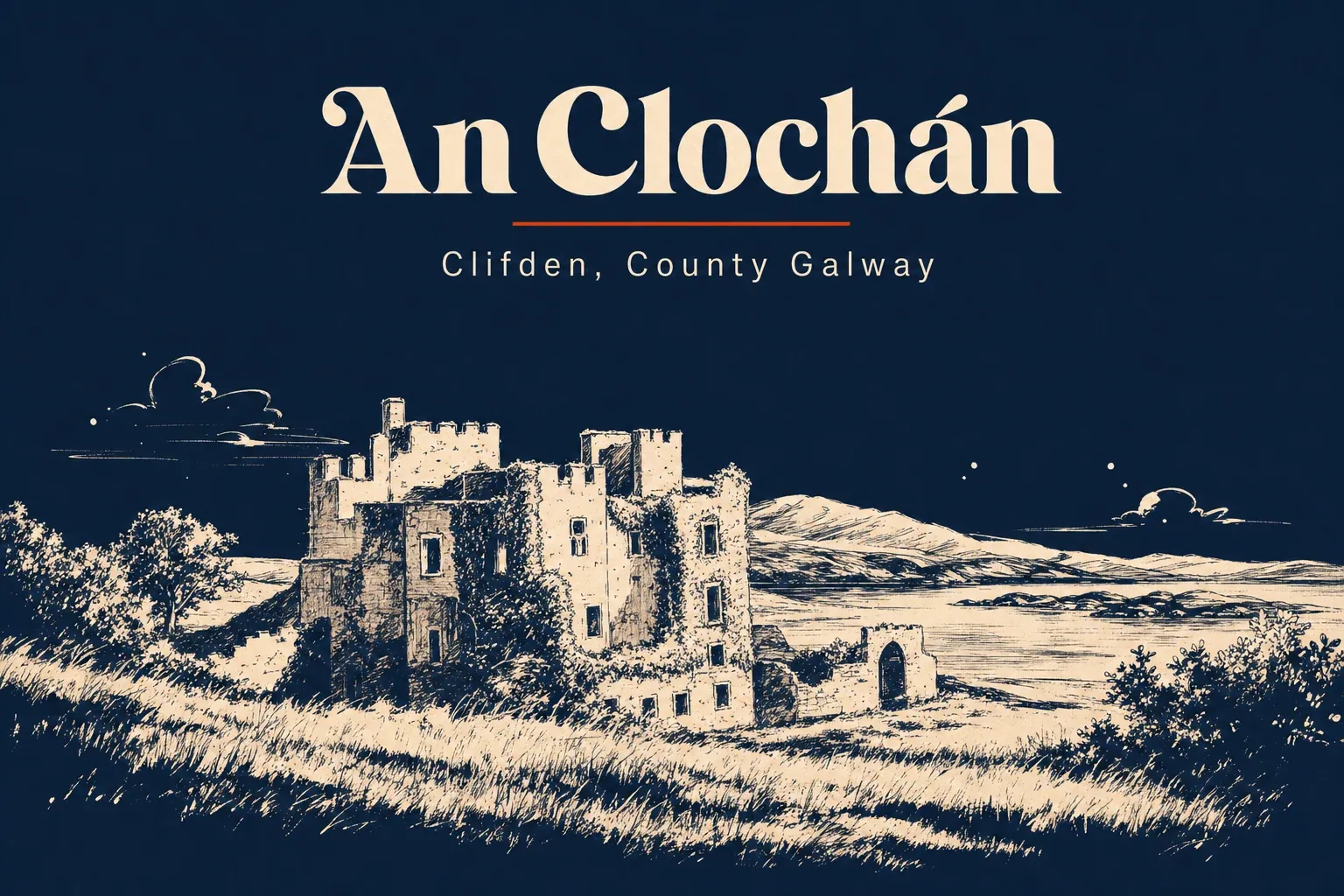
An Clochán · Co. Galway
A planned town at the edge of Connemara, with a bog full of firsts behind it.
Clifden is a town somebody drew on a map. In 1812 a 26-year-old landlord called John D'Arcy stood on his inheritance - 17,000 acres of bog and rock with almost nobody on it - and decided he was going to build a market town from scratch. By 1831 there were 1,257 people, 196 houses, two churches, three schools, a courthouse, a gaol, a distillery and 23 pubs. Then the Famine came and the family ran out of money and sold up. The grid he drew is still the grid you walk.
What you need to know: Clifden is the capital of Connemara because nothing else nearby is big enough to be the capital of anywhere. It sits between the Twelve Bens and the Atlantic, on a bay that does not stay still. The Sky Road loops out to the west, Derrygimlagh bog sits to the south with two of the most absurd events in 20th-century history quietly buried in it, and Connemara National Park starts twenty minutes north at Letterfrack. You can use Clifden as a base for all of it without ever moving the car for the first night.
Don't try to do Connemara in a day from here. The roads are narrower than the map suggests, the weather is its own opinion, and the light at half-six on a clear evening on the Sky Road will rearrange how you feel about Ireland. Two nights minimum. Three is better. Bring boots, a coat that means it, and the patience to let a bog road do what a bog road does.