County Galway Ireland · Co. Galway · Glinsk Save · Share
POSTED FROM
GLINSK
CO. GALWAY · IE

Glinsk
Gleann Uisce, Co. Galway

The Ireland's Ancient East
STOP 07 / 07
Gleann Uisce · Co. Galway

One of the last fortified houses built in Ireland, marooned in a working corner of the Suck valley where Galway runs into Roscommon.

Glinsk - Gleann Uisce, the glen of the water - is a parish and a scatter of townlands rather than a village in the picture-postcard sense. It sits in north-east Galway in the valley of the River Suck, halfway between Creggs and Ballymoe, close enough to the Roscommon border that the nearest towns of any size are on the far side of it. There is a church, a primary school, a shop, a pub and a GAA pitch. That is the village, and it is honest about being no more than that.

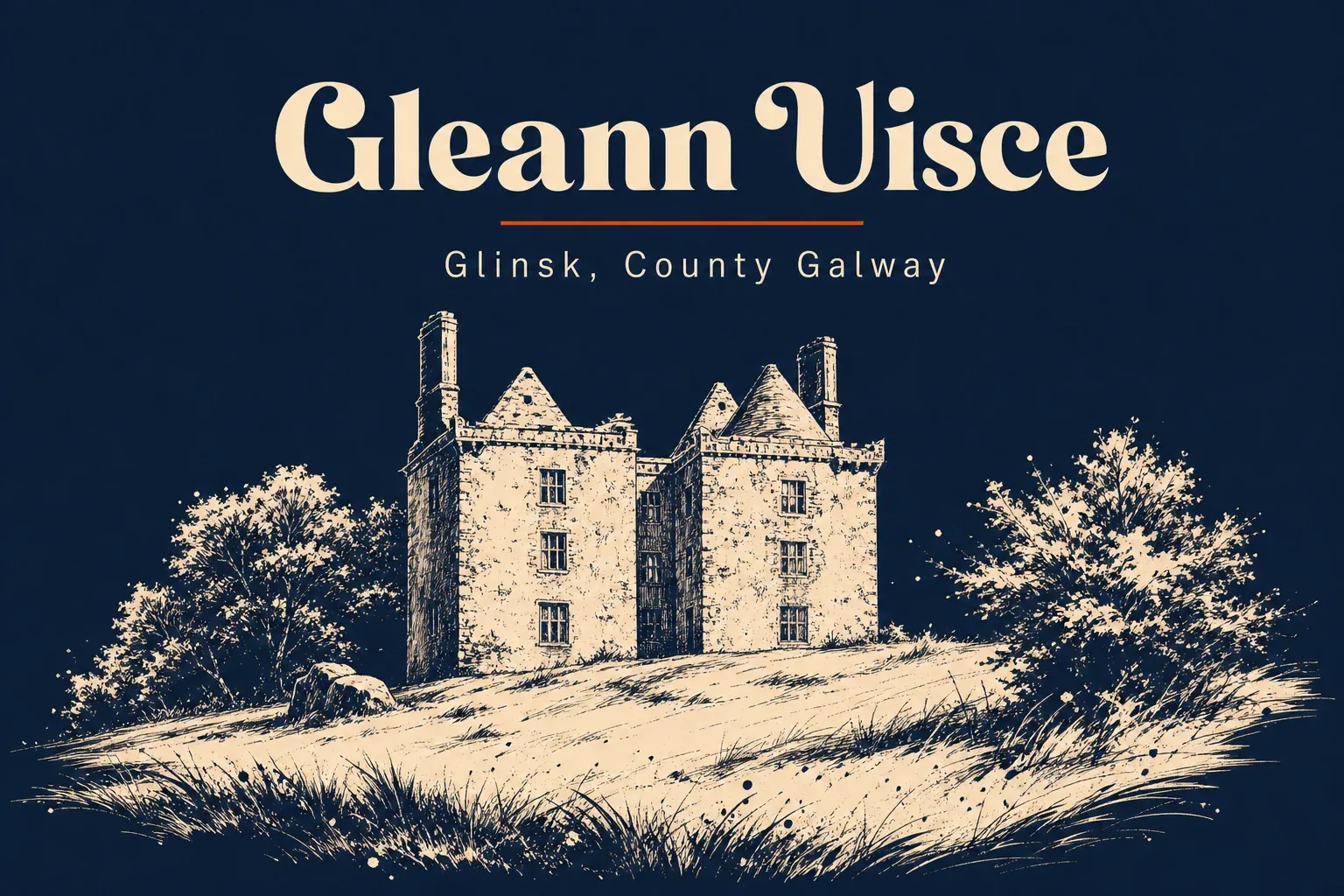
What puts Glinsk on the map is the castle. Sir Ulick Burke, first of the Burke baronets of Glinsk, began it around 1628, and it is often called one of the last true castles built in Ireland - a fortified house caught between two ages, with gun loops and bartizans for defence and big mullioned windows for show. It was gutted by fire, most likely during the Cromwellian wars, and has stood roofless ever since. The Burke estate, some seven thousand acres, was sold in 1854 through the Encumbered Estates Court to Allan Pollock of Glasgow, and that was the end of the family here.

Come for the castle and the quiet, and not much else. The standing ruin is the reason to turn off the road; the rest is a working farming parish that asks nothing of you. If you have come this far you are either chasing the Burkes, walking a stretch of the Suck, or lost on the back roads between Galway and Roscommon. All three are fine reasons.
Population
A rural townland and parish of a few hundred people
Founded
Glinsk Castle begun c. 1628 (Sir Ulick Burke, 1st Baronet)
Coords
53.6519° N, 8.4319° W
01 / 07

At a glance.

Three things every local will eventually mention. Read these and you've already understood more than most day-trippers do.

02 / 07

The pubs.

None of these are themed Irish pubs, because they don't need to be. A few that earn the trip:

The village pub

One bar, locals first
Local pub, Glinsk village

Glinsk has a pub - one of them - and it serves the parish, the GAA crowd and whoever turns off the road. We have not been able to confirm a current trading name from reliable sources, so we will not put words in its mouth. If you are passing through and want a pint, this is the place; treat it as a working local, not a destination, and you will not be disappointed.

03 / 07

Stories & lore.

The reason to come back. The things every local will eventually tell you about, usually after the second pint.

The last of the castles

Glinsk Castle

Sir Ulick Burke, 1st Baronet of Glinsk, began building around 1628, and the result is one of the last fortified houses raised in Ireland - the moment the medieval keep gave way to the country manor, caught mid-stride. It is rectangular with two southern towers, mullioned windows with weepers, gun loops, bartizans and high basements, and two chimney shafts each carrying a battery of five diagonal stacks. A bawn wall with turrets once enclosed it; little of that survives. Fire gutted the building, probably during the Cromwellian wars, and it has stood open to the sky ever since. By 1829 a visitor called it a terrific roofless pile haunted by a colony of rats. It is a National Monument in state care today.

Norman family, Connacht land

The Burkes of Glinsk

The de Burgh, anglicised to Burke, were a Norman family who settled deep into Connacht and made it home. Sir Ulick Burke was created a baronet in 1628 - the Burke baronetcy of Glinsk in the County of Galway - and built the castle as his seat. The family married into native Irish lines, the O'Conors and MacDermots among them, and were tangled in the rebellions and wars of the seventeenth century. The estate, over seven thousand acres around Glinsk, held until the Great Famine broke the tenant economy. It was sold in 1854 to Allan Pollock, a Glasgow man, and the Burke name went with it.

Thirteenth-century ruin nearby

Ballynakill Abbey

Older than the castle by four centuries, the remains of Ballynakill Abbey, dating from the early thirteenth century, lie in the parish. It is a quiet ruin in a quiet place, the kind of site you find by asking locally rather than following a sign. Worth knowing it is there if medieval stone is what brought you to this corner of the Suck valley in the first place.

04 / 07

Things to do outside.

Wear waterproofs. Bring a sandwich. Tell someone where you're going if it's the mountain.

Glinsk Castle and the village The castle stands in the middle of the village with a small car park on the road opposite; access to the site is over a stile, and the gate can be padlocked and the ground nettled, so wear boots. The interior key has traditionally been kept at a house near the castle - ask locally if you want inside. Otherwise walk the perimeter and read the chimneys and gun loops off the walls.
Short strolldistance
30 minutestime
Suck Valley Way (nearby stretches) The Suck Valley Way is a long-distance walking route threading the river valley through this part of Galway and Roscommon. Glinsk is in Suck country; the nearest signed loops and stages give you riverside and farmland walking with little traffic. Check the current waymarking locally before setting out, as some sections are quiet and lightly maintained.
Pick your distancedistance
Half a day or moretime
05 / 07

When to go.

There is no bad time. There are different times.

Spring
Mar-May

Long light over the Suck valley, the fields greening, dry-ish ground at the castle. The best window to climb the stile without wading through nettles and mud.

◉ Go
Summer
Jun-Aug

Warmest and driest, longest evenings, GAA in full swing on the pitch. Vegetation around the castle is thickest now, so the boots still earn their keep.

◉ Go
Autumn
Sep-Oct

Quiet roads, low gold light on the limestone, the harvest off the land. A good time to have the castle to yourself, which is most of the year anyway.

◉ Go
Winter
Nov-Feb

Short days and wet ground in a low river valley. The castle is open to the weather and the access can be muddy and overgrown. Doable, but pick a dry spell.

◐ Mind yourself
06 / 07

What to skip.

Honestly? Don't bother.

If a local was sitting beside you, this is the bit where they'd lean in.

×
Expecting a restored castle

Glinsk Castle is a roofless ruin, gutted by fire and standing open to the sky for nearly four centuries. There is no visitor centre, no tearoom, no guided tour. That austerity is the appeal - it is a National Monument left honestly as it is - but go knowing it.

×
Expecting a village to wander

Glinsk is a church, a school, a shop, a pub and a GAA pitch in a farming parish. It is not a strolling village with a main street of shopfronts. Come for the castle and the quiet; do not come expecting to fill an afternoon on foot in the village itself.

×
Turning up without checking castle access

The gate can be padlocked and the site nettled, and the interior key has been kept at a nearby house. If getting inside matters to you, ask locally before you go rather than driving the back roads and finding a locked stile.

+

Getting there.

By car

Glinsk lies on minor roads between Creggs and Ballymoe in north-east Galway, near the Roscommon border. From Galway city it is roughly an hour and a quarter, generally via the N63 toward Roscommon and minor roads west of Creggs. From Roscommon town it is about 30 km. The last stretch is narrow country road - take it slowly.

By bus

There is no direct scheduled bus to Glinsk. The nearest meaningful services run to Castlerea and Roscommon (Co. Roscommon) and Ballygar; Local Link covers parts of rural east Galway and Roscommon but routes are infrequent. Plan ahead and expect to finish the journey by car.

By train

The nearest railway station is Castlerea (Co. Roscommon) on the Dublin to Westport line, roughly 20 to 25 minutes away by road. From there you will need a car or taxi to reach Glinsk.