County Kerry Ireland · Co. Kerry · Ballylongford Save · Share
POSTED FROM
BALLYLONGFORD
CO. KERRY · IE

Ballylongford
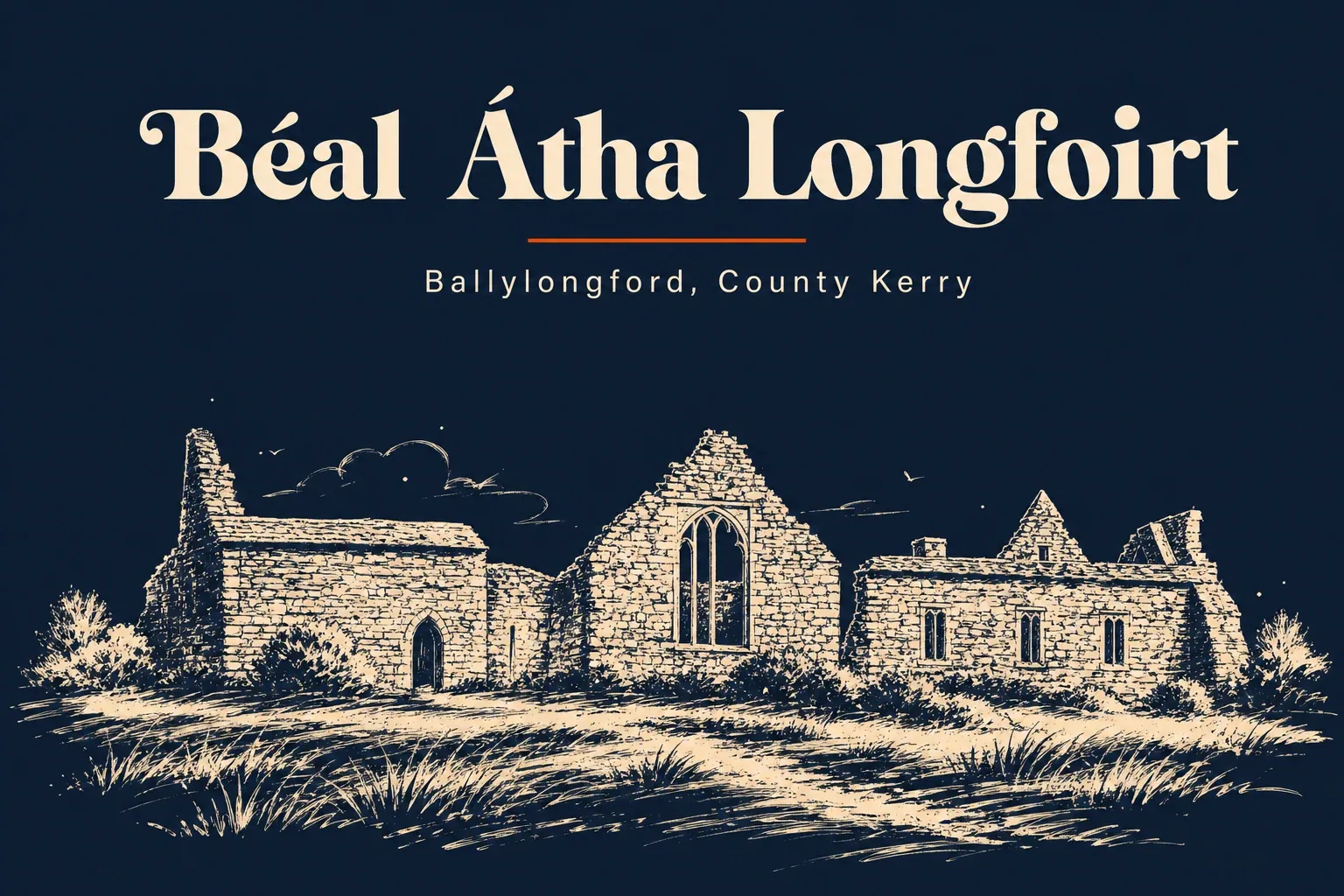
Béal Átha Longfoirt

The Wild Atlantic Way
STOP 07 / 07
Béal Átha Longfoirt · Co. Kerry

A north-Kerry creek village with a Cromwell-blasted castle and a poet buried in the ground.

Ballylongford sits on a tidal creek off the Shannon estuary, at the top end of Kerry where the county runs out of road. Four hundred and fifteen people, a square, two churches, a few shops. The sign as you come in says Béal Átha Longfoirt — "the mouth of the ford of the encampment" — and the encampment in question was Norman, then Gaelic, then English, then everyone, in that order, with most of the violence happening in 1580.

The reason to stop is Carrigafoyle. The O'Connor Kerry tower house out on the island was the strongest castle in Munster when the Second Desmond Rebellion broke out, and Sir William Pelham brought ships and cannon up the Shannon at the end of March 1580 and broke it open in three days. The garrison — seventy Irish, Italian and Spanish soldiers under a Captain Julian — were mostly killed where they stood. The breach is still in the wall. You can climb the spiral stair to the top and look down at the same estuary the ships came up.

The other reason to stop is Brendan Kennelly. The poet was born in the village in 1936, taught at Trinity for forty years, and is buried in the churchyard a short walk from where he grew up. There isn't a museum. There is a pub he used to drink in, and a festival the village runs in his honour, and a quiet headstone. That's the right size for it. Have a look at Carrigafoyle, walk up to Lislaughtin, get a pint, and then take the ferry from Tarbert if you're going on. The road out of here goes north into Clare on a boat.
Population
415
Founded
Carrigafoyle built c. 1490
Coords
52.5461° N, 9.4781° W
01 / 07

At a glance.

Three things every local will eventually mention. Read these and you've already understood more than most day-trippers do.

02 / 07

The pubs.

None of these are themed Irish pubs, because they don't need to be. A few that earn the trip:

The Thatch Bar

Locals, low-key
Village pub

Square in the middle of the village, low ceilings, regulars on the bar stools. The kind of pub where the door swings open and three people look up and one of them knows your father. Brendan Kennelly was a regular.

McGrath's

Old-school
Pub & shop

Bar, grocery, a bit of everything — the village pub doing the village pub job. Open the hours it wants to be open. Ring ahead for a meal.

Sean Magees

Quiet pint
Local

Smaller again, no music, no menu, just a pint. There are nights when the door is shut and you knock. The locals know which nights.

03 / 07

Stories & lore.

The reason to come back. The things every local will eventually tell you about, usually after the second pint.

Carrigafoyle, March 1580

Pelham's siege

Carrigafoyle was the O'Connor Kerry stronghold and the strongest castle in Munster when the Second Desmond Rebellion went up. Sir William Pelham, the English Lord Justice, brought a fleet of ships up the Shannon at the end of March 1580 and laid cannon against the seaward wall. Three days of bombardment broke it open on Easter Sunday. The garrison — about seventy men, Irish, Italian and Spanish, under a Captain Julian — were mostly cut down in the breach or hanged afterwards. The castle never recovered. The breach is still in the wall, six storeys up. Stand under it and the scale of what happened lands.

Buried 1580, found 1871

The Lislaughtin Cross

When word came that the English raiders were on their way, the Franciscans at Lislaughtin Friary buried their great silver-gilt processional cross in the ground for safekeeping. The friary was sacked, three friars were killed at the altar, and the cross stayed lost for two hundred and ninety-one years. A man digging in a field outside the village turned it up in 1871. It is fifteenth-century work, made for the friary by the O'Connor Kerry chiefs in 1479, and it is now in the National Museum in Dublin. The friary it was made for is still standing in ruins down the road.

The poet from the square

Brendan Kennelly

Brendan Kennelly grew up in a pub on the village square, went to Trinity in 1953, and stayed there teaching English literature for nearly half a century. He published over thirty books — Cromwell, The Book of Judas, The Man Made of Rain — and became the public face of Irish poetry on television and radio for two generations. He came home often. He died in October 2021 and is buried in the churchyard at Lislaughtin. The headstone is unfussy. He would have wanted that.

Five kilometres up the road

The Tarbert ferry

Five kilometres north of the village the road runs into the Shannon at Tarbert, where a car ferry crosses to Killimer in Clare every hour on the half-hour, every day of the year except Christmas. Twenty minutes across. It saves you a hundred-and-thirty-seven-kilometre drive round through Limerick, and it puts the cliffs at Loop Head and the Wild Atlantic Way of west Clare an hour up the road. The ferry has been running since 1969. Most people who pass through Ballylongford are on their way to it.

04 / 07

Things to do outside.

Wear waterproofs. Bring a sandwich. Tell someone where you're going if it's the mountain.

Carrigafoyle Castle ramparts Three kilometres out the Saleen road, then a short causeway across to the island. The 104-step spiral stair is intact and you can climb to the top. Mind the breach — the floors are gone above it. Free, unstewarded, gates open.
1 km from car parkdistance
45 mintime
Lislaughtin Friary loop Out the road past the GAA pitch to the friary ruins. The choir arch and the east window still stand. The friary cemetery is the village's working graveyard, so walk gently. Brendan Kennelly's grave is here.
3 km returndistance
1 hourtime
Saleen pier Down to the old quay on the creek. The tide does most of the work — full at high water, mud at low. Curlews and herons most of the year. You can see Carrigafoyle from the pier head.
2 km returndistance
40 mintime
05 / 07

When to go.

There is no bad time. There are different times.

Spring
Mar–May

Long evenings, quiet roads, the friary in fresh leaf. The anniversary of the siege is Easter — there is a small commemoration at the castle some years.

◉ Go
Summer
Jun–Aug

The Pattern Day pilgrimage at Lislaughtin runs in summer. The village is busiest then, which is to say you might have to wait at the bar.

◉ Go
Autumn
Sep–Oct

The estuary light in October is the reason photographers come. Storms blowing up the Shannon. Sessions in the pubs picking up after the summer lull.

◉ Go
Winter
Nov–Feb

The castle is still open, but the road is dark by five and half the village is at its own fireside. Pub hours go irregular. Ring ahead.

◐ Mind yourself
06 / 07

What to skip.

Honestly? Don't bother.

If a local was sitting beside you, this is the bit where they'd lean in.

×
Treating Carrigafoyle as a ten-minute photo stop

It is a ruin, but it is a serious ruin with a stair you can climb six storeys. Give it an hour. The view from the top is the view Pelham's gunners had in reverse.

×
Looking for the Lislaughtin Cross at the friary

The cross is in the National Museum on Kildare Street in Dublin. The friary has the empty space it came out of. That is its own kind of thing, but know what you are looking at.

×
Expecting a tourist circuit

There is no visitor centre, no ticket booth, no coffee dock at the castle. Bring a flask. That is the village's offer and it is a fair one.

+

Getting there.

By car

Listowel to Ballylongford is 15 minutes on the R553. Tarbert and the Shannon ferry are 5km north on the R551. Tralee is 50 minutes south.

By bus

Local Link Kerry routes connect Listowel and Tarbert through the village a few times a day. Check timetables — services are sparse and Sunday is thin.

By air

Kerry Airport (KIR) is 1h 15m. Shannon (SNN) is 1h 30m by road, or 30 minutes if you take the Tarbert ferry across.