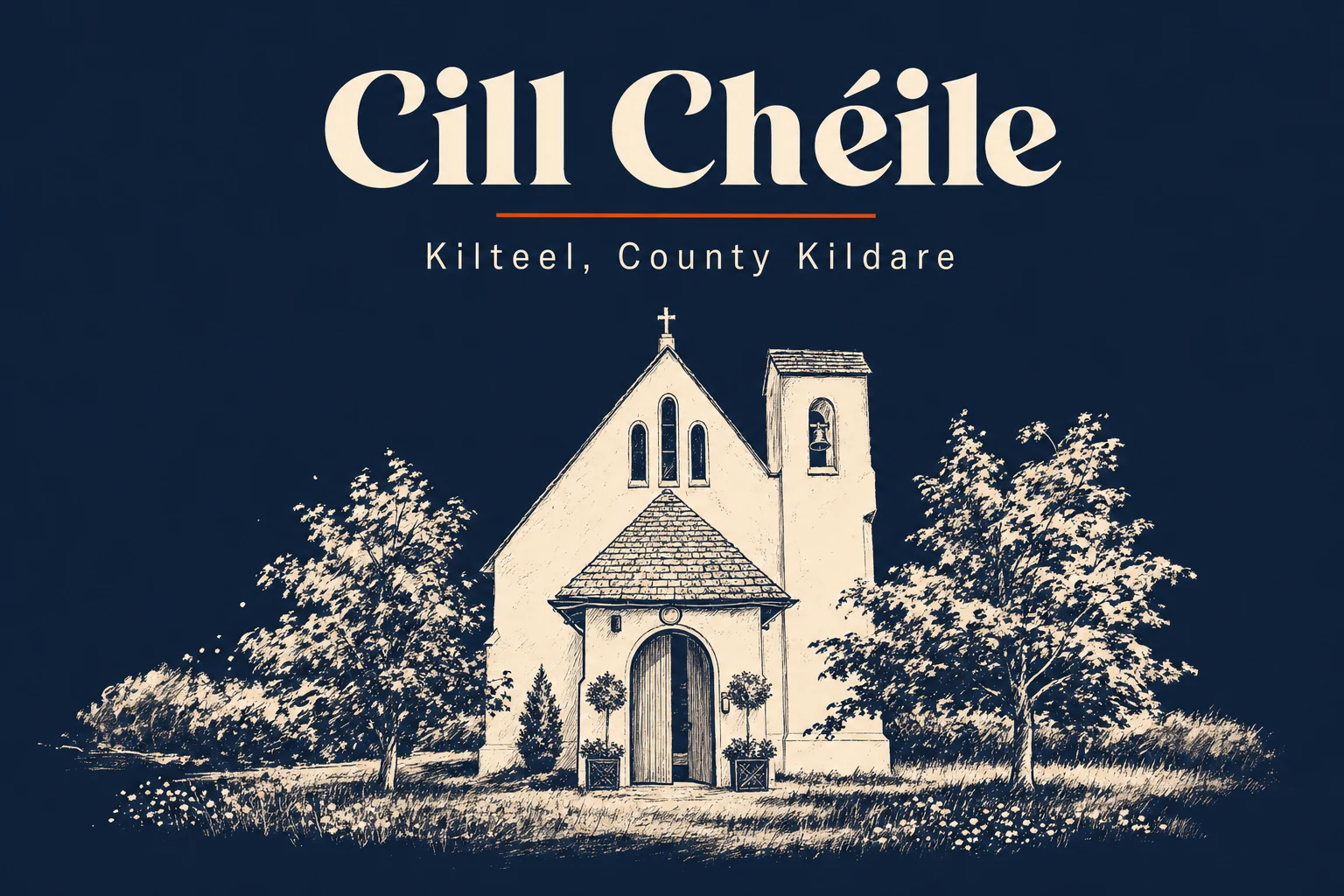
Cill Chéile · Co. Kildare
Kildare's highest village, with a Crusader castle and one very old pub.
Kilteel sits at 243 metres on a ridge where the Kildare plain runs out and the Wicklow Mountains begin. The name is Cill Chéile - the church of Celé Crist, a bishop of the Cenél nEóġain who died in 727 AD. That church was documented in a 1179 papal letter. The ruins beside the tower house are the same site. There is a continuity of use here spanning thirteen centuries, and most people drive past without stopping.
The castle compound is the reason to stop. Maurice Fitzgerald, 2nd Baron of Offaly, built a Knights Hospitaller preceptory here in the 13th century on the site of the earlier monastic settlement. The Hospitallers were a military religious order - crusaders who also ran hospitals and pilgrim routes. Their Irish houses defended the colonial frontier and managed estates. Kilteel was on the southwest edge of the English Pale, watching the gap in the hills where Wicklow began. When the Dissolution came in 1539, Thomas Alen got the preceptory. A 15th-century tower house survives alongside the earlier remains, five storeys with a spiral staircase and a gatehouse. Both are National Monuments.
The village today is small and residential - a commuter settlement for Naas and Dublin, elevated enough that the views east toward the Wicklow hills are a genuine reason to drive up. Brennan's Inn has been here since at least the 1820s under various names and families; the current premises date from 1900. There is a church of St. Laurence O'Toole, dedicated in 1935. There is a small oak wood to the north, designated a Proposed Natural Heritage Area. That is Kilteel: medieval ruins, one pub, one church, a ridge, and a view.