County Leitrim Ireland · Co. Leitrim · Cloone Save · Share
POSTED FROM
CLOONE
CO. LEITRIM · IE

Cloone
An Chluain, Co. Leitrim

The South Leitrim
STOP 07 / 07
An Chluain · Co. Leitrim

A small south Leitrim farming village in John McGahern country, built on a sixth-century monastery, with two pubs and a meadow for a name.

Cloone is a small farming village in south Leitrim, off the R201, with Mohill the nearest town about seven kilometres to the north. The name is the anglicised cluain - a meadow - and that is honest advertising. This is low, damp, green country: riverbank, wet meadow, woodland, bog and lakeshore, the limestone wetland landscape that south Leitrim does better than anywhere.

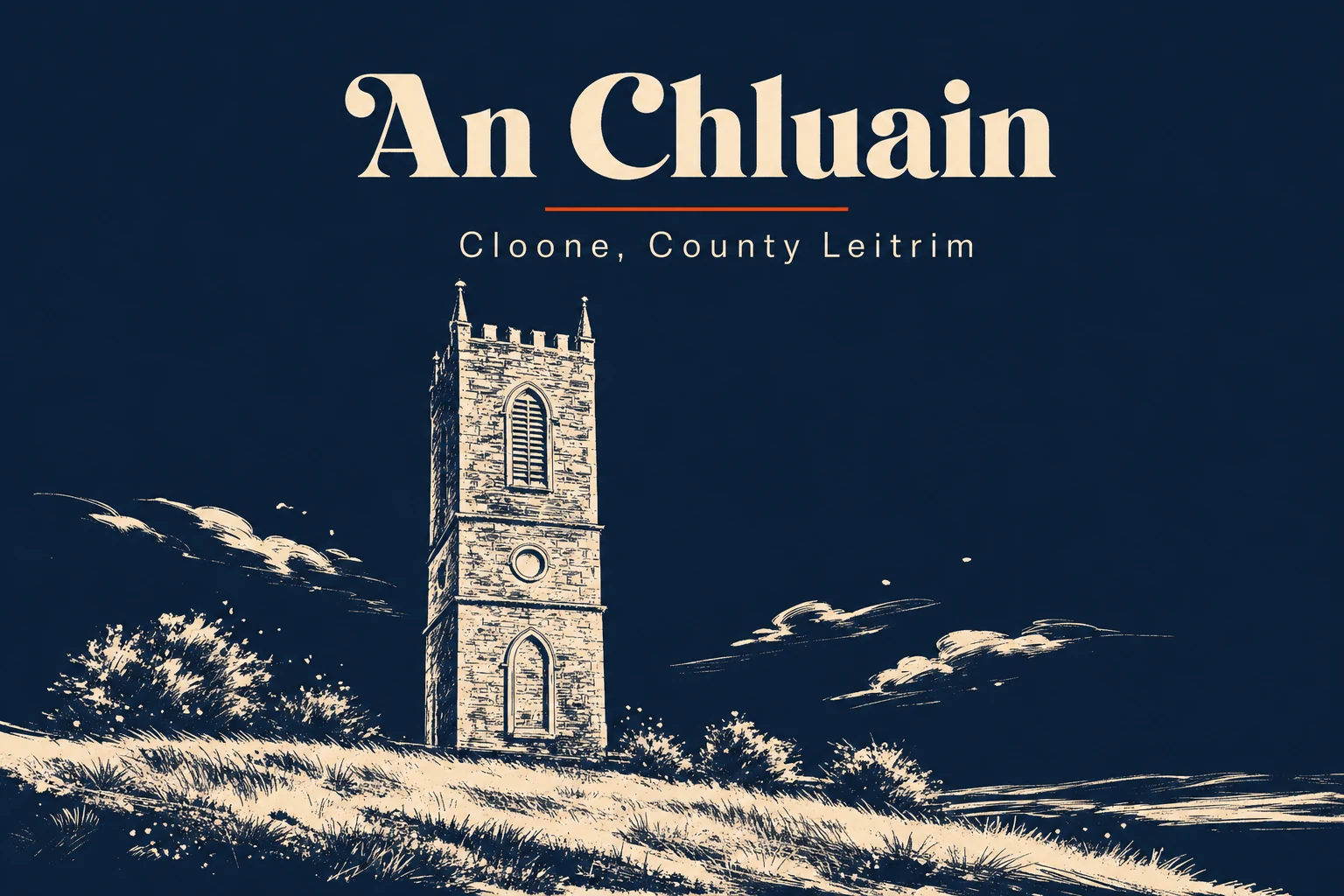
There has been a settlement here a very long time. Saint Fraoch founded a monastery at Cloone in 570, and fragments of a Celtic high cross and the monastic stones were gathered up and set in the village cemetery on the old foundation. The other landmark is the bell tower of St James's Church of Ireland - all that is left of a church built by the Board of First Fruits in 1822, the tower restored in the mid-1990s with a clock by Samuel Elliott of Dublin.

This is John McGahern country. The novelist grew up at Aughawillan a few townlands away, and the small fields and lakeland of his books - Amongst Women, The Dark, That They May Face the Rising Sun - are the fields around here. There is no McGahern museum in Cloone, but there is an interpretive trail linking Mohill, Fenagh, Ballinamore and Aughawillan if you want to walk where the writing came from.

There is no tourist infrastructure and no pretending otherwise. Two pubs, a church tower, a quiet trail by a lake, and an agricultural show on the August Bank Holiday Monday that brings the parish in. Come for the McGahern landscape, the fishing, or the walk by Annaghmaconway. Do not come expecting a day out built for you - this is a working village that gets on with its own business.
Population
~600 (2006)
Pubs
2and counting
Founded
Monastery founded 570 by Saint Fraoch
01 / 07

At a glance.

Three things every local will eventually mention. Read these and you've already understood more than most day-trippers do.

02 / 07

The pubs.

None of these are themed Irish pubs, because they don't need to be. A few that earn the trip:

Creegans Pub

Local, traditional
Village bar

One of the two pubs in the village. A working south Leitrim local - a pint, the GAA on the television, the regulars at the bar. Useful after the Bothar na Naomh trail or on a show-day weekend.

McKeons Bar and Lounge

Local
Bar and lounge

The other Cloone pub. Bar and lounge, the version of a night out you get in a village this size. Between the two of them they keep the place watered - down from the seven licensed houses the village had in 1925.

03 / 07

Stories & lore.

The reason to come back. The things every local will eventually tell you about, usually after the second pint.

A foundation of the year 570

Saint Fraoch's monastery

Saint Fraoch founded a monastery at Cloone in 570, in the early centuries of Irish Christianity when small monastic settlements like this were the centres of learning and prayer across the country. The Catholic parish carried the old name Cloone-Conmaicne. What survives is fragmentary - pieces of a Celtic high cross and stones from the monastery, gathered up and set in the village cemetery on the ground where the foundation stood. The sixth century was hard on the place: the Justinian plague that swept the barony of Mohill is recorded as having badly affected the Cloone area. Stand in the cemetery and you are on a site that has been sacred ground for around fifteen centuries.

A church gone, a tower left standing

St James's bell tower

The bell tower of St James's Church of Ireland is all that remains of a church built by the Board of First Fruits in 1822 - the body that funded Protestant church-building across Ireland in the early nineteenth century. The church itself is gone; the tower was restored in the mid-1990s and a clock installed, manufactured by Samuel Elliott of Dublin. It is the most visible old structure in the village, and a small monument to the layered religious history of a place that has had a church on its ground since the sixth century.

The fields behind the novels

McGahern's landscape

John McGahern (1934-2006) grew up at Aughawillan, a few townlands from Cloone, and the south Leitrim of small fields, lanes and lakeland is the country of his fiction. His novels - Amongst Women, The Dark, and the late masterpiece That They May Face the Rising Sun - do not romanticise rural Ireland; they show its harshness and its beauty without flinching. McGahern is buried at Aughawillan. There is no museum in Cloone, but an interpretive McGahern trail links Mohill, Fenagh, Ballinamore and Aughawillan, the ground he grew up on and wrote from. If you have read the books, the walk around here is the books.

Eleven county titles, and a man who built Quinnsworth

Cloone's GAA and its sons

Cloone's Gaelic football club won eleven Leitrim Senior Football Championships, the most recent in 1980 - a serious record for a parish this small, and a source of long memory at the bar. The village has produced its share of notable people: Pat Quinn, founder of the Quinnsworth supermarket chain that became part of Tesco Ireland, and Shane Kelly, the horse-racing jockey. Fr Peter Conefrey, a Cloone pastor and Irish cultural nationalist, is also part of the parish story.

04 / 07

Things to do outside.

Wear waterproofs. Bring a sandwich. Tell someone where you're going if it's the mountain.

Bothar na Naomh (Saints' Road) Developed in 2013 in the environs of Annaghmaconway lake. A family-friendly woodland and lakeshore trail through the limestone wetland landscape - riverbank, damp meadow, woodland, bog and lakeshore. Marked both ways with shorter and longer options. Quiet, scenic, and the best single thing to do in the village. Used for walking, running, horse riding and kayaking.
3.75 km loop, up to 5.75 km of traildistance
1 hourtime
Annaghmaconway lake fishing The lake has ten fishing points and a boat slip. Coarse fishing in classic south Leitrim wetland water. Bring your own gear and your own patience.
lakeshoredistance
an afternoontime
05 / 07

When to go.

There is no bad time. There are different times.

Spring
Mar-May

The wet meadows green up and the Bothar na Naomh trail is at its best. Quiet, no crowds, the McGahern landscape at its most legible.

◉ Go
Summer
Jun-Aug

Long evenings for the lakeshore and the trail. The Cloone Agricultural Show falls on the August Bank Holiday Monday - cattle, stalls, music and the whole parish out. The one day the village fills up.

◉ Go
Autumn
Sep-Oct

Good walking weather, low light on the lakeland. A fine time for the McGahern country if you have the books with you.

◉ Go
Winter
Nov-Feb

Short days and the wetland landscape can be sodden underfoot. The pubs keep going. Boots essential on the trail.

◐ Mind yourself
06 / 07

What to skip.

Honestly? Don't bother.

If a local was sitting beside you, this is the bit where they'd lean in.

×
Looking for a day-out village

Cloone is a working farming village with two pubs, a church tower and a lake trail. There is no visitor centre, no row of cafes, no tour. That is the point of it, not a failing. Scale your expectations to the place.

×
A McGahern museum in Cloone itself

There isn't one. The McGahern interpretive trail runs through Mohill, Fenagh, Ballinamore and Aughawillan. Cloone is part of the landscape, not the headquarters of it. Use the trail and the books, not a gift shop.

+

Getting there.

By car

Cloone is off the R201 in south Leitrim. Mohill, the nearest town, is about 7 km north; Carrick-on-Shannon is roughly 25 km northwest via Mohill. From Dublin, take the N4 to Carrick-on-Shannon, then south. A car is the only realistic way in.

By bus

Public transport is sparse. Local Link Sligo Leitrim Roscommon runs limited rural services in the area; check timetables in advance. Do not plan a day around the bus.