County Leitrim Ireland · Co. Leitrim · Kinlough Save · Share
POSTED FROM
KINLOUGH
CO. LEITRIM · IE

Kinlough
Cionn Locha, Co. Leitrim

The North Leitrim
STOP 08 / 08
Cionn Locha · Co. Leitrim

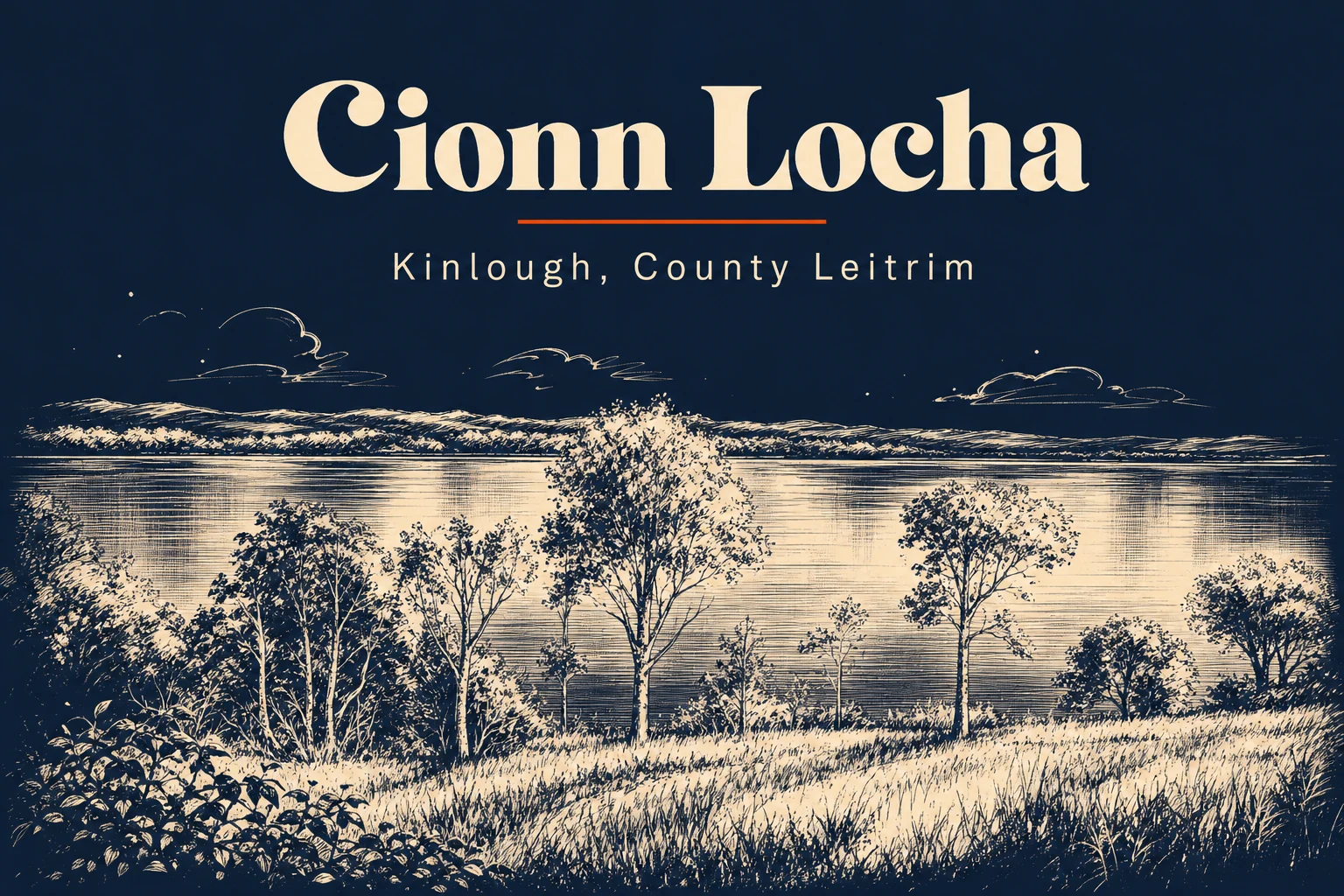
Cionn Locha, the head of the lake - an estate village at the top of Lough Melvin, with three rare trout, a ruined island castle, and the Donegal coast two miles up the road.

Kinlough is Cionn Locha, the head of the lake, and the lake is Lough Melvin. That is the whole geography in one phrase. The village sits in the far northern corner of Leitrim, between the River Duff and the River Drowes, under the Dartry Mountains, with the Atlantic and Bundoran two and a half miles north and the Fermanagh shore of Melvin across the water to the east. Three counties meet near here. It has always been a crossing place.

There was a settlement called Cenn Locha here from at least the 8th century, in the old MacClancy country of West Breifne. The village you see now grew up in the 1800s around the Johnston estate - Kinlough House, originally Oakfield, was the family seat, and at its height the estate ran to over twelve thousand acres spread across Leitrim, Donegal, Fermanagh and Sligo. The population held at around 350 from the Famine right through the twentieth century, then roughly tripled in a generation: 1,196 at the 2022 census, much of it commuter overspill from Bundoran and Ballyshannon.

Come for the lough and what is on it. Lough Melvin is internationally important for its wildlife, and famous among anglers for three trout - the gillaroo, the sonaghan and the ferox - that survive together here and almost nowhere else on earth. A mile out from the village, on a crannog near the southern shore, are the ruins of Rossclogher Castle, a MacClancy tower with a genuine Spanish Armada story attached. The Kinlough Folk Museum on Barrack Street keeps the everyday end of the history - farm tools, household objects, the rural life that the estate ran on.

It is a working village rather than a polished one. There is a primary school named for the Four Masters, two churches, a folk museum, a clutch of pubs and a couple of good places to eat, and not a great deal else - which is honest. Use it as a quiet base on the Lough Melvin shore with Bundoran, Rossinver and the Dartry glens all within a short drive.
Population
~1,196 (2022)
Walk score
The village to the head of Lough Melvin in ten minutes
Founded
Cenn Locha recorded from the 8th century; estate village grew up around Kinlough House from the early 1800s
Coords
54.4500° N, 8.2833° W
01 / 08

At a glance.

Three things every local will eventually mention. Read these and you've already understood more than most day-trippers do.

02 / 08

The pubs.

None of these are themed Irish pubs, because they don't need to be. A few that earn the trip:

Village pubs

Local, unpolished
Traditional pubs, village centre

Kinlough has a handful of ordinary village pubs serving a local and angling trade rather than a tourist one. None has the standing of a destination bar - they are where you go for a pint after a day on the lough. Names change hands; ask locally for what is open and pouring.

03 / 08

Where to eat.

PlaceTypeLocal note
The Courthouse Restaurant Irish and Mediterranean, village centre €€€ The standout, and by some distance the reason food-minded visitors stop in Kinlough. Irish ingredients given a Mediterranean turn - the fillet steak is a regular order. Long-running and very well regarded. Book at the weekend; this is a small village and the dining room is not large.
Kinlough Inn Chinese and takeaway €€ The local Chinese and takeaway option, well thought of for what it is. Useful when the Courthouse is full or you want something quick after a day on the water.
04 / 08

Stories & lore.

The reason to come back. The things every local will eventually tell you about, usually after the second pint.

Gillaroo, sonaghan, ferox - relicts of the ice

The three trout of Lough Melvin

Lough Melvin is one of very few places on earth where three distinct kinds of trout live alongside each other and stay genetically separate: the gillaroo (an giolla rua, the red fellow, a bottom-feeder with a hard gizzard-like stomach), the sonaghan (a dark, deep-water trout), and the ferox (a large, long-lived fish-eater). They are thought to be relict lineages that colonised the lough as the ice retreated and never interbred. For fish biologists Melvin is a textbook case study; for anglers it is a place of pilgrimage. The lough also takes a run of Atlantic salmon. A sixth of the water lies in Fermanagh, the rest in Leitrim, and the village sits at the head of it.

MacClancy, a crannog fort, and Francisco de Cuellar, 1588

Rossclogher Castle and the Spanish captain

A mile from the village, on a small artificial island near the southern shore of Lough Melvin, stand the ruins of Rossclogher Castle - a late-medieval tower-house of the MacClancys, the Gaelic chiefs of this corner of West Breifne, second only to the O'Rourkes. It was a refuge rather than a residence, sited in bog and water to keep cannon at bay. In November 1588 the Spanish Armada survivor Francisco de Cuellar, shipwrecked at Streedagh in Sligo, reached MacClancy country and sheltered here. When 1,700 English troops marched on the lordship, MacClancy took to the hills while Cuellar and a handful of Spaniards held the castle through a seventeen-day siege until winter weather forced the English off. Cuellar eventually escaped north to Derry and home to Spain, and his letter is one of the great firsthand accounts of Armada-era Ireland. MacClancy himself was caught and beheaded by 1590. Nearby on the mainland are the remains of Rossclogher Abbey.

Kinlough House and twelve thousand acres

The Johnston estate village

The modern village is an estate creation. Kinlough House, first called Oakfield, was the seat of the Johnston family from the early 1700s and was remodelled by Robert Johnston around the 1820s, when it took the Kinlough name. The estate was vast - over twelve thousand acres reaching across four counties, Leitrim, Donegal, Fermanagh and Sligo - with the demesne and the village core in Kinlough townland and the rest let to tenants. The street pattern, the churches and the early-19th-century shape of the place all date from that period. The Four Masters are remembered in the village too: the primary school carries their name, and the Annalists are commemorated in stone on the Four Masters Bridge on the Ballyshannon road.

05 / 08

Things to do outside.

Wear waterproofs. Bring a sandwich. Tell someone where you're going if it's the mountain.

Lough Melvin shore The head of the lough is a ten-minute walk from the village. Shore access for the angling marks and views east toward the Fermanagh side and Rossclogher's island. Boots after rain; the ground is soft near the water.
Variabledistance
30 minutes upwardtime
Village and Folk Museum walk An easy turn around the village taking in the two churches, Barrack Street and the Kinlough Folk Museum (check opening - it keeps limited hours). Add the Four Masters Bridge on the Ballyshannon road if you want the annalists' memorial stone.
1.5 km loopdistance
40 minutestime
06 / 08

When to go.

There is no bad time. There are different times.

Spring
Mar-May

Trout season opens and the lough comes to life with anglers. The Dartry hills green up. Quiet in the village, the coast at Bundoran not yet busy.

◉ Go
Summer
Jun-Aug

Long evenings on the lough and the best weather for the shore and the island views. Bundoran two miles north is in full swing if you want the seaside; Kinlough stays calmer.

◉ Go
Autumn
Sep-Oct

Salmon and the late trout, colour in the glens, the tourist traffic gone from the coast. A good honest month for the lough.

◉ Go
Winter
Nov-Feb

Short days, wet weather off the Atlantic, fishing largely closed. The pubs and the Courthouse keep going, but there is little reason to come unless you want the lough at its bleakest and emptiest.

◐ Mind yourself
07 / 08

What to skip.

Honestly? Don't bother.

If a local was sitting beside you, this is the bit where they'd lean in.

×
Expecting to walk out to Rossclogher Castle

It sits on a crannog, an artificial island, near the shore - not on the mainland. There is no maintained access onto the island and the approach is boggy and unsafe. View and photograph it from the shore; do not attempt to wade or scramble out.

×
A big resort or a buzzing tourist village

Kinlough is a working estate village of around twelve hundred people, much of it commuter housing. Two churches, a folk museum, some pubs and a couple of eating places. The draw is the lough and the quiet, not the village itself.

×
Reliable bus connections

Public transport is minimal - Bus Eireann runs only limited Friday services. Without a car you will struggle. Treat this as a drive-to destination off the Bundoran road.

+

Getting there.

By car

In the far north of Leitrim where the R280 and R281 meet. Two and a half miles south of Bundoran on the N15 corridor; about 13 miles from Manorhamilton. From Sligo roughly 40 minutes via Bundoran. A car is effectively essential.

By bus

Very limited. Bus Eireann has run Friday-only services (around routes 483 to Sligo and 495 toward Manorhamilton) connecting via Bundoran and Ballyshannon. Check current timetables before relying on them - frequency is minimal.

By air

Ireland West Airport Knock (NOC) is about 1 hour 20 minutes by car. City of Derry (LDY) is a similar distance to the north.