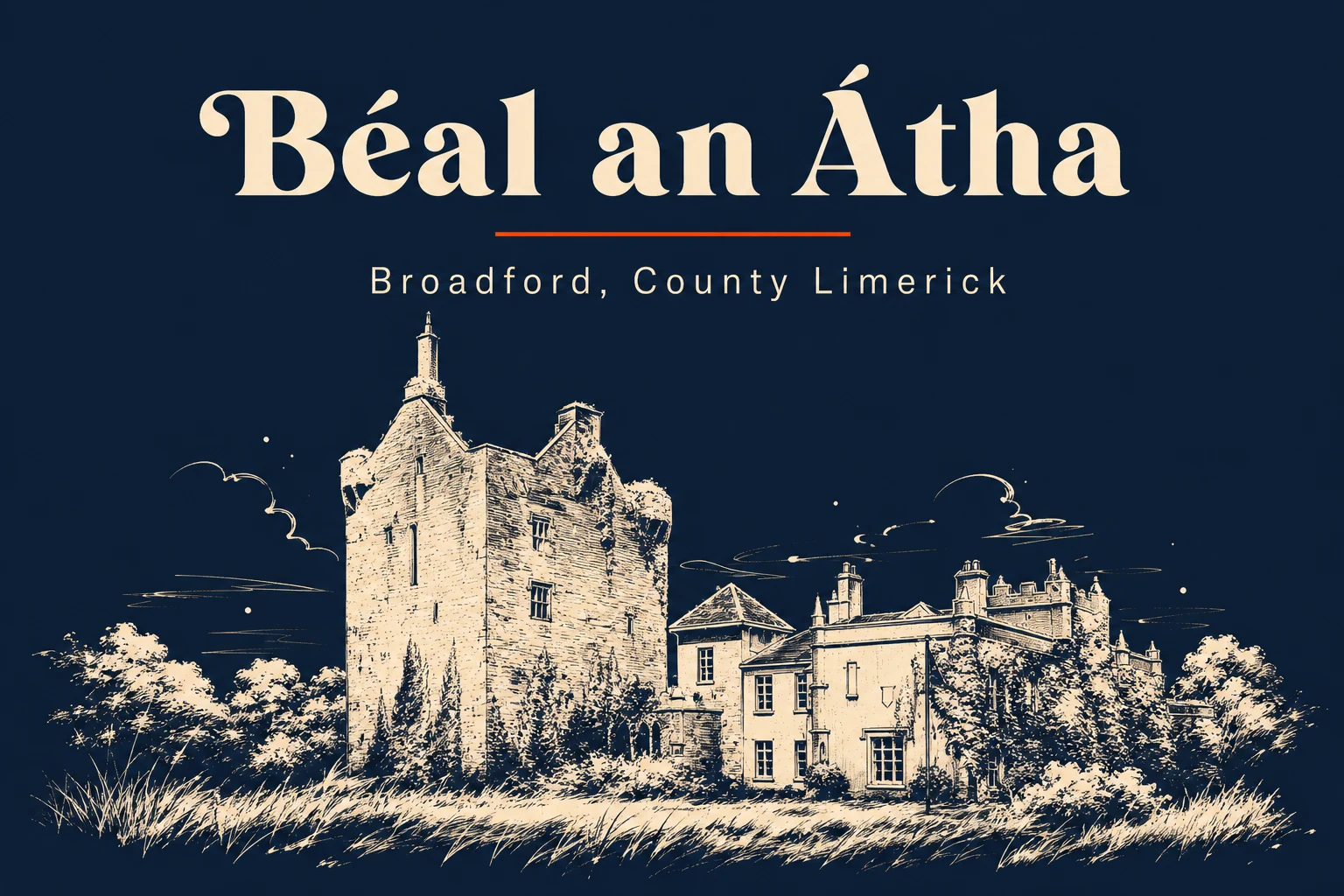
Béal an Átha · Co. Limerick
The home ground of Dáibhí Ó Bruadair, the last of the great bardic poets, in the quiet hills of west Limerick.
Broadford is the Limerick one - not the Clare Broadford an hour north in the Slieve Bernagh hills. It sits in the west of the county on the road between Newcastle West and Dromcollogher, below the Mullaghareirk mountains that mark the Limerick-Cork border. The Irish name is Béal an Átha, the mouth of the ford. About 276 people live in the village; close to a thousand in the wider electoral division. It is farming country, and it does not pretend otherwise.
The village as you see it is younger than it looks. Cartographers first recorded it in 1837, and the run of five conjoined houses centred on the Post Office was built by Henry Dean Spread in the early 1880s. But the parish underneath it is old - Killaliathan, or Killagholehane, a medieval foundation a mile or so south, gave the place its first name and its ruined church. Five limestone quarries once worked the surrounding fields, and the Mohilly family of stonemasons cut their mark into half the headstones in the district.
The one thing that lifts Broadford above the run of quiet west Limerick villages is a poet. Dáibhí Ó Bruadair (c.1625-1698) is reckoned the last of the great Irish bardic poets, and he spent most of his adult life around here, under the patronage of the FitzGeralds of Springfield Castle. He almost certainly came to study at the O Daly bardic school in the townland of Tullaha. He died poor. In 1998 the village put up a statue to him, and President Mary McAleese came to unveil it.
Come for the walks, the stone, and the ghost of the poet. There are three pubs, a supermarket and a post office, and not much else dressed up for visitors. Pair it with Dromcollogher down the road or the Ballyhoura hills to the east, and let Broadford be the quiet end of the trip - which is what it is.