County Limerick Ireland · Co. Limerick · Glin Save · Share
POSTED FROM
GLIN
CO. LIMERICK · IE

Glin
An Gleann

The Wild Atlantic Way
STOP 08 / 08
An Gleann · Co. Limerick

A Georgian castle by the Shannon, 700 years of the same family, and a pint that tastes like history.

Glin sits on the south shore of the Shannon estuary, a village laid out in a large square that slopes down to the water. It's small — very small — but shaped by one fact: for over seven centuries, the same family owned the land, the house, and the title. The Knights of Glin were not royalty and not English. They were a branch of the Munster Geraldines, a Norman-Irish dynasty that took root in Limerick and stayed rooted.

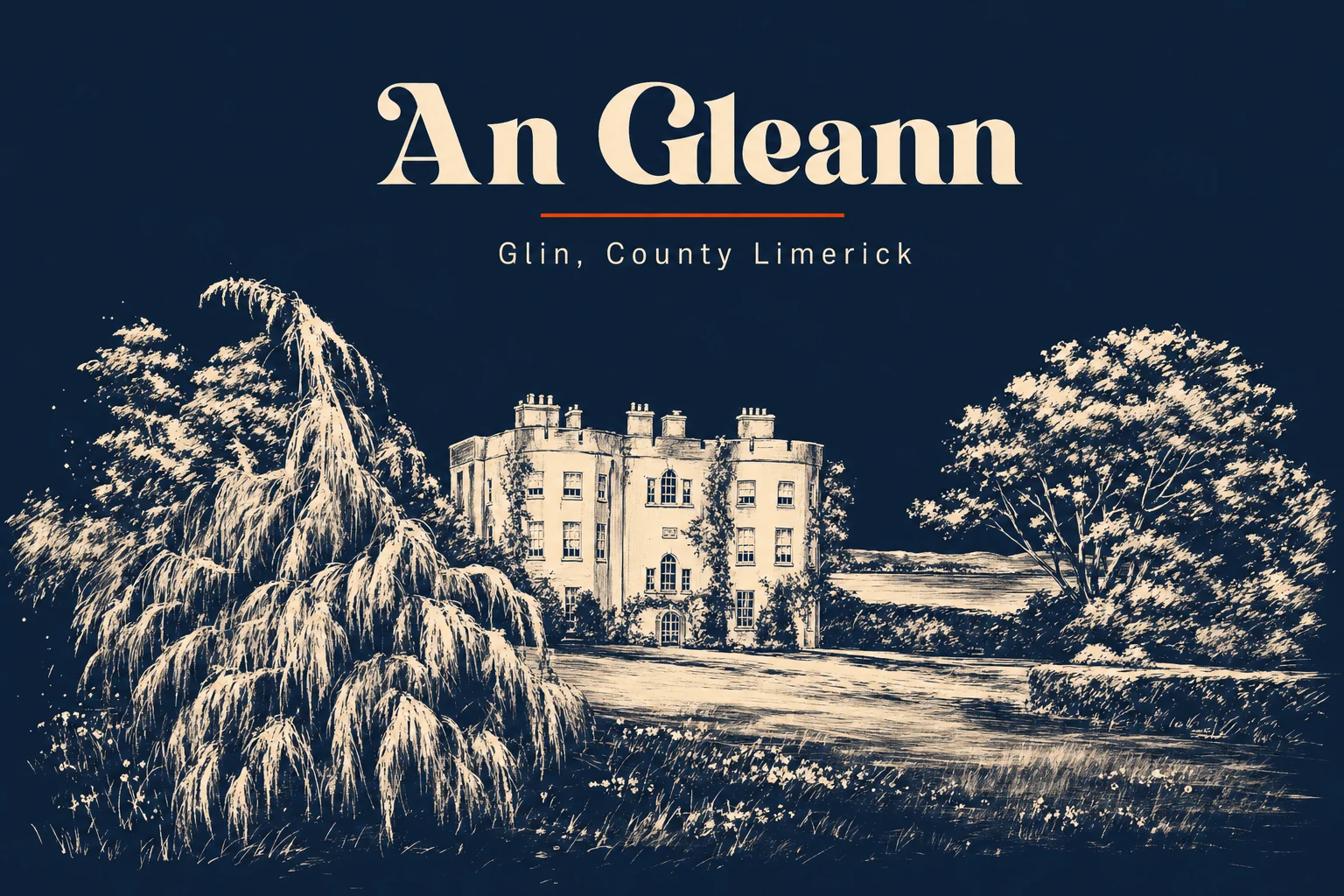
The castle you see is Georgian — built in 1780–1790 to replace the older tower house. It was commissioned by Colonel John Bateman FitzGerald, the 23rd Knight; the architect remains unknown. What you're looking at is not medieval stone but late 18th-century elegance: a country house that happens to be called a castle because the family who owned it had held a castle on the same spot for centuries. The last Knight, Desmond FitzGerald, died in 2011. He had no son. The title became dormant. The castle became a private rental.

Glin gives you what most villages this size cannot: a sense of historical continuity you can walk through. The castle demesne, the village square, the pier where boats still tie up, the heritage trails that loop around the estuary — they all hang together as a single story. Come for a night if you can. Rent a cottage nearby and walk the Shannon edge. Have a pint in Conway's Bar or O'Shaughnessy's Pub — both have watched the same family rule the landscape for 700 years. One of them is still watching.
Population
644
Pubs
2and counting
Walk score
Village square plus three heritage trails
Founded
Medieval, Knights of Glin from early 14th century
Coords
52.5703° N, 9.2828° W
01 / 08

At a glance.

Three things every local will eventually mention. Read these and you've already understood more than most day-trippers do.

02 / 08

The pubs.

None of these are themed Irish pubs, because they don't need to be. A few that earn the trip:

O'Shaughnessy's Pub

Local, estuary views
Pub, sixth generation

Just outside the castle walls. In family ownership for six generations. Simple, genuine, the kind of place the Knights would have ducked into before going back up the hill.

Conway's Bar

The way it used to be
Pub on Main Street

Ranks high in Glin dining reviews. Described as 'the way Irish pubs used to be.' That is high praise and apparently accurate.

03 / 08

Where to sleep.

PlaceTypeLocal note
Glin Castle Exclusive private hire, 15 bedrooms The castle itself. Rent the entire property for events, weddings, house parties. Rate card from €14,560 (2 nights, low season, January–March) to peak rates in summer. Includes breakfast, daily housekeeping, grand hall, library, dining room, open fires, walled gardens. Also rooms for smaller groups via regional operators. Book direct at glin-castle.com.
04 / 08

Stories & lore.

The reason to come back. The things every local will eventually tell you about, usually after the second pint.

Seven centuries, one family

The Knights

The Knights of Glin descend from younger sons of the 1st Baron Desmond, a Norman-Irish dynasty that dug in deep. They held Glin in unbroken succession from the early 14th century until 2011 — an extraordinary run. The title was hereditary but not royal: a local dominion, land and family tangled up together until you couldn't tell one from the other. The last Knight, Desmond FitzGerald (1937–2011), was an architect, author, and decorative arts expert. No son meant the title became dormant. The line ended.

Built 1780–1790, architect unknown

The castle's architect

What stands in Glin now is not a medieval stronghold but a Georgian country house commissioned by Colonel John Bateman FitzGerald, the 23rd Knight, in the last decades of the 18th century. The identity of the actual architect remains uncertain — it may have been the Colonel himself working with Limerick craftsmen. It sits on the Shannon estuary, 15 bedrooms, a raised platform commanding views — the architecture of a family secure enough not to need walls. They had held the land for 400 years already. A castle was no longer the point. A beautiful house was.

The harbour master

Margaret Moloney

In the heart of Glin, a sculpture commemorates Margaret Moloney (1869–1959). She was Ireland's first known female harbour master. She took over the position from her brother in 1919 and held it until she retired in 1952, working into her eighties. She was paid eight pounds a year by the Limerick Harbour Board in the 1920s — later increased to ten, with an allowance for a uniform that had to be specially made because none existed for women. The sculpture was raised in 2000 as part of the Millennium celebrations. The woman is worth remembering.

An Gleann, the Glen

The name

Glin comes from the Irish An Gleann — the glen, or more precisely, the valley. In older times it was called the Glen of the Corbrái (Gleann Corbraighe), the Corbrái being a Celtic tribe settled on the Shannon Estuary in ancient times. Up to the 1600s, the Knight was sometimes called the Knight of the Valley. Gleann is pure Goidelic — you'll hear the same root in Scottish and Manx. It comes from Old Irish glenn, from Proto-Celtic. The place has had the same geological name for over 1,500 years.

05 / 08

Things to do outside.

Wear waterproofs. Bring a sandwich. Tell someone where you're going if it's the mountain.

The Knights Walk St Paul's Heritage Centre on Church Street to the highest point of Glin Demesne and a raised platform with panoramic Shannon views. Woodland and farmland. Moderate difficulty. Safe parking at the trailhead.
4 km returndistance
2 hourstime
The Path (Estuary Walk) Multi-access trail west from St Paul's along the Shannon Estuary shoreline. Easy, level, good for early morning or last light when the water holds the sky.
4 km returndistance
1 hourtime
Knockaranna Trail Via the Town Park and Pier, passing Hamilton Tower. Easy terrain, introduces the full span of Glin — water, built history, outbuildings, the sense of a place that once mattered and still does.
8.5 km loopdistance
2 hourstime
06 / 08

When to go.

There is no bad time. There are different times.

Spring
Mar–May

Lambs on the demesne slopes, birds on the estuary, the castle gardens starting to push. Quiet. Clear light.

◉ Go
Summer
Jun–Aug

The castle books up for events and private hire. Book early for accommodation. The village itself stays small and calm.

◐ Mind yourself
Autumn
Sep–Oct

The estuary gets dramatic. The trails are best. The light is honest. The castle is renting long weekends.

◉ Go
Winter
Nov–Feb

Quiet and real. The two pubs are local. The castle is silent unless someone's hired it. Walk the estuary in the thin light.

◉ Go
07 / 08

What to skip.

Honestly? Don't bother.

If a local was sitting beside you, this is the bit where they'd lean in.

×
Glin Castle as a day-visit tourist attraction

It is not open to walk-in visitors. It is a private rental. You do not get to tour the rooms. You get to hire the whole building.

×
Expecting a busy village atmosphere

Glin is small and quiet. It does not have a restaurant, a café, a row of shops. It has two pubs and a castle. If that sounds like loneliness, book elsewhere.

×
The Tarbert-Killimer ferry "adventure" story

It is a 20-minute car ferry across the estuary. It is mundane and essential. It is not an experience. The ferry serves people going to Kerry, not tourists going for the ferry.

+

Getting there.

By car

From Limerick city, 50 minutes on the N69 west via Adare. From Shannon Airport, 55 minutes to 1 hour via Adare. From Tarbert (Kerry side), 20 minutes via the Killimer ferry (5 km crossing) or 1 hour via road around the estuary.

By bus

Limited service. Bus Éireann runs a Limerick–Foynes route that passes near Glin. Check schedules before planning around it.

By train

No station in Glin. Nearest is Foynes, 20 minutes by car, served by limited rail.

By air

Shannon Airport (SNN) is 55 minutes to 1 hour by car. Cork is 2+ hours. Dublin is 3.5.