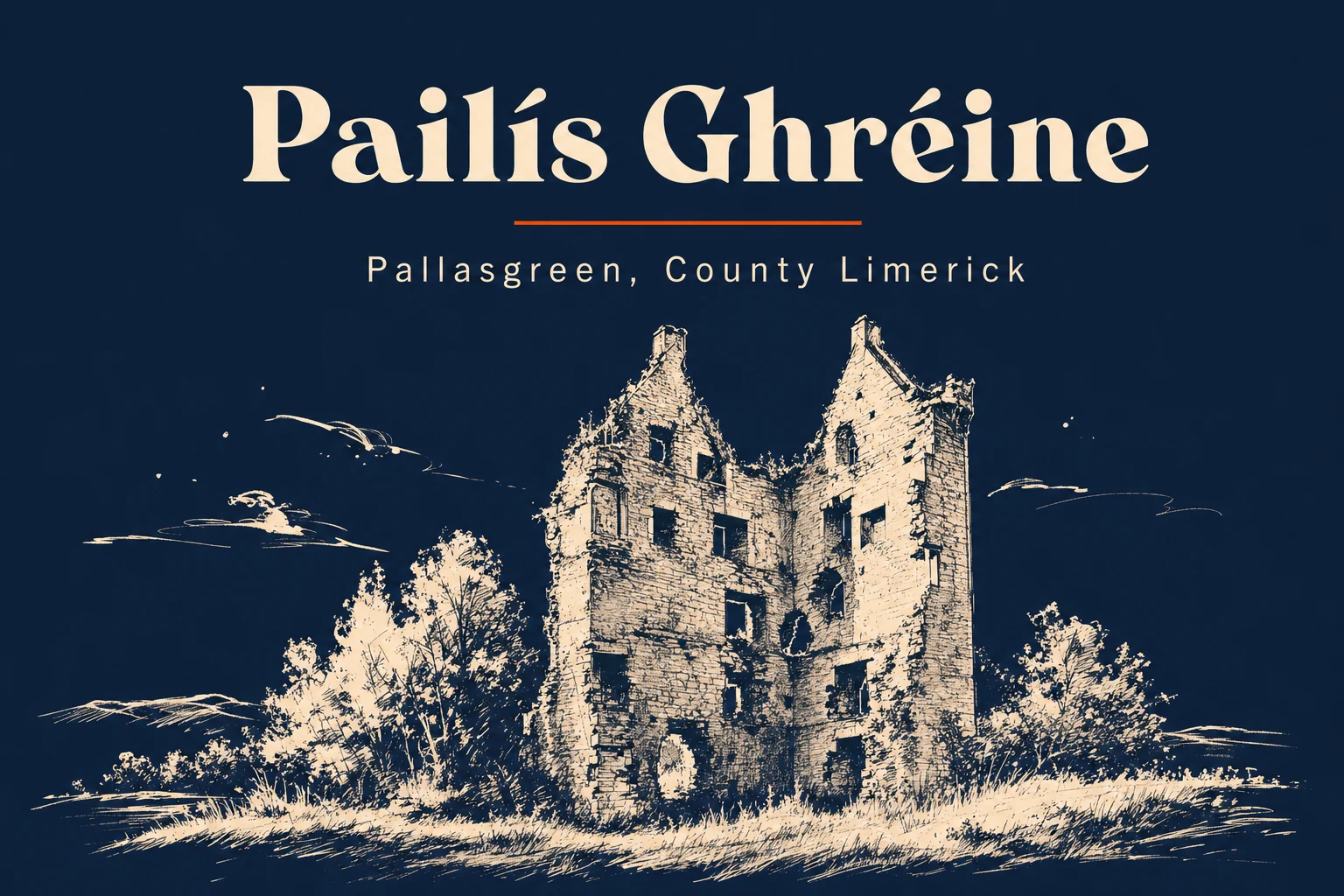
Pailís Ghréine · Co. Limerick
A working village on the Limerick-Waterford road, named for a love goddess and ringed by old volcanoes.
Pallasgreen - Pailis Ghreine, the stockade of Grian - sits in east County Limerick on the N24, the old Limerick to Waterford road, about twenty kilometres southeast of the city. It is a roadside farming village in the proper sense: it grew along a through-route, and the trade of passing traffic plus the dairy and tillage country around it have kept it in services that a village of two hundred and twenty-nine people would not otherwise hold. There is no lake, no abbey, no visitor centre. There is a working main street and a name with a goddess in it.
The name is the most interesting thing about it. Grian was an old Irish goddess of love, and tradition put her home on the Hill of Nicker, a couple of kilometres north - the highest of a small group of carboniferous volcanoes, long extinct, that give this corner of Limerick a faintly odd, humped topography you do not get elsewhere. The village proper was on the map by 1831 as a constabulary post with sixty-two thatched houses and a sub-post office to Limerick and Clonmel. The railway came through in 1848 and a station stood here until it closed; the trains still run on the line but they do not stop.
What the village has now is the ordinary furniture of a Munster farming community: four pubs, a butcher, a service station, a post office, a couple of mechanics, two hairdressers, a chipper and a Chinese takeaway. The GAA club, founded in 1887, plays in blue and gold like Tipperary six miles up the road, and pulls its players from Pallasgreen, Old Pallas, Nicker and Barna. If you stop here it is for a pint, a feed, a tank of diesel, or because you wanted to stand under a hill where a love goddess was supposed to live. All three are legitimate reasons. The village does not pretend to be more than it is.