County Longford Ireland · Co. Longford · Edgeworthstown Save · Share
POSTED FROM
EDGEWORTHSTOWN
CO. LONGFORD · IE

Edgeworthstown
Meathas Troim

STOP 09 / 09
Meathas Troim · Co. Longford

Where Maria Edgeworth wrote. A literary town with a walled garden and no pretence.

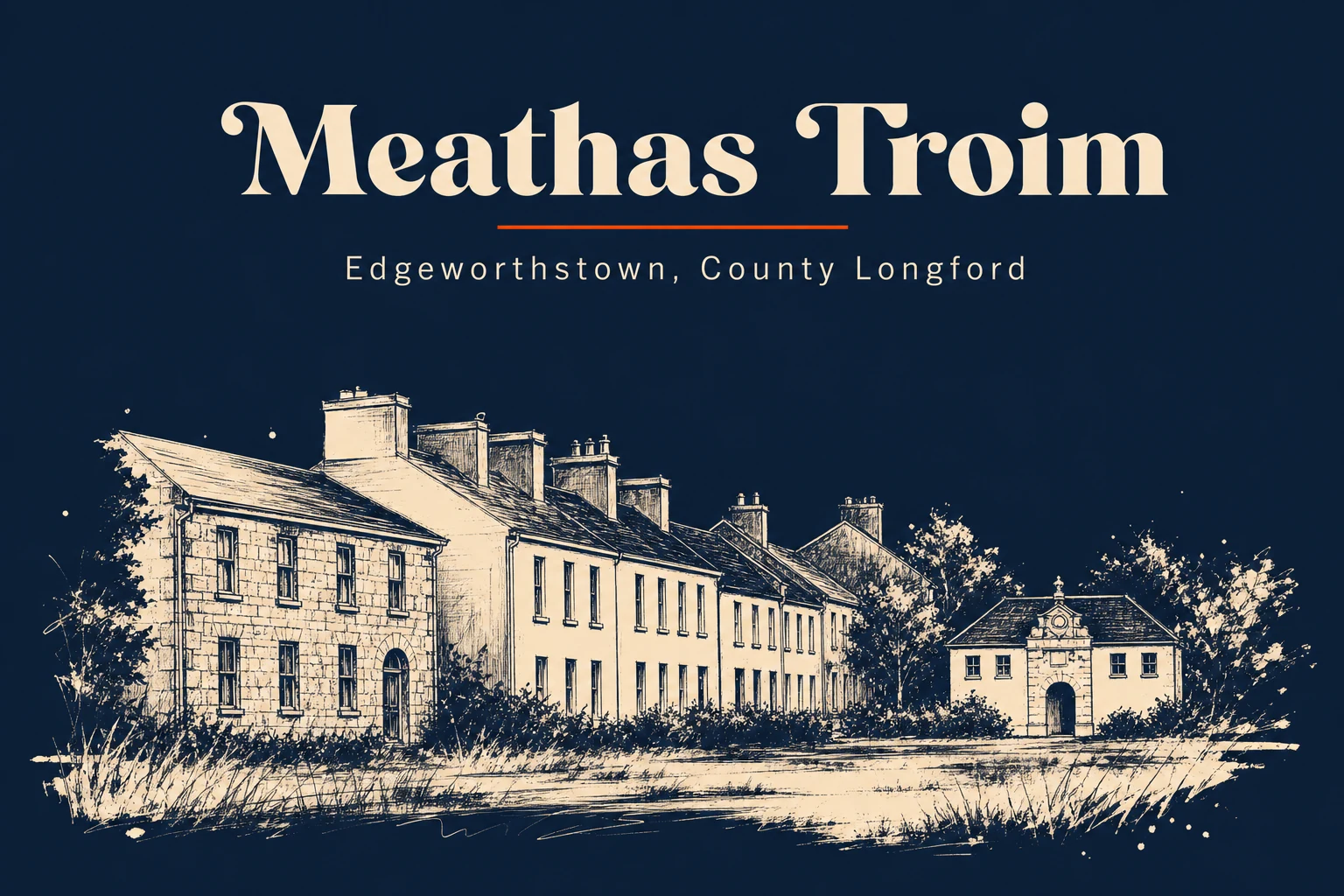
Edgeworthstown is a working town, not a theme park. The Edgeworth name haunts it with literature — Maria Edgeworth wrote Castle Rackrent here in 1800 and spent most of her 81 years in this place. But the town is not obsessed with her. There is a centre, open to scholars and readers. There is a garden, open to walkers. The rest is just a market town that happens to hold a novelist.

Richard Lovell Edgeworth arrived in the 18th century and built a house. Maria was born in Oxon but raised here, educated by her father in a style that was unusual and deliberate. She became one of the first realist writers — not gothic heroines and duels, but actual people running actual estates, making actual mistakes. She watched the town and the estate and she wrote what she saw.

The house is now a nursing home. The visitors who come are usually looking for the manuscripts or the facts. The town offers both. But it also offers something the guidebooks do not mention: a place where something real was made, and the ground has not been relaid since.

Population
~2,100
Pubs
8and counting
Walk score
Town and gardens in 30 minutes
Founded
Settled by the Edgeworth family in the 18th century
Coords
53.3833° N, 7.6833° W
01 / 09

At a glance.

Three things every local will eventually mention. Read these and you've already understood more than most day-trippers do.

02 / 09

The pubs.

None of these are themed Irish pubs, because they don't need to be. A few that earn the trip:

The Imperial Bar & Restaurant

Mixed ages, food
Pub & restaurant

The heart of the town, with food that is not an afterthought. The bar side is quieter than you might expect for a market town on the Sligo line.

Goldsmith Inn

Local, steady
Pub

A proper pub, not themed. The kind of place where a stranger is asked politely where they are from and why.

Gorman's Lounge Bar

Locals
Pub

Quiet most days, busier on Fridays. The sort of place you find because you know someone who knows someone.

03 / 09

Where to eat.

PlaceTypeLocal note
The Imperial Bar & Restaurant Pub restaurant €€ Soups, chowders, local beef. Not fancy. Works.
Edgeworthstown cafes (Maria Edgeworth Centre area) Café The centre and town square have basic café options. Good for a coffee after touring the gardens or the centre.
04 / 09

Where to sleep.

PlaceTypeLocal note
Smith's B&B Bed & breakfast On the Bracklin Road, family-run, breakfast included. A quiet base if you are staying for the literary trail or the Edgeworth Centre.
Railway Lodge B&B Bed & breakfast On Ballymahon Road, rural setting, close enough to walk to pubs if inclined. Warm welcome described by the owners as "authentic and family-run".
Park House Hotel Hotel The hotel option in town. Basic comfort, reasonable rates. Useful if you want a restaurant on premises.
05 / 09

Stories & lore.

The reason to come back. The things every local will eventually tell you about, usually after the second pint.

The novel that changed Irish writing

Castle Rackrent

Published in 1800, Castle Rackrent is told by the estate steward of a failing Irish landlord family — four generations of Rackrens who mismanage, gamble, litigate and ruin themselves. It was Ireland seen from inside, not from a distance. No sentiment. No gothic frills. Just actual people. The book sat in the circulating libraries of London, and readers did not know how to read it because they had never read anything like it before. Maria Edgeworth wrote it here, in this house, in this town, watching a society she knew inside-out.

Built by Richard Lovell, lived in by Maria

The Edgeworth house

Richard Lovell Edgeworth arrived in County Longford in the 18th century and built a house. He was a writer and inventor himself, and an unusual father — he educated his children (including Maria) in his own methods. Maria was born in Oxon in 1768 but came here as a child and never really left. She lived here for 81 years, wrote here, managed the estate with her father and then alone, and died here in 1849. The house is now a nursing home. It is not open to tourists. But the ground it sits on is still the ground where she worked.

The manuscripts and the scholar work

The Maria Edgeworth Centre

Housed in what was the old national school building — built in 1840 and believed to be the oldest remaining purpose-built national school in Ireland — the centre holds manuscripts, letters, books, and objects spanning centuries. It is not a museum in the tourist sense. It is a working archive. Scholars come. Readers come. The centre runs Monday to Friday 9 a.m.–5 p.m. and Saturday 10 a.m.–2 p.m. The annual Edgeworth Literary Festival runs each May and brings contemporary and historic writers to the town.

The ground the Edgeworths walked

The walled garden

The walled garden survives, accessible year-round during daylight hours. It is part of the literary trail. No café. No shop. Just the garden and the time to walk through it and think about the fact that this is the same ground where a novelist who changed English prose spent her days. That simplicity is the whole point.

06 / 09

Things to do outside.

Wear waterproofs. Bring a sandwich. Tell someone where you're going if it's the mountain.

Edgeworth Literary Trail Starting at the Maria Edgeworth Centre, the trail takes you through the town, past the house (viewable from outside), through the walled garden, and past the parish church where she is buried. Easy ground. No special equipment needed. Go slow. The point is not the distance.
2 km loopdistance
45 minutes to 1.5 hourstime
Walled Garden walk The garden itself, year-round. Daylight hours. The path is clear but old. The point is to move slowly and notice what was chosen to plant here, and what has survived since.
1 kmdistance
30–45 minutestime
Town to Edgeworth House approach Walk from the town square toward the house. You cannot enter it, but the approach shows you the setting. Then turn back and find a pub.
1 km from the squaredistance
15 minutestime
07 / 09

When to go.

There is no bad time. There are different times.

Spring
Mar–May

The garden wakes up. The literary festival runs in May. Weather is unpredictable but the light is clear.

◉ Go
Summer
Jun–Aug

Warm and long evenings are real. The centre is open late. But it is also when most visitors arrive, such as they are.

◐ Mind yourself
Autumn
Sep–Oct

Settled weather. The literary season. Fewer tourists. The town is most itself.

◉ Go
Winter
Nov–Feb

Quiet. Cold. The kind of time when sitting in a pub with a book makes sense. Edgeworthstown in winter is a place for readers.

◉ Go
08 / 09

What to skip.

Honestly? Don't bother.

If a local was sitting beside you, this is the bit where they'd lean in.

×
Expecting Edgeworthstown House to be open to the public

It is a private nursing home now. The Edgeworth Centre and the walled garden are the places to go. The house itself is best viewed from the approach road.

×
Looking for a big literary museum or gift shop

This is not that kind of town. The centre is a working archive, not a tourist centre. There is no shop. Go to the centre if you want to research. Go to the garden if you want to walk. Do not come expecting a branded experience.

+

Getting there.

By car

Longford town is 15 minutes north (N4). Dublin is 90 minutes south on the N4. The town is on the main Dublin–Sligo route.

By bus

Bus Éireann and local services connect to Longford town. From Longford, local buses to Edgeworthstown. Less frequent than the train.

By train

The Dublin–Sligo line stops at Edgeworthstown. Dublin Connolly is 90 minutes. Sligo Mac Diarmada is 60 minutes. Up to 12 trains daily in each direction. The station is a 5-minute walk from the town square.

By air

Shannon Airport is 1.5 hours south. Dublin Airport is 2 hours. Knock (Ireland West) is 1.5 hours west. The train from Dublin is usually the practical option.