County Mayo Ireland · Co. Mayo · Ballina Save · Share
POSTED FROM
BALLINA
CO. MAYO · IE

Ballina
Béal an Átha

The Wild Atlantic Way
STOP 02 / 06
Béal an Átha · Co. Mayo

Where the Moy opens into Killala Bay — a salmon river town that knows what it is.

Ballina — Béal an Átha, "mouth of the ford" — is Mayo's largest town and has been since it learned to live with the Moy. The river runs through the centre, widens as it approaches the sea, and turns the lower town into a working fishing hub. Boats still go out. Boats still come back in. The town adjusts itself around that rhythm without fuss.

You need to know: Ballina is not trying to be a destination on its own. It is the county seat, a functioning market town, and the gateway. The Moy itself is the draw — it's one of Ireland's storied salmon rivers and Riddles bar on the bridge has the particular atmosphere of a place where someone across the table might have just landed a 20-pound fish. The town runs to this. North of Ballina — five kilometres — is Killala, where a French general landed with an army in 1798. South and west is the North Mayo coast: Downpatrick Head with its sea stack and blowhole, Céide Fields where neolithic farmers left their field walls under the bog five thousand years ago. Ballina is the hinge.

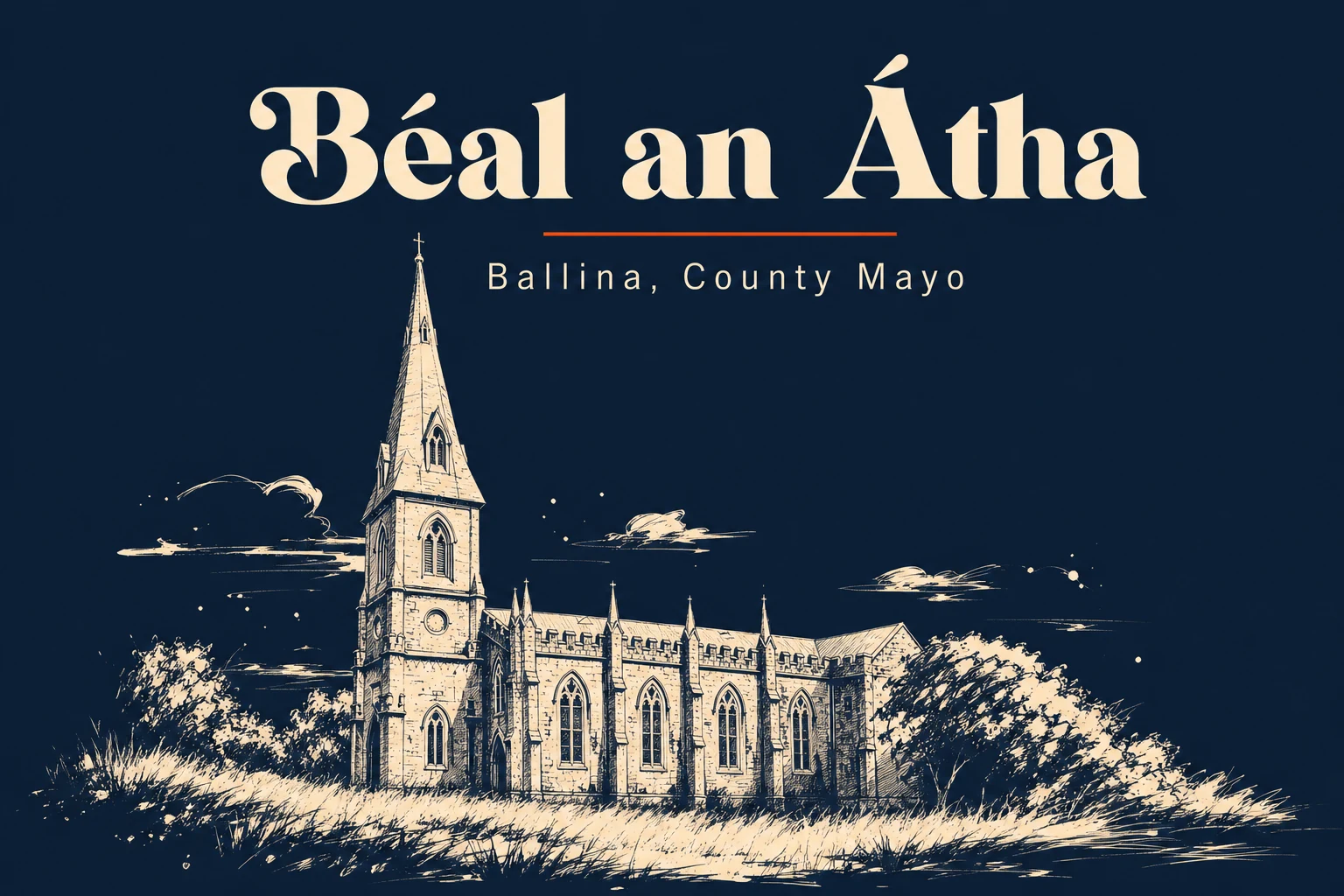
Belleek Castle sits on the river edge on the town's west side — now a hotel and restaurant, once the seat of the Coclans. The cathedral — St Muredach's, limestone Gothic from 1831 — anchors the upper town. The Jackie Clarke Collection, one of the country's finest private archives of historical documents and political memorabilia, sits quietly in a converted townhouse and is free to walk in. None of these are trying to be attractions. They are just what Ballina contains.
Population
~10,500
Pubs
28and counting
Walk score
Bridge Street to cathedral in ten minutes
Founded
Medieval (mouth of the ford)
Coords
54.1145° N, 9.1571° W
01 / 09

At a glance.

Three things every local will eventually mention. Read these and you've already understood more than most day-trippers do.

02 / 09

The pubs.

None of these are themed Irish pubs, because they don't need to be. A few that earn the trip:

Riddles Bar & Restaurant

Anglers, locals, fishing talk
Riverside pub & food

On the bridge over the Moy. The working pub for the river trade — wet anglers, boat talk, the particular quiet of people who spend their day waiting. A pint and a view of the water that matters.

The Humbert Inn

Stories, reliably good
Pub & restaurant

Named for General Humbert who marched through here in 1798. Solid, no fuss, food done without apology. The bar staff know the town by sight.

McGing's Bar

Locals, steady
Traditional pub

Off the main drag. The pub for a quiet pint and the paper. They know who the fish are running and who caught what this week.

O'Rourke's

Mixed, music nights
Town-centre pub

Music nights come seasonally. A solid mainstream pub — you'll find the full width of Ballina in here on a Saturday.

Belleek Castle Bar

River view, quieter
Hotel bar

In the castle grounds on the river edge. Less frantic than the bridge pubs. Useful if you want the atmosphere without the fishing-chat volume.

03 / 09

Where to eat.

PlaceTypeLocal note
The Broken Jug Restaurant €€€ Off Pearse Street. Local reputation, sourced-produce cooking, wine list that suggests thought. Book a few days ahead in summer.
Belleek Castle restaurant Fine dining €€€ In the castle grounds. More formal, river views, the kind of meal where the plates are arranged and the service explains itself. Non-residents welcome; book ahead.
Riddles Bar & Restaurant Pub food €€ The bridge pub. Fish when it's available — catch of the day with respect paid to it. Chowder is the chowder.
Lacken Café Daytime café Soup, sandwiches, the kind of coffee people move cities for. Breakfast and lunch only. Closes mid-afternoon.
Regan's of Ballina Deli & takeaway Proper sandwiches built to order, salads, baked goods. Eat it on a bench by the Moy if the weather holds.
04 / 09

Where to sleep.

PlaceTypeLocal note
Belleek Castle Hotel Historic hotel On the river edge west of town. Eighteen-century castle, modern rooms, the grounds are the selling point. The restaurant is its own destination. You are paying for the building as much as the bed.
Ice House Hotel Riverside hotel On the Moy quay, built in and around an actual ice house — the building dates to 1807. Design-forward. The restaurant overlooks the river. Fishing parties book here for the proximity to the boats.
Mount Falcon Estate Country house hotel A few kilometres outside town on the river. Georgian house, fishing lodge vibe, river access. More retreat than town stopover. Book the fishing package if the salmon are running.
Ballina Manor House B&B B&B Town-centre location, family-run, breakfast worth the room rate. Walking distance to pubs and the bridge.
05 / 09

Stories & lore.

The reason to come back. The things every local will eventually tell you about, usually after the second pint.

The French landing, 1798

Humbert's march

In August 1798 a French general named Jean-Joseph-Amable Humbert landed at Killala with 1,000 soldiers and marched inland to support the United Irishmen uprising. He came through Ballina and got as far as Collooney in Co. Sligo before being cut off by a British force and forced to surrender. The rebellion lasted ninety days. Humbert was paroled and went home to France. The soldiers who followed him were not — many were executed. The Humbert Inn on Bridge Street marks the moment. The Rising's failure was total. Its effect on Irish history was not.

A private archive in a townhouse

The Jackie Clarke Collection

Jackie Clarke, a Ballina-born politician, spent decades assembling one of the finest private collections of Irish historical documents — political papers, manifestos, prints, letters from every significant moment of the last 250 years. The collection runs from the 1798 Rising through Pearse, the Civil War, the Land War, the civil rights era. When Clarke died the collection nearly dispersed. Instead it was gifted to the people and a heritage centre was established in his townhouse on the main street. Entry is free. The range of what you can walk in off the street and see is quietly extraordinary.

The cathedral stones

St Muredach

St Muredach's Cathedral sits on the upper town and is built from grey limestone in Gothic style — 1831, designed by a Dublin architect, seat of the Bishop of Killala. The building is bigger than the town needs and that is the point. It was built as a statement during the Catholic Emancipation — a declaration that the faith that had been suppressed was returning. The stones are cold. The light through the windows at evening is particular. Walk in, sit at the back, be unreligious if you like. The building does not require faith of you.

The river trade

Salmon in the Moy

The Moy is one of the northeast's greatest salmon fisheries. The season runs April to September and anglers come from Britain, France, Scandinavia — wherever people care about fly-fishing. The river holds wild Atlantic salmon — fish that have migrated thousands of kilometres and will fight you for an hour over a pool. The town adjusts for this. Boat hire, ghillies, tackle shops, restaurants that know the word "catch." Riddles has been the meeting point for a century. You do not need to fish to see the ecosystem working.

06 / 09

Things to do outside.

Wear waterproofs. Bring a sandwich. Tell someone where you're going if it's the mountain.

Downpatrick Head Twelve kilometres north. A sea stack 50m high with a blowhole that pounds when the swell is heavy. The cliff path loops around and down — grass underfoot, vertigo views, the ocean deciding what volume it wants to be. Do it in clear weather; cloud takes away most of the reason.
2.5 km loopdistance
1–1.5 hourstime
Dolmen of the Four Maols Six kilometres north on the road toward Killala — then walk. A neolithic megalith, 500 BC or older, five standing stones. The fields around are working farmland. You will likely be the only person here.
1.5 km returndistance
45 mintime
Céide Fields circuit Fifteen kilometres north. The oldest known field system in the world — neolithic farmers laid out stone walls around 3500 BC, then bog grew up over the top and preserved them. The visitor centre explains what you are seeing. A walk that takes you 5,000 years into the past and leaves you standing in a farmer's field.
5 kmdistance
2–3 hourstime
River Moy waterside walk Along the river from the bridge in town, upstream. Flat, easy, the working fishery beside you. Boats, birds, the particular quiet of moving water. End at Belleek Castle grounds if you want the walk to end somewhere with coffee.
3–4 kmdistance
1 hourtime
07 / 09

When to go.

There is no bad time. There are different times.

Spring
Mar–May

Salmon season is opening. The Moy is clearing from winter. Anglers are back in Riddles. North Mayo coast — Downpatrick Head, Céide Fields — is empty and green.

◉ Go
Summer
Jun–Aug

The town works fine but it is working weather — warm, busy enough for the restaurants and pubs to be staffed, fish moving through the river in daylight hours. The coast gets walkers.

◐ Mind yourself
Autumn
Sep–Oct

The locals' season. Salmon running hard into September. The light over the Moy and out toward Killala Bay is the angle you came for. Pubs back to their own rhythms. Downpatrick Head in Atlantic swell is worth the drive.

◉ Go
Winter
Nov–Feb

The town does not shut — it is a working place — but the fishing slows, the restaurants thin, the coast in January is for people who came on purpose. The river is high and serious.

◐ Mind yourself
08 / 09

What to skip.

Honestly? Don't bother.

If a local was sitting beside you, this is the bit where they'd lean in.

×
Viewing Ballina as a day-trip from Westport or Achill

If you drive through in an hour you have missed the point. The town works on river time — sit in Riddles for an evening, walk the Moy at dawn, eat a proper dinner. That is the Ballina experience.

×
The Moy in high water without a ghillie

The river can be big and brown and unforgiving. If you are fishing, hire a local who knows the pools. If you are walking, pick a calm day when you can see what is happening.

×
Planning Downpatrick Head in cloud

The point of the sea stack and the blowhole is the vertical. In cloud you are walking in fog on a cliffside. Come back when the sky clears.

×
Showing up at Belleek Castle Hotel without a booking

Eighteen-century building, restaurant with reputation, limited rooms. Showing up on spec is a wasted trip down the castle drive. Book days ahead.

+

Getting there.

By car

Westport is 50km south — 50 minutes. Castlebar is 35km south — 40 minutes. Dublin is 210km via the M4/N5 — 2h 45m. Sligo is 80km via the N59 — 1h 20m.

By bus

Bus Éireann 22 (Dublin–Westport) stops in Ballina. Local services run to Killala, Bangor Erris, and smaller villages. Check rural frequency.

By train

Nearest stations are Westport (50km) and Castlebar (35km). No direct train to Ballina. Then bus or taxi.

By air

Ireland West Airport (NOC) at Knock is 70km — about 1 hour. Dublin is 2h 45m. Shannon is 2h 30m.