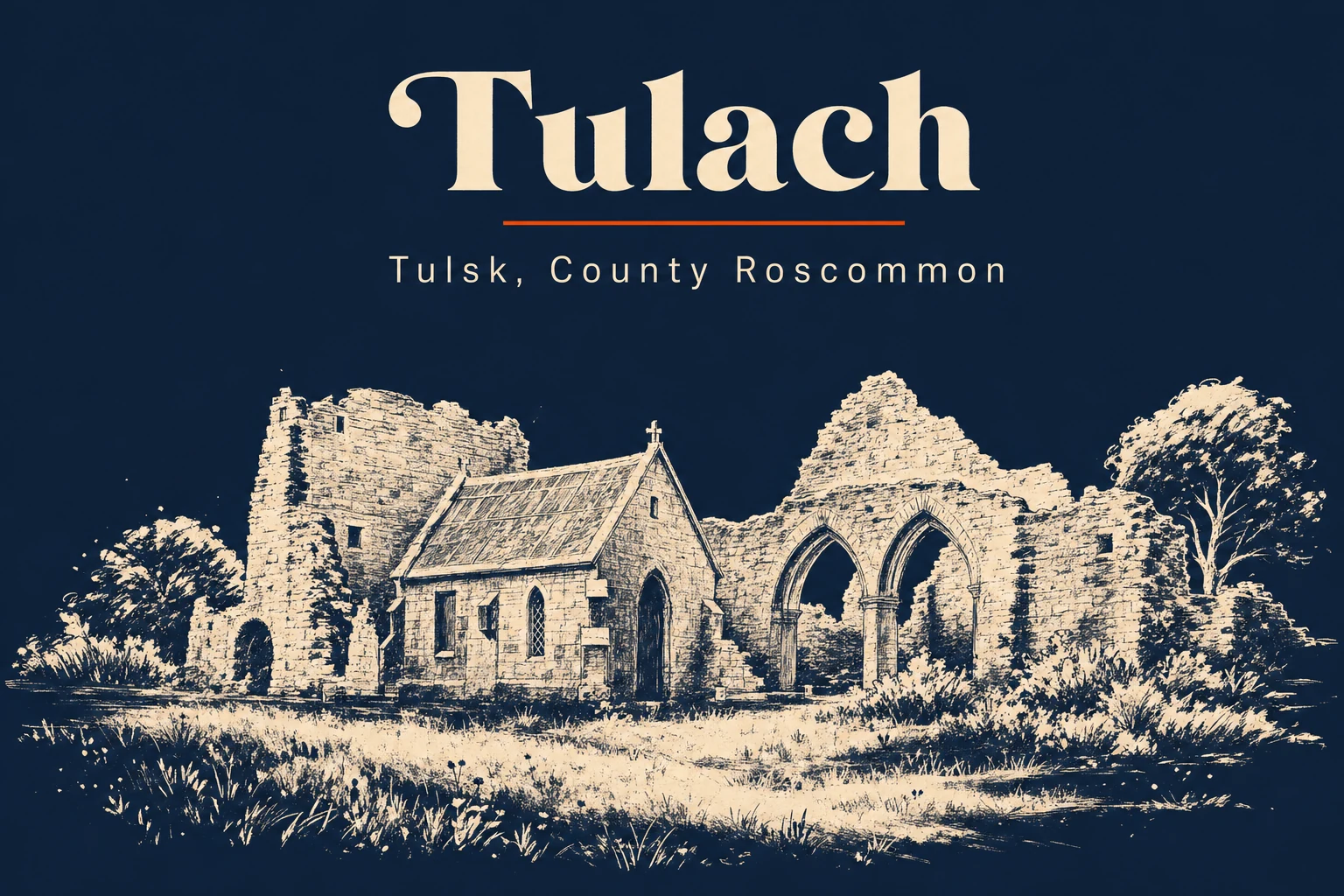
Tulach · Co. Roscommon
Tiny village beside Rathcroghan - an ancient royal seat and one of Europe's largest unexcavated archaeological complexes.
Tulsk is a tiny village of about 100 people near Rathcroghan (Cruachan), the ancient royal seat of Connacht. The landscape around Rathcroghan is one of the most significant archaeological sites in Ireland and Europe - over 240 monuments across 6 square kilometres. National Geographic describes it as 'Europe's largest unexcavated royal complex.'
The site is best known as the royal seat of Queen Maeve (also spelled Medb), the legendary Queen of Connacht. The Táin Bó Cúailnge - the Cattle Raid of Cooley - one of Ireland's great epics and a cornerstone of Irish literature, begins and ends here. The myth is rooted in actual landscape. You can stand where the story says Queen Maeve stood.
The Cruachan Aí Visitor Centre at Tulsk offers modern interpretation of the site - exhibitions, guided tours, artefacts. The visitor centre holds Óenach Cruachain, a collection of 35 artefacts discovered in the Roscommon landscape that were previously held in the National Museum of Ireland and not accessible to the public. You can walk the landscape - Rathcroghan Mound, Oweynagat (the Cave of the Cats, described as Ireland's 'gate to hell' in medieval literature) - and connect the physical site to the mythological narrative.