County Sligo Ireland · Co. Sligo · Toorlestraun Save · Share
POSTED FROM
TOORLESTRAUN
CO. SLIGO · IE

Toorlestraun
Tuar Loistreáin, Co. Sligo

The Wild Atlantic Way
STOP 07 / 07
Tuar Loistreáin · Co. Sligo

A market village for dairy farmers in south Sligo, better known across the county for its football club than anything you can photograph.

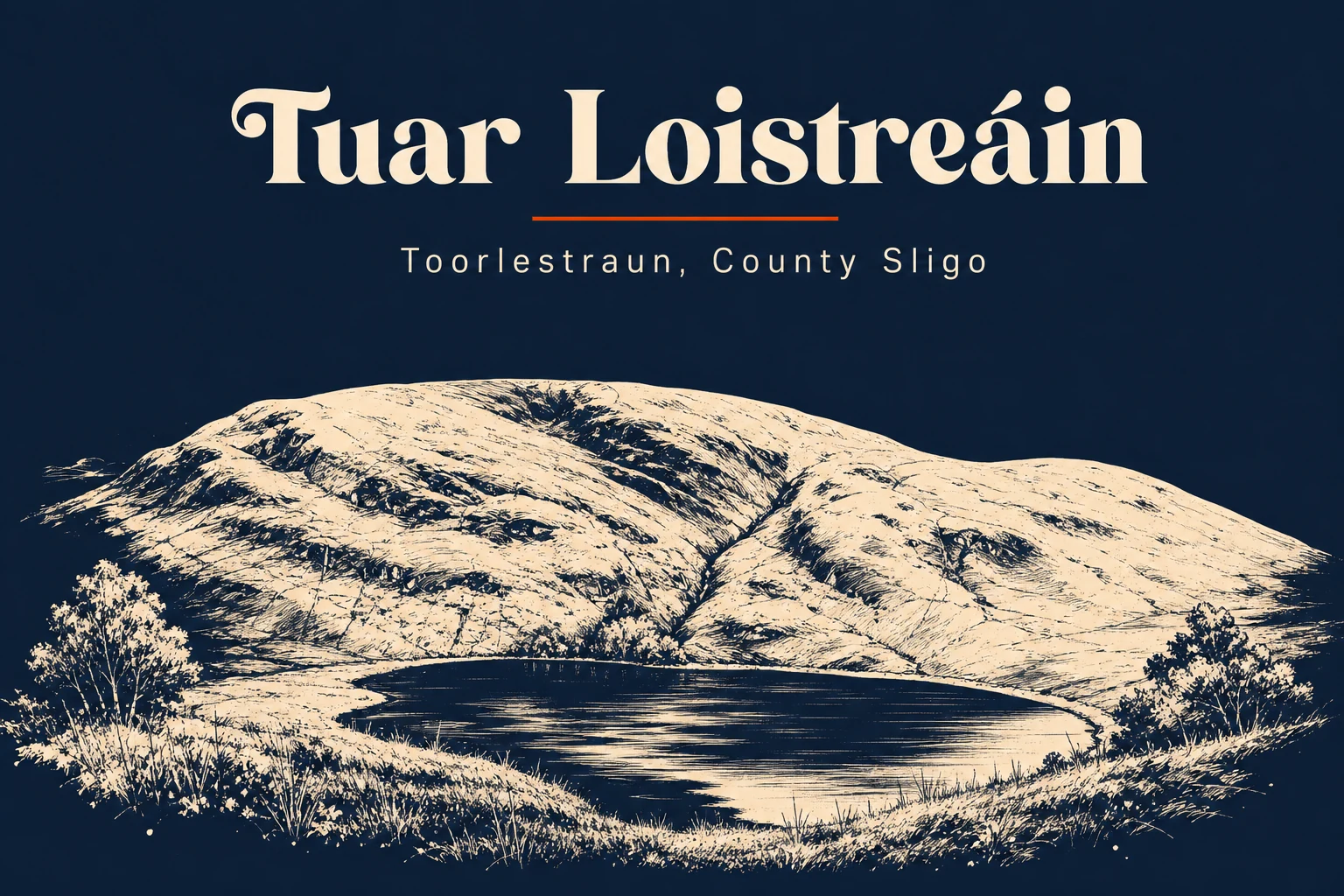
Toorlestraun - more often written Tourlestrane locally - is a small village in the parish of Kilmactigue in deep south-west Sligo, close to the Mayo border. The Irish, Tuar Loistreáin, is usually read as the green field of the scorching or burning. It is the smaller of the parish's two main villages, Aclare being the larger, with Banada the third settlement and an older monastic name than either.

The village core is the kind you drive through without noticing: the parish church of St Attracta, a school, the GAA grounds, a scatter of houses. It has long been a market centre for the dairy farmers of the surrounding townlands rather than a place that set out to be looked at. There is no signposted attraction, no heritage car park, no visitor centre. Set your expectations to a working rural parish and you will not be disappointed.

What carries Toorlestraun's name around the county is football. Tourlestrane GAA is one of the most successful clubs in Sligo, and the seven county titles in a row between 2016 and 2022 - capped by a run to the Connacht club final - put a village of a few hundred people on the provincial map. If you want to understand the place, a championship Sunday tells you more than any guidebook.

Treat it as part of a south Sligo and Ox Mountains loop rather than a stop in its own right. The headwaters of the Moy system drain this country, Lough Talt sits up in the hills to the north-west, and the Sligo Way long-distance trail begins at the lake. Use Tubbercurry or Sligo town as your base and come out here for the road, the hills and, if one is on, a session in a parish pub.
Population
Rural parish village, a few hundred in the wider Kilmactigue parish
Walk score
A church, a GAA pitch, a school and a handful of houses
Founded
Parish church records begin c. 1845; the Kilmactigue parish is far older
Coords
54.0397° N, 8.8425° W
01 / 07

At a glance.

Three things every local will eventually mention. Read these and you've already understood more than most day-trippers do.

02 / 07

Stories & lore.

The reason to come back. The things every local will eventually tell you about, usually after the second pint.

The parish patron

St Attracta and the dragon

The parish patron is St Attracta, an early Irish saint associated with this corner of Sligo and Roscommon, and the parish church in Toorlestraun carries her name. Local tradition has her defeating a dragon or serpent that was killing farmers' livestock - the kind of cattle-country miracle a dairy parish would keep alive. The Catholic parish of Kilmactigue, in the Diocese of Achonry, runs three churches: St Attracta's here in Toorlestraun, the church in Kilmactigue, and the church of the Sacred Heart at Lough Talt. Parish registers begin around 1845, which is early for rural Ireland and a help to anyone tracing south Sligo roots.

Eighteen Sligo titles, seven in a row

Tourlestrane GAA

For a village this size the football record is hard to credit. Tourlestrane GAA has taken the Sligo Senior Football Championship eighteen times, with first wins back in the 1950s and a modern dynasty of seven consecutive titles from 2016 to 2022 - in 2022 reaching the Connacht club final, the club's high-water mark in the provincial championship. Eamonn O'Hara, who played senior inter-county football for Sligo and represented Ireland in the International Rules series against Australia, came out of the club and later managed it. A south Sligo parish of a few hundred people does not produce a record like that by accident; the football here is the spine of the community.

An Augustinian friary, founded 1423

Banada Abbey

A few minutes from the village, on the west bank of the Moy at Banada, stand the ruins of an Augustinian friary founded in 1423 by Donnchadh O'Hara of the local ruling family. Dedicated to Corpus Christi, it was the first house of the Observant reform movement in the Augustinian order in Ireland - a real footnote in Irish church history for so quiet a place. It was dissolved around 1613, the friars lingered locally for generations after, and much of the building finally collapsed in 1897. What survives - chancel walls and carved limestone fragments among the graves - sits in Banada graveyard. There is no formal visitor setup; it is a ruin in a country churchyard, which is exactly why it is worth the small detour.

A 15th-century clan fight in the townland name

Clooncagh, the meadow of the battle

The neighbouring townland of Clooncagh carries the Irish Cluain Chatha, the meadow of the battle, remembering a fifteenth-century fight between warring clans in this country. There is nothing signposted to see - the story lives in the placename and the local memory - but it is a reminder that the quiet south Sligo back roads were contested Gaelic ground long before they were dairy farms.

03 / 07

Things to do outside.

Wear waterproofs. Bring a sandwich. Tell someone where you're going if it's the mountain.

Lough Talt loop A roughly two-hundred-acre lake set in the foothills of the Ox Mountains, a short drive north-west of the village. A waymarked path of about 5.5 km runs the perimeter. Brown trout and perch in the water, and it holds the threatened Arctic char and the critically endangered European eel, so it is a quietly important little lake as well as a pretty one. The most reliable proper walk in the parish.
5.5 km loopdistance
1 hour 15 minutestime
The Sligo Way (western trailhead) The Sligo Way, the county's main waymarked long-distance trail, starts at Lough Talt on the Sligo-Mayo border and runs roughly 80 km east along the line of the Ox Mountains to Dromahair in Leitrim. You do not have to walk the lot. The first stretch out of Lough Talt gives you the feel of the Ox ridge for an hour or two before you turn back to the car.
About 80 km in totaldistance
Multi-day; or a short out-and-backtime
Ladies Brae and the Ox Mountain drive Not a single walk so much as a scenic drive up into the Ox Mountains with stops to stretch the legs. The winding minor roads climb to the viewing points at Ladies Brae; nearby Lough Achree is reputed to be the youngest lake in Ireland, said to have formed in an earthquake around 1490. Best on a clear day - in low cloud you will see the inside of a hedge and little else.
Drive with road-walkingdistance
Half a daytime
04 / 07

Tours, if you want one.

The ones below are bookable through our partners - pick one that suits, or skip the lot and just turn up.

We earn a small commission when you book through our tour pages. It costs you nothing extra and keeps the village hubs free. All Co. Sligo tours →

05 / 07

When to go.

There is no bad time. There are different times.

Spring
Mar-May

Bog and hill roads drying out, the Ox ridge greening, the Lough Talt loop at its best.

◉ Go
Summer
Jun-Aug

Long evenings for the lake and the hills. The South Sligo Summer School in nearby Tubbercurry in mid-July spills sessions out across the parishes.

◉ Go
Autumn
Sep-Oct

Championship football season for Tourlestrane GAA, and the light on the Ox Mountains at its best.

◉ Go
Winter
Nov-Feb

Short days, exposed back roads, hill weather. The reasons to be here mostly close down until spring.

◐ Mind yourself
06 / 07

What to skip.

Honestly? Don't bother.

If a local was sitting beside you, this is the bit where they'd lean in.

×
Treating Toorlestraun as a destination

It is a working parish village with no signposted attraction. The reasons to come are the Ox Mountains, Lough Talt and the Sligo Way on its doorstep - not the village itself.

×
Expecting anything open on spec

This is a small rural parish. Do not assume a pub, a shop or the church will be open when you arrive. If you want a session or a meal, the larger towns of Tubbercurry and Swinford are the safer bet.

×
The back roads in poor light

The roads in from Tubbercurry and up to Lough Talt are narrow, twisty and unlit. After dark, slow right down - farm traffic and sheep do not.

+

Getting there.

By car

Sligo town to Toorlestraun is about 50 minutes via the N17 and the south Sligo back roads. Tubbercurry is around 25 minutes east, Aclare a few minutes north-east, and Foxford in Mayo about 25 minutes west.

By bus

Sparse. Bus Éireann route 479 links the village to Sligo via Coolaney and Collooney on Fridays only. Otherwise a car is effectively essential.

By train

No station. The nearest railheads are Sligo MacDiarmada and Foxford (Mayo) on the Dublin to Westport line, both well over half an hour away.

By air

Ireland West Airport Knock (NOC) is roughly 25 to 30 minutes by car.