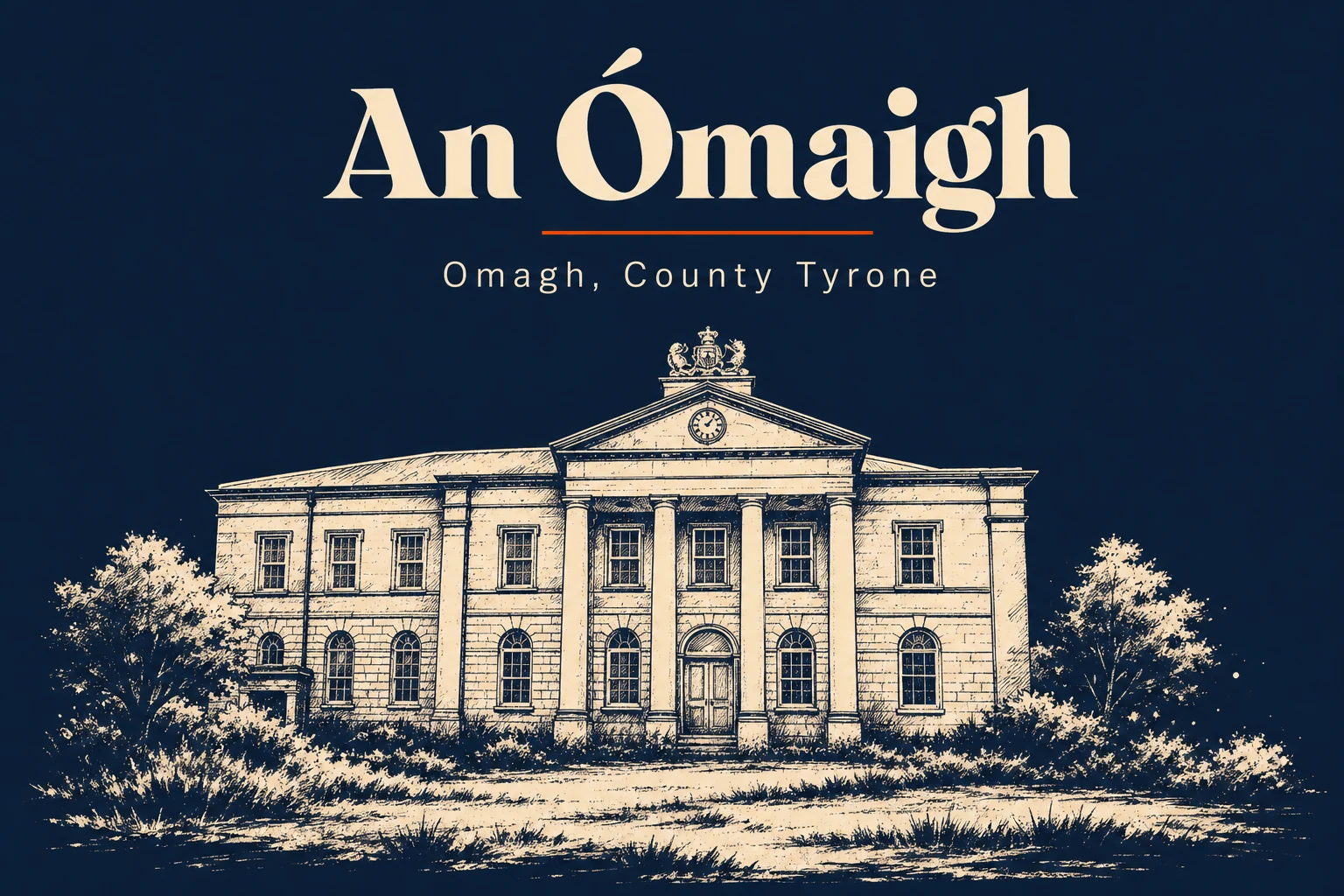
An Ómaigh · Co. Tyrone
Three rivers meet here, and the town has been carrying a weight since 1998 that no town should have to carry.
Omagh sits in a bowl of drumlin country where the Drumragh and Camowen rivers come together to form the Strule. The town climbs uphill from that confluence - the High Street, the Georgian courthouse, the Sacred Heart Church with its twin Gothic spires that have dominated the skyline since construction began in 1892. It replaced Dungannon as county town of Tyrone in 1768, and for most of its history it was the kind of place that administered a county without drawing much attention to itself.
That changed on 15 August 1998. A Real IRA car bomb detonated on Market Street at 3.10 in the afternoon, a Saturday, the town full of back-to-school shoppers. Twenty-nine people died - from Omagh, from Buncrana, from the Republic, from Spain, including a woman pregnant with twins. It was the single deadliest atrocity of the Troubles. Three weeks later a thirtieth victim, Seán McGrath, died of his injuries. The bombing came fourteen weeks after the Good Friday Agreement was signed, which is part of what made it so brutal to absorb.
The town didn't collapse. The memorial in the Garden of Light on Drumragh Avenue, unveiled on the tenth anniversary in 2008, is quiet and considered - a reflecting pool, silver birch trees, a heliostat mirror that tracks the sun. The glass obelisk on Market Street marks the exact spot. The town has rebuilt itself around the memory rather than under it. It still has the feel of a working county town - a market, a courthouse, a GAA stadium, pubs that fill on a Saturday night.
The Ulster American Folk Park is five kilometres north on the Castletown Road and is genuinely worth a morning. It tells the story of emigration from Ulster to America through full-scale reconstructed buildings - a pre-Famine cottage, a dockside streetscape, a ship's hold. The Sperrins start a few kilometres east. Gortin Glen Forest Park is twenty minutes up the road.