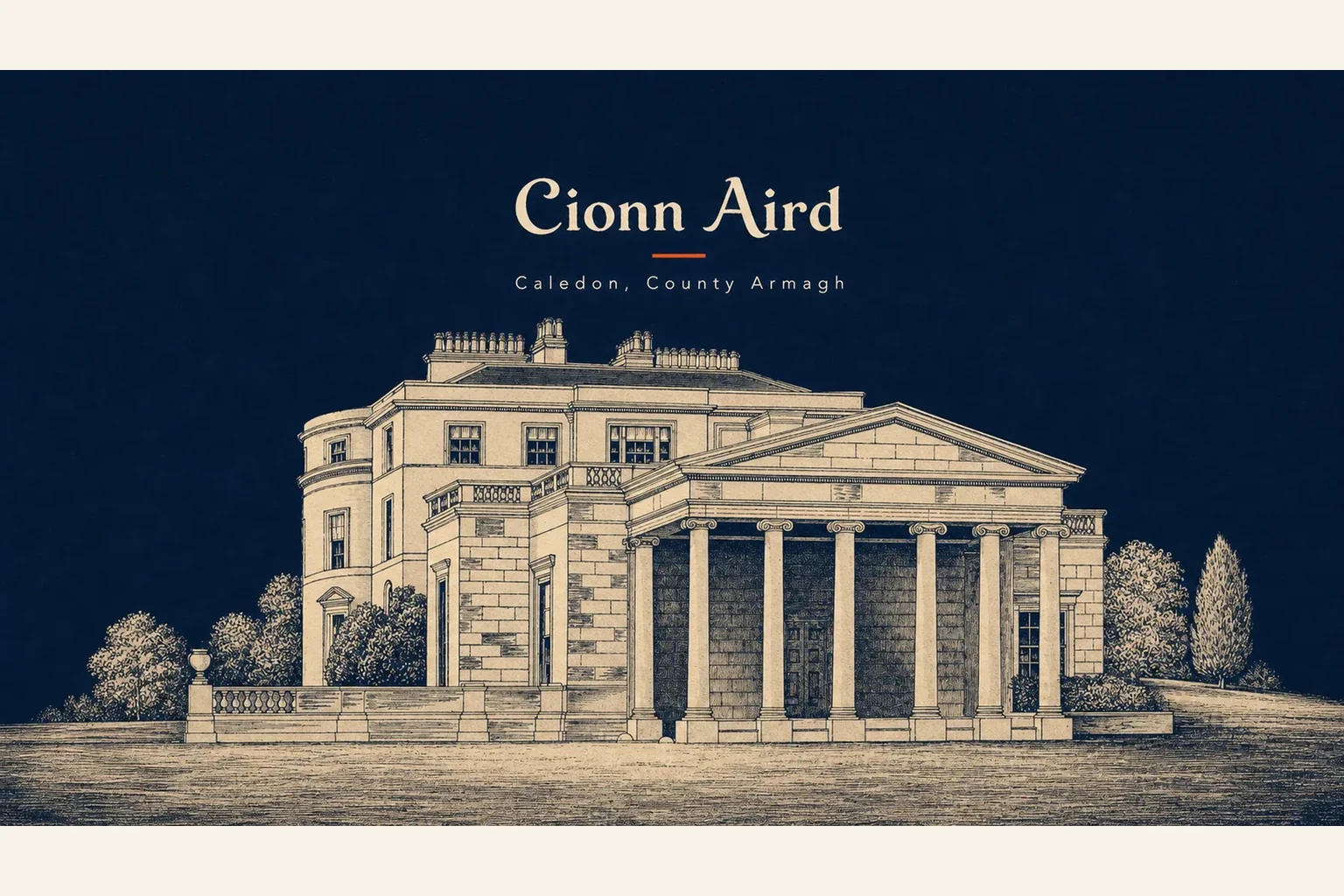
Cionn Aird · Co. Armagh
An estate village on the Blackwater, where 1968 cracked something open.
Caledon is a planned estate village strung along the Blackwater, which here is the county boundary. The Alexander family - Earls of Caledon since 1800 - laid the streets, built the courthouse, the market house, the cottages, the gates. They still live behind the wall. You won't be invited in.
What's left for you is the village itself, which is small and intact and unusually well-kept for somewhere this far off any tourist road. Conservation area since 1984. Eighteenth- and nineteenth-century stone buildings up Main Street. The gate piers to the demesne sit at the end of the village like a full stop.
And then there's the other thing. In June 1968, a young nationalist MP named Austin Currie occupied a council house at Kinnard Park to protest its allocation - a single 19-year-old, Protestant, secretary to a unionist candidate, given the keys ahead of Catholic families with children. He was thrown out the same afternoon. Two months later there was a march in Dungannon, then Derry in October, then everything that followed. People come to Caledon for the architecture. The rest of the story is here too, on a quiet residential street, with no plaque.