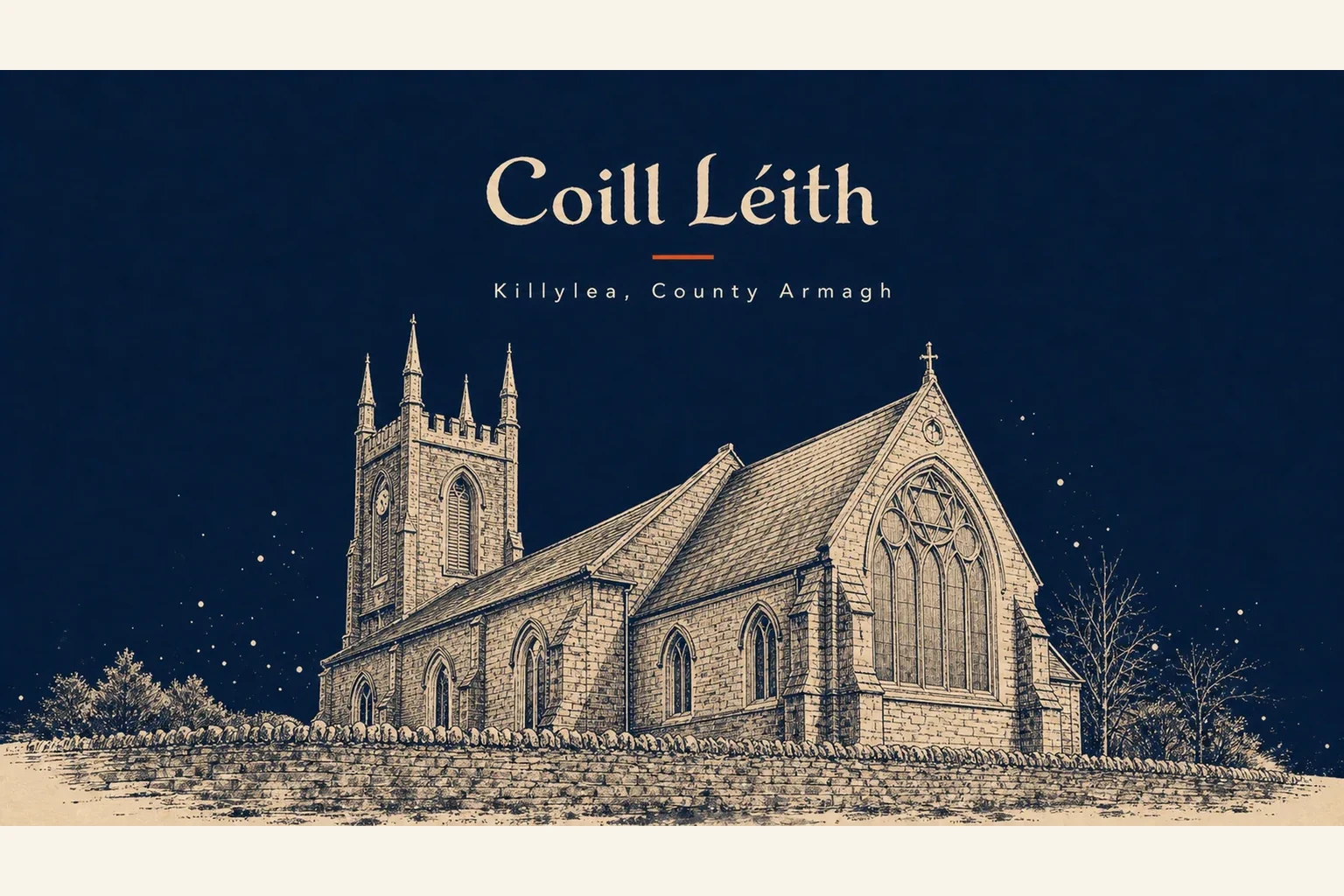
The church at the top, 1832
St Mark's on the hill
Killylea was carved out of the parishes of Armagh, Tynan and Derrynoose. St Mark's Church of Ireland was built at the highest point of the village in 1832 and the parish has run from there ever since. Today it's joined with Caledon and Brantry as a grouped parish under the Diocese of Armagh. The graveyard is small and quiet. The view from the gate looks east across drumlin country toward Armagh city. The Methodist congregation built its own church at the foot of the hill and the two have shared the village without fuss for the best part of two centuries.
Ulster Railway to GNR to nothing
The railway that ran the line
The Ulster Railway opened Killylea station on 25 May 1858 as part of its extension west toward Clones. The company merged into the Great Northern Railway in 1876, and for the next eighty years the line carried passengers and goods between Armagh, Tynan & Caledon, Glaslough, Monaghan and Clones. The Northern Ireland government forced the closure of the GNR's lines through Armagh on 1 October 1957. Killylea shut on 14 October. The track was lifted, the station was demolished, and the village's connection to the wider network became — and remains — a bus.
Killylea, Middletown, Tynan village
Tynan parish
Killylea sits inside the historic civil parish of Tynan, which also takes in Middletown to the south-west and Tynan village itself a couple of miles further on. The parish was historically dominated by the Stronge family of Tynan Abbey — a grand house burnt out in 1981 — and the neighbouring Caledon estate of the Earls of Caledon, just over the Tyrone border. Most of the land around Killylea was rented from one estate or the other through the nineteenth century. The estate walls are still there. The big houses are not what they were.