County Armagh Ireland · Co. Armagh · Milford Save · Share
POSTED FROM
MILFORD
CO. ARMAGH · IE

Milford

The Ireland's Ancient East
STOP 08 / 08
Milford · Co. Armagh

Victorian linen village two miles south of Armagh, and the place that gave football the penalty kick.

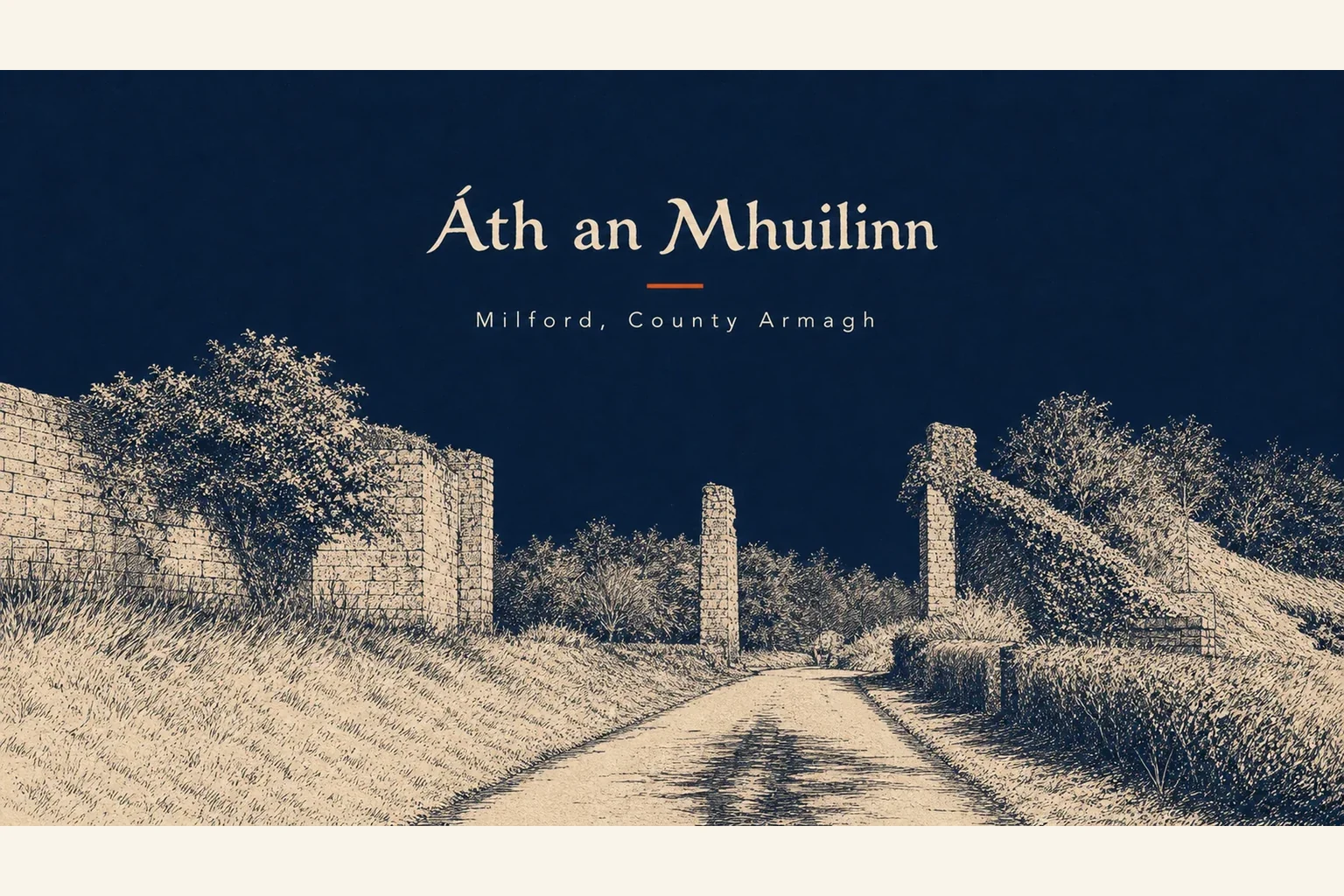
Milford sits two miles south of Armagh city on the River Callan, and on the map it looks like nothing — three streets of terraced houses, a Victorian mansion in the trees, a small park. Stop the car and the story opens up. This is a planned linen village, drawn on a piece of paper by Robert Garmany McCrum in the middle of the 19th century and built around the family's mill. At its peak it was the largest linen factory in Ireland. Houses, school, church — all McCrum.

And one resident of that village changed the world's most popular game. William McCrum, born here in 1865, played in goal for Milford FC in the first season of the Irish League. The team finished bottom — fourteen games, ten goals scored, sixty-two conceded, zero points. From the end he was defending, he watched defenders cynically hack down forwards bearing in on goal, and he wrote to the Irish FA proposing a new rule: a direct shot from twelve yards, keeper alone. The IFAB adopted it in 1891. He's buried in the churchyard a short walk from where he lived.

The mill kept spinning until the 1980s. The factory came down in 1996 and the site was cleared for housing by the early 2000s. What's left is the bones — the terraces, Milford House in its woodland, the William McCrum Park up in the Linen Green estate (laid out, with a straight face, in the shape of a goalpost). Come for an afternoon, take the house tour, walk the village. It's small. It punches a long way above its weight.

Population
~600
Walk score
Three terraces, a big house and a park — 15 minutes
Founded
1808 (McCrum corn mill); model village laid out c. 1850s–60s
Coords
54.3239° N, 6.6822° W
01 / 08

At a glance.

Three things every local will eventually mention. Read these and you've already understood more than most day-trippers do.

02 / 08

Where to eat.

PlaceTypeLocal note
Milford House Afternoon Tea Heritage tea room ££ Silver service in the Victorian drawing room of the McCrum family home. Booking essential — 028 3752 5467. Pairs naturally with the house tour. The setting is the point.
03 / 08

Where to sleep.

PlaceTypeLocal note
Stay in Armagh city Hotels & B&Bs, 5 minutes north Milford itself has no hotel. The city is two miles away — Charlemont Arms in the centre, Armagh City Hotel on the outskirts, plus B&Bs. Drive or walk in.
04 / 08

Stories & lore.

The reason to come back. The things every local will eventually tell you about, usually after the second pint.

1890

William McCrum and the penalty kick

William McCrum was born in Milford in February 1865, only son of the linen millowner R. G. McCrum. Educated at the Royal School Armagh, then Trinity College Dublin (graduated 1886). He played in goal for Milford FC in the first season of the Irish League — 1890/91. Milford finished rock bottom: 14 games, 10 scored, 62 conceded, zero points. From behind that defence he watched professional fouling — defenders dragging down attackers because the only sanction was a free kick from where the foul happened. He proposed something cleaner: if you deliberately foul inside a defined area near the goal, the attacking team gets a direct shot from twelve yards with only the keeper to beat. He sent it to the Irish FA in 1890. They sent it to the International Football Association Board. The IFAB adopted it for the 1891/92 season. It's been in the Laws of the Game ever since. McCrum is buried in the local churchyard.

Linen, 1808 — 1980s

McCrum, Watson & Mercer

The mill started as a corn mill in 1808, built by the first William McCrum on the Callan. His son Robert Garmany — known as RG — converted and expanded it into a linen-finishing operation trading as McCrum, Watson & Mercer. By the second half of the 19th century it was, by repeated local accounts, the largest linen factory in Ireland, and a properly modern one: Milford House was one of the earliest houses in the country to be lit by hydroelectric power, with electricity generated off the river. People came from Armagh at night just to see the lit avenue. RG died in 1915. His son William inherited the village and half the business; the Wall Street Crash of 1929 finished off what the post-war linen slump had started. William died in December 1932, aged 67. The mill kept going under other hands until the 1980s, and the chimney finally came down in 2001.

The big house in the woods

Milford House

Built around 1850 at the edge of the village in mature woodland, Milford House was the McCrum family home for three generations and later served as Manor House School. It now operates as the Milford House Collection — guided tours of the McCrum rooms, the artworks, the family papers, and a sideline in silver-service afternoon tea in the Victorian drawing room. Open weekends and bank holidays from April to September, 2pm to 6pm, last tour at 5. Adults £4.50, concessions £3.50. Group tours and costumed Victorian re-enactments by arrangement. Booking essential.

In the Linen Green estate

William McCrum Park

The modern housing estate built on the old factory ground is called Linen Green, and somebody had the sense to lay it out in the shape of a goalpost, with William McCrum Park as the centrepiece. The park was opened by Gerry Armstrong — Northern Ireland's 1982 World Cup goalscorer against Spain. There's a memorial to McCrum and his invention. Always open, free, a quiet spot to stand and think about how a man whose team conceded 62 goals in 14 matches ended up changing football.

05 / 08

Things to do outside.

Wear waterproofs. Bring a sandwich. Tell someone where you're going if it's the mountain.

The old Milford railway line The branch line ran from 1909 to 1932 and the trackbed behind Milford House has been reclaimed as a wildlife corridor — rare orchids, butterflies in summer. Flat, easy, quiet.
~3 km returndistance
1 hourtime
The model village Walk the three original terraces, past Milford House gates, through Linen Green to William McCrum Park. The whole Victorian plan reads on the ground. Read the McCrum memorial in the park.
1 kmdistance
20 minutestime
Milford to Armagh city Quiet country road north into Armagh — the two cathedrals appear over the rooflines on the way in. Pleasant on a dry day. Bus back if the legs go.
~3 km one waydistance
40 minutestime
06 / 08

When to go.

There is no bad time. There are different times.

Spring
Mar–May

House reopens in April. Orchids start showing on the old railway line.

◉ Go
Summer
Jun–Aug

Best window for the house tour — full opening hours, butterflies on the line, long evenings.

◉ Go
Autumn
Sep–Oct

House open into September. Woodland around Milford House turns. Quietest visiting time.

◉ Go
Winter
Nov–Feb

Milford House Collection is shut. The park, the line and the streets are still walkable — that's the visit.

◐ Mind yourself
07 / 08

What to skip.

Honestly? Don't bother.

If a local was sitting beside you, this is the bit where they'd lean in.

×
Showing up at Milford House on a Tuesday in November

It only opens weekends and bank holidays, April to September, 2pm–6pm. Off-season tours by prior arrangement only. Phone first.

×
Looking for the mill

It's gone. Closed in the 1980s, demolished in 1996, the rest cleared by the early 2000s. The Linen Green housing estate sits on the footprint. The story is in the houses and the park, not the rubble.

×
Expecting a pub crawl

Milford is a tiny residential village. For pubs you're going to Armagh city, two miles north. That's a five-minute drive.

+

Getting there.

By car

Two miles south of Armagh city on the Milford / Tassagh road. Five minutes from the Mall. Belfast is about 45 minutes via the A3 and M1.

By bus

Translink Ulsterbus services run from Armagh Buscentre toward Keady and Newtownhamilton via Milford — check timetables, they're infrequent.

By train

No station. The Milford branch line closed in 1932. Nearest mainline is Portadown, about 20 minutes by car.

By air

Belfast International (BFS) about 60 minutes up the M1. Dublin Airport about 90 minutes south.