The reason to come back. The things every local will eventually tell you about, usually after the second pint.
Born 4 November 1932
Tommy Makem
Tommy Makem was born here on 4 November 1932 and grew up in a house full of songs — his mother Sarah knew over five hundred of them by heart. He emigrated to the United States in 1955, met the Clancy brothers in New York, and through the 1960s the four of them in their Aran jumpers became the most famous Irishmen in America. He wrote "Four Green Fields" in 1967, "Gentle Annie", "The Winds Are Singing Freedom" and a long list more. He died in New Hampshire on 1 August 2007. He always called Keady the hub of the universe. Liam Clancy sang "The Bard of Armagh" at the funeral.
The source singer
Sarah Makem
Sarah Makem (1900–1983) is the more important figure to anyone who works in traditional song. She was a source singer — that is, an unschooled carrier of the unbroken oral tradition — and what came out of her kitchen in Keady was recorded by Sean O'Boyle, Peter Kennedy, Diane Hamilton, Jean Ritchie and Alan Lomax. Her 1951 recording of "As I Roved Out" became the signature tune of the BBC's long-running radio programme of the same name. She was, by all accounts, mortified to be hearing herself broadcast across the country every week.
A town built for its mill-owner
The Kirk Monument
The granite-and-freestone monument at the junction of Market, Kinelowen, Davis and Bridge Streets was put up in 1871, paid for by the people of Keady themselves, in memory of William Kirk (1795–1870). Kirk owned the big linen mills at Darkley and Annvale. He was a Liberal MP, a Presbyterian, a campaigner for religious equality, and he built houses, schools and a small hospital for the people who worked his looms. The villagers buried him in the family vault at Second Keady Presbyterian and then commissioned the engineer Fitzgibbon Louch to design the obelisk. There aren't many Irish towns that built a memorial to their factory-owner. Read into that what you will.
Forty mills on two rivers
Linen and water
Keady's geography is a wet one — the Callan and the Clea drop fast off the south Armagh hills — and Englishmen with money saw it in the 1750s. By 1837 there were spinning mills at New Holland and Darkley employing 780 people (mostly young women), a fine-linen manufactory at Ballier with another 2,500, and bleach-greens at Anvale, Greenmount, Dundrum, Ballier, Millview, Darkley and Linenvale finishing 235,000 pieces of cloth a year for the English market. Forty mills along the two rivers in total. Most of the buildings are gone or are sheds for tractors now; the dams and the mill-races are still there if you walk for them.
A bridge from a railway that closed
Tassagh Viaduct
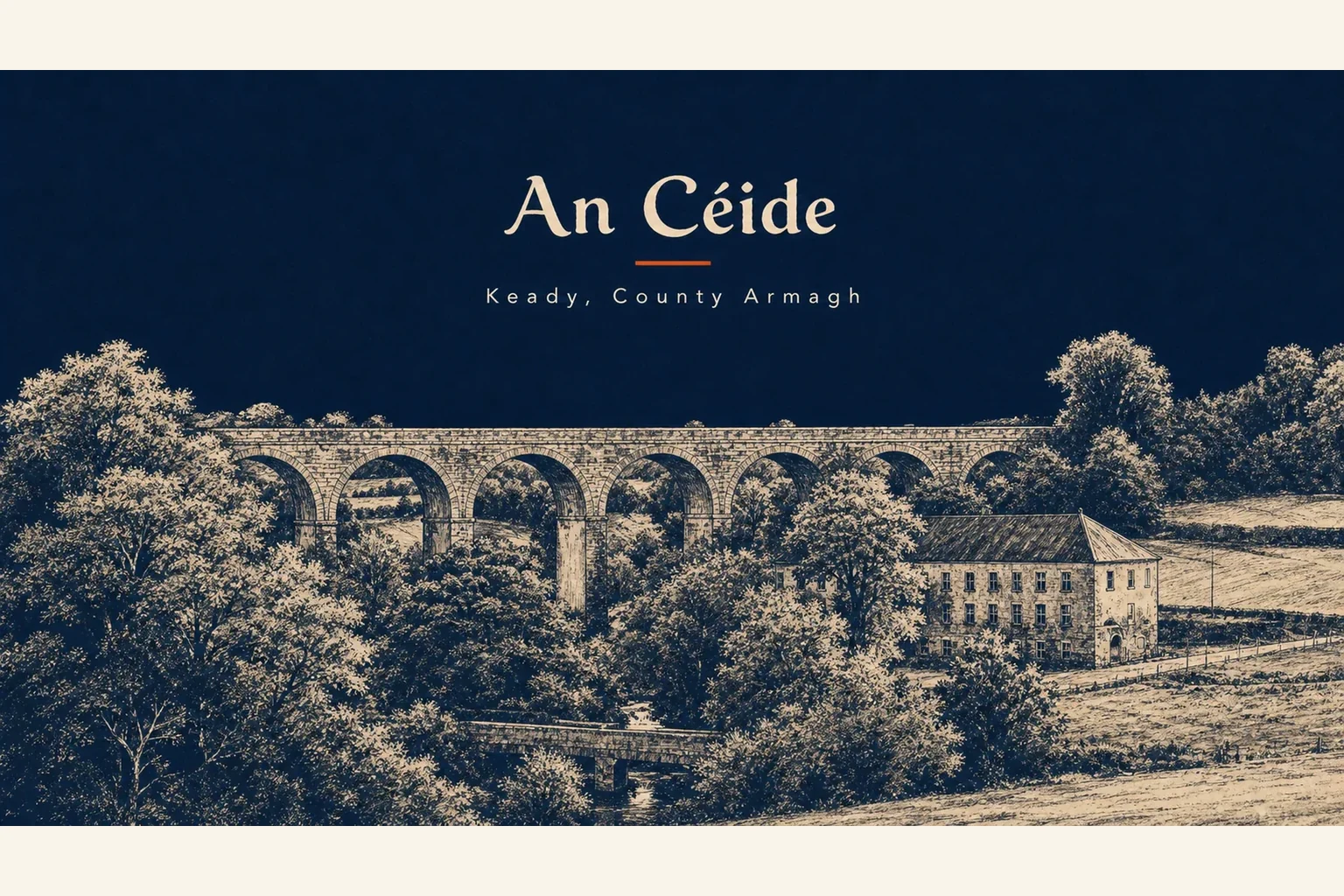
Two miles north of the town the eleven brick arches of the Tassagh Viaduct stride across the Callan valley. Designed by Sir Benjamin Baker — the same engineer who built the Forth Bridge in Scotland — it carried the Castleblayney, Keady & Armagh Railway from 1910. The Armagh-to-Keady section had opened a year earlier, in 1909. Five hundred thousand bricks. 174 metres long, 24 high. The line closed in 1957 and the viaduct was listed in 1976. Now it sits in a field above the river, no track, no trains, all the engineering and none of the point — which is a fine thing to walk to in the evening.
Where the linen went
The Town of Tailors
Where there is linen, sooner or later there are tailors. In the late nineteenth and early twentieth centuries Keady was known up and down Ulster as the Town of Tailors — at the peak there were around a hundred and twenty of them in and around the town, every street with a workshop, the linen coming in off the bleach-greens a mile away. The trade declined after the first war as ready-to-wear took over. The last tailor still on the books is Hugh McElvanna on Main Street — opened 1968, London Diploma in Tailoring on the wall, in-house alterations still done.
Built in 1860, bigger than it looks
St Patrick's Church
The Catholic parish church on the hill above the town was built in 1860 and is one of the largest churches in the Archdiocese of Armagh by seating capacity. Gothic, T-shaped after the 1989 extension, with a three-stage square bell tower, corner pinnacles and crenellation. From the square it doesn't look extraordinary; from inside it surprises you. Worth ten quiet minutes if the doors are open.
One of the first GAA clubs in Armagh
Keady Michael Dwyer's
Keady Michael Dwyer's GFC was founded in 1888 — a year before the Armagh county board itself existed — making it one of the original Armagh clubs. Plays at Gerard McGleenan Park. The hurling sister club, Keady Lámh Dhearg, came along in 1949. Football is the dominant code, as everywhere in Armagh. A Sunday match in the Intermediate Championship will tell you who is in town that weekend.