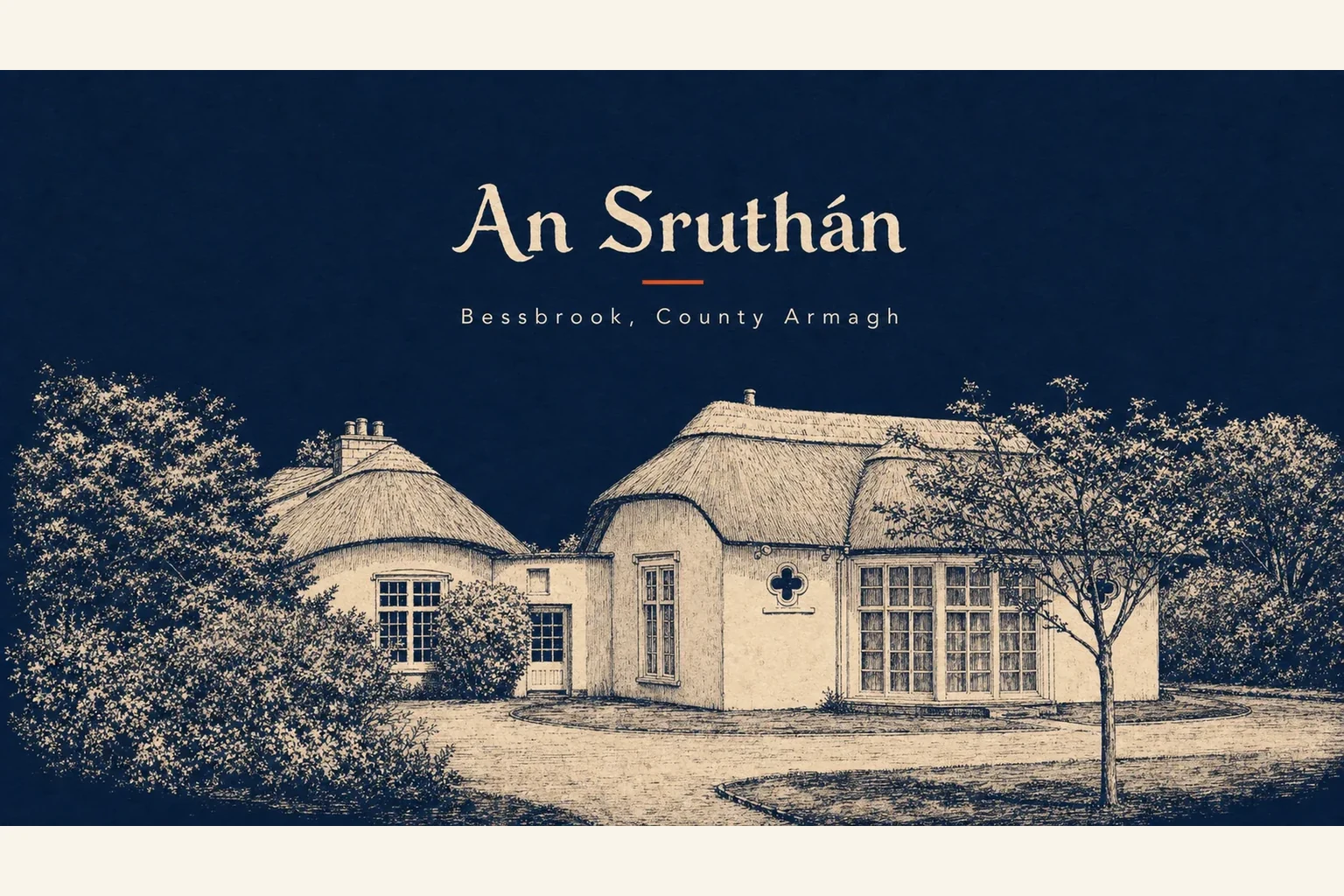
An Sruthán · Co. Armagh
A Quaker model village that built houses, schools and a church - and no pubs. Still none.
Bessbrook is the village a Quaker linen merchant drew on a piece of paper in 1845 and then built. John Grubb Richardson bought the mill, hired the workforce, and wrapped granite terraces around two squares - College Square and Charlemont Square - with a school, a dispensary, a meeting house, and homes for nearly three thousand workers. He left out three things on purpose: a public house, a pawn shop, and a police station. His logic was a chain: no pub means no debts, no debts means no pawnbroker, no pawnbroker means nothing for the police to do. Bournville in England copied the idea thirty years later and got famous for it. Bessbrook did it first.
The pubs never arrived. Nearly two centuries on, you still can't get a pint inside the village boundary - the nearest is in Camlough up the road, or back into Newry. The mill spun linen until 1972 and then stood empty until the British Army took it over and turned it into the busiest military heliport in Europe. For thirty years Lynx and Wessex and Puma helicopters lifted off the mill yard every few minutes, day and night, ferrying troops down to Crossmaglen and Forkhill. They stopped in 2007. The village heard the difference.
What's left is the bones of the original plan - the granite, the squares, the meeting house from 1864, the line where the tramway ran. Down the road, Derrymore House sits in its demesne with the room where the Act of Union was drafted in 1800. It's a small village with a strange amount of history per square metre, and it doesn't make a fuss about any of it.