County Louth Ireland · Co. Louth · Dundalk Save · Share
POSTED FROM
DUNDALK
CO. LOUTH · IE

Dundalk
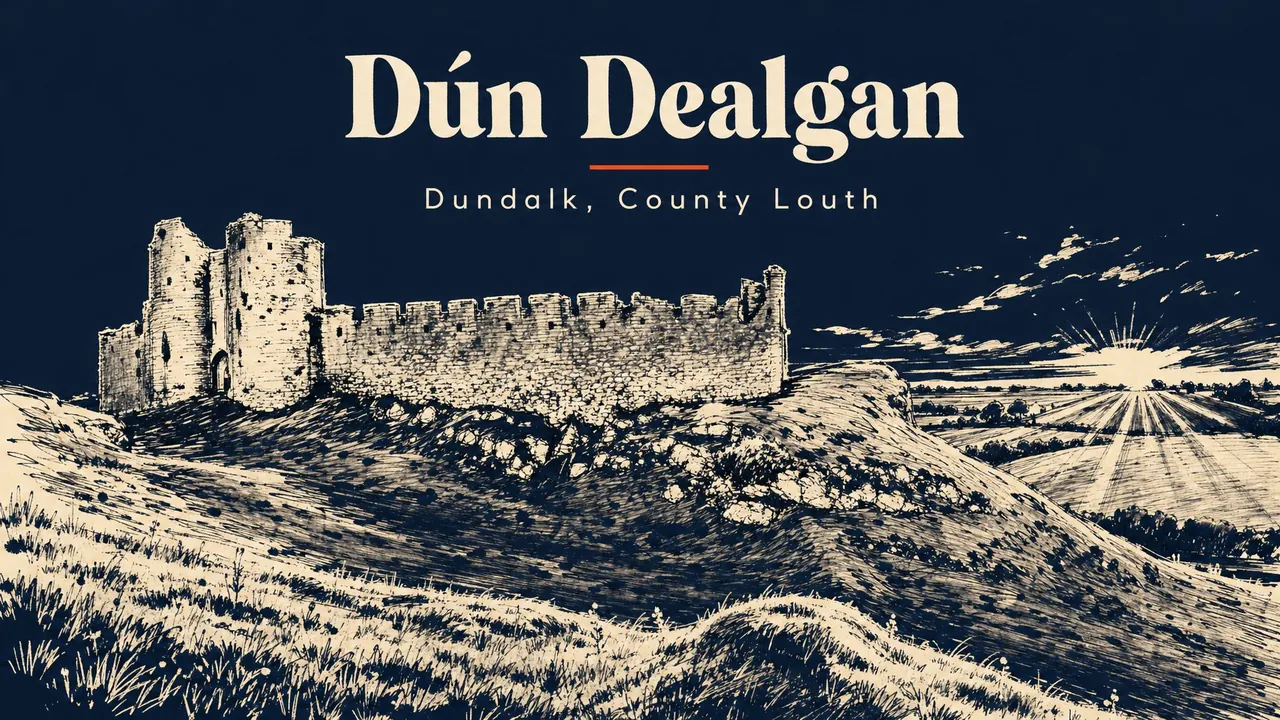
Dún Dealgan

The Ireland's Ancient East
STOP 01 / 05
Dún Dealgan · Co. Louth

Cú Chulainn's home town, the last big stop before the border, and a county town that knows what it is.

Dundalk is not Carlingford, and that is its point. Forty-three thousand people, an industrial past, a working main street, a third-level institute, and a football team that has won the league five times in the last decade. It is the county town of Louth, a Pale frontier turned border town, and the first or last big stop on the M1 depending on which way you are driving.

The Normans built it. Bertram de Verdun put a manor at Castletown around 1185, and the motte where the locals now insist Cú Chulainn was born is on the same hill. The town that grew up around it ran on textiles, brewing, distilling, and from the 1820s onwards the P.J. Carroll tobacco factory which kept the place in work for nearly two centuries. Carrolls closed in 2005 and the building — designed by Ronnie Tallon, the Carrolls headquarters is one of the great pieces of mid-century Irish architecture — is now part of the Institute of Technology.

Don't come for postcards. Come for a pint in the Spirit Store on the quay where the music is properly programmed, a steak in the Lisdoo where they have been pouring Guinness since 1896, a match at Oriel Park if Dundalk FC are at home, a card or six at Dundalk Stadium on a winter evening, and a slow walk around St Patrick's Cathedral on the Roden Place side where the limestone soot still tells you what the town used to burn for fuel. The county museum across the way is housed in an 18th-century distillery warehouse and is small and good.

If you are using Dundalk as a base — which is the right way to use it — the Cooley Peninsula starts five minutes the other side of the bay, the Boyne Valley sites are forty minutes south, and Belfast is an hour. The Inner Bay at low tide with Slieve Foye across the water is one of the better views in Leinster. Most visitors miss it because they came in on the M1 and never got off.
Population
~43,112 (2022)
Pubs
6and counting
Walk score
Clanbrassil Street to the Quay in fifteen minutes
Founded
Norman manor c. 1185 (Bertram de Verdun); medieval charter under Richard II
Coords
54.0014° N, 6.4054° W
01 / 10

At a glance.

Three things every local will eventually mention. Read these and you've already understood more than most day-trippers do.

02 / 10

The pubs.

None of these are themed Irish pubs, because they don't need to be. A few that earn the trip:

The Spirit Store

Music room with a proper bar downstairs
Pub & live music venue, Georges Quay

On the quay where the Castletown River meets the harbour, in a converted bond store. Downstairs is a proper old bar with a Sunday-evening trad session most weeks. Upstairs is the music room — IMRO live venue of the year more than once, and a stage that has seen everyone from Lankum to Lisa O'Neill. The pint is properly poured. The booking is half the reason people come to Dundalk.

The Lisdoo Bar & Restaurant

Family-run, since 1896
Pub & restaurant, on the Carrick road

On the edge of town heading west. Same family for over a century. Steaks the speciality, Guinness the other. The dining room fills with a Sunday-lunch crowd and the bar fills the rest of the time. If you only get to one pub outside the town centre, it's this one.

The Spotted Dog

Town-centre, busy at lunch
Bar & bistro, Roden Place

Across from St Patrick's Cathedral. The food is the draw — locally sourced, decent menu, the Sunday lunch crowd queues out the door. Bar at the front, dining room at the back. Useful if you are walking the town and want one stop that does both jobs.

The Jockeys

Old-school local
Traditional bar, Anne Street

Near Clarke Station. Leather-backed lounges, polished wood, a stove in the back room. Pub grub at lunch. The kind of bar you walk into to get out of the rain and end up staying for three pints because the regular at the bar has views on the County Council.

McManus's

Locals first
Town-centre pub, Seatown

On Seatown, ten minutes from the Square heading down toward the Quay. A working man's pub that has not been refitted to look like a pub. Pint, packet of crisps, racing on the small TV. The version of Dundalk that the marketing people forget to mention.

Russells

Town-centre, weekend
Pub & late bar, Park Street

On Park Street, the main run from the Square down toward the bus station. Front bar quiet on a Tuesday, a different proposition Friday and Saturday when the late licence brings the town in.

03 / 10

Where to eat.

PlaceTypeLocal note
Rosso Restaurant Bistro, Roden Place €€€ On Roden Place opposite the cathedral. Mark Boylan has been running the kitchen for twenty-plus years; the dining room is the proper night out in Dundalk. Local meat, lough-side seafood, a wine list that knows the regulars. Book Friday and Saturday two weeks ahead.
The Spotted Dog Bistro at the Spotted Dog pub, Roden Place €€ The mid-range workhorse. Burgers, steaks, pasta, a short fish menu. Lunchtimes are the pull. The room is busy and noisy in the right way — town-centre, families and shoppers and the odd councillor.
The Lisdoo Pub restaurant, west of town €€ The steak is the order. Sirloin, ribeye, the surf-and-turf if you are eating someone else's wallet. Sunday roast still goes out the door at four p.m. on a winter afternoon. Booking advised at the weekend.
Fitzpatrick's Country pub & restaurant, Jenkinstown (15 min) €€ Out the Carlingford road. Not in town — fifteen minutes north on the R173, halfway to the peninsula — but locals will send you there for a proper plate of fish or a Sunday lunch. Big country-pub interior dressed with bric-à-brac. Worth the drive.
Sitar Indian Restaurant Indian, Park Street €€ On Park Street, near the Imperial. The reliable curry in the town centre. Decent biryani, the chef's tandoor specials worth the punt. Useful late-night option after a pint in Russells or the Imperial bar.
04 / 10

Where to sleep.

PlaceTypeLocal note
Ballymascanlon Hotel & Golf Resort 4-star country hotel, 5 km north The proper hotel. Victorian house in a hundred and thirty acres, a golf course, a spa, the Proleek Dolmen on the grounds. Five minutes from the M1, ten from the town centre. The version of Dundalk that has wedding parties on a Saturday. Booked up months ahead in summer.
Fairways Hotel 4-star hotel, south side R132 On the south side of town off the R132 toward Castlebellingham. Refurbished, conference-friendly, a hundred and thirteen rooms. Functional rather than pretty, but the location is honest about itself and the breakfast is large.
Crowne Plaza Dundalk Hotel beside Dundalk Stadium On the south edge of town, attached to Dundalk Stadium and a stone's throw from the M1 junction. Business-traveller territory, but if you are in town for a night at the dogs or the all-weather it is the easiest bed in Ireland.
Hotel Imperial Dundalk Town-centre hotel, Park Street Right in the middle of the grid on Park Street. Older building, walking distance to everything in the town centre — Rosso, the Spotted Dog, Russells, Clarke Station. If you want to be on foot for the evening, this is the bed to take.
05 / 10

Stories & lore.

The reason to come back. The things every local will eventually tell you about, usually after the second pint.

Mé do rug Cú Chulainn cróga

Cú Chulainn's town

The motte at Castletown, two kilometres west of the town centre, is the traditional birthplace of Cú Chulainn — the seventeen-year-old who held off Medb's army at the river fords during An Táin Bó Cúailnge. The Normans put a wooden castle on the mound in the 1180s; an antiquarian called Patrick Byrne built a folly on top of it in 1780, which is what you see today. Locals still call the hill Cú Chulainn's Castle. The town's coat of arms makes the claim explicit: Mé do rug Cú Chulainn cróga, 'I gave birth to brave Cú Chulainn'. The Cooley Peninsula opens out from this hill.

Cambridge, in limestone, in famine

St Patrick's, 1847

Thomas Duff's cathedral on Roden Place was begun in 1835 and finished in 1847 — a fan-vaulted nave modelled on King's College Chapel, Cambridge, in honest north-Louth limestone. It was built through the worst years of An Gorta Mór; the families who paid for the stone were burying children at the same time. Inside, look up at the vault: the same fan-tracery as a fifteenth-century English chapel, set down in the middle of a famine market town. The east-end mosaic was added later by the Salviati workshop in Venice. It is the most ambitious church between Dublin and Newry, and it is on the main square, free to enter.

P.J. Carroll, 1824–2005

Carrolls and the cigarette town

P.J. Carroll & Co. started rolling tobacco in Dundalk in 1824 and stayed there for a hundred and eighty years. At its peak the factory employed nearly a thousand people and gave the town its smell — a sweet tobacco-leaf scent that hung over Dublin Road on a still day. In 1969 Ronnie Tallon designed the new headquarters in Dundalk Industrial Estate; it is one of the great pieces of mid-century Irish modernism, a long low Mies-influenced glass pavilion. Carrolls closed manufacturing in 2005, the brand was sold off, and the Tallon building is now part of Dundalk Institute of Technology. Half the town used to know somebody who worked there.

A railway works team, since 1903

Dundalk FC and Oriel Park

Dundalk F.C. was founded in 1903 as Dundalk Great Northern Railway — the works team of the line that still runs through Clarke Station. They moved to Oriel Park in 1936 (named for the medieval kingdom of Airgíalla) and have stayed there since. The 2010s were a remarkable decade: League of Ireland champions in 2014, '15, '16, '18 and '19, the Europa League group stages in 2016 and again in 2020. The ground is small, tight, the floodlights visible from half the town. A Friday-night match in October with the rain coming sideways is the version of Dundalk that converts neutrals.

06 / 10

Things to do outside.

Wear waterproofs. Bring a sandwich. Tell someone where you're going if it's the mountain.

Town centre heritage walk Start at the Maid of Erin on the Square, down Clanbrassil Street to St Patrick's Cathedral on Roden Place, into the Louth County Museum (free) in the old distillery warehouse, on through Crowe Street and back via Park Street. The medieval grid is mostly gone but the 19th-century town is largely intact. A good hour, more if the museum holds you.
3 km loopdistance
1 hourtime
The Long Walk to the Quay From Jocelyn Street down the Long Walk to the harbour and the Spirit Store on Georges Quay. Not pretty in a postcard sense — working harbour, mudflats at low tide — but it is how the town meets the sea, and the Inner Bay view across to Slieve Foye on a clear evening is the picture you came for.
2 km returndistance
45 minutestime
Dún Dealgan motte (Cú Chulainn's Castle) Two kilometres west of the centre on the old Castletown Road. The motte rises out of the ground; Byrne's folly tops it. Note: the folly is fenced and the path can be muddy. Locals will tell you the field below was where Cú Chulainn was born. Bring boots and a healthy distrust of the precision of myth.
6 km return on foot, or short drivedistance
1 hour walkingtime
Proleek Dolmen at Ballymascanlon On the Ballymascanlon Hotel grounds five kilometres north. A 35-tonne capstone on three uprights, around 3,000 BC. Walk through the golf course on the marked path. Throw a small stone onto the capstone and a wish, locally. Surprisingly few people come.
2 km return on groundsdistance
30 minutestime
07 / 10

Tours, if you want one.

The ones below are bookable through our partners — pick one that suits, or skip the lot and just turn up.

We earn a small commission when you book through our tour pages. It costs you nothing extra and keeps the village hubs free. All Co. Louth tours →

08 / 10

When to go.

There is no bad time. There are different times.

Spring
Mar–May

The Cooley behind the bay turns green, the Inner Bay light is at its best in March and April, and the town is busy without being touristed. Festival season starts.

◉ Go
Summer
Jun–Aug

Long evenings, music in the Spirit Store, Dundalk FC mid-season, the Cooley Peninsula on the doorstep. The town fills with people heading for Carlingford or Newry; book hotels for weekends.

◉ Go
Autumn
Sep–Oct

October light on St Patrick's limestone is what the building was made for. Match nights at Oriel Park. The all-weather at Dundalk Stadium starts its winter season. Probably the best month.

◉ Go
Winter
Nov–Feb

Short days, weather off the Inner Bay can be miserable. The pubs and the stadium and the cathedral keep going. A wet Saturday with a Dundalk FC match and dinner in Rosso is the version of Dundalk that earns it the love.

◐ Mind yourself
09 / 10

What to skip.

Honestly? Don't bother.

If a local was sitting beside you, this is the bit where they'd lean in.

×
The M1 fly-by

Most people pass Dundalk doing 120 km/h on the motorway and never get off. You have just bypassed the seventh-largest town in the Republic. Take junction 18 (Dundalk North) once. Walk the Square. Have a pint. Then keep going if you must.

×
Looking for a medieval Dundalk

Carlingford is intact. Dundalk is not. The Pale frontier was here, but the wall is gone, the friary is a fragment, and what survived is mostly 19th-century. Adjust your camera. The 19th-century town is also worth looking at.

×
Dundalk Stadium and Oriel Park as the same place

They are not. Dundalk Stadium is the all-weather greyhound and horse track on the south edge of town, opened 2003/2007. Oriel Park is the Dundalk FC football ground, two kilometres away, since 1936. Don't show up at the wrong one.

×
The Marshes Shopping Centre as your tour of Dundalk

It is a shopping centre. There is one in every town in Ireland of this size. Do not write your verdict on Dundalk from the Marshes car park. Walk into the town centre.

+

Getting there.

By car

Dublin to Dundalk is 1 hour on the M1 (junctions 16, 17 or 18 depending on where in town you want). Belfast is 50 minutes via the A1/M1. The town centre is signposted off junction 18 (Dundalk North).

By bus

Bus Éireann route 100/100X (Dublin–Belfast) and route 161 to Carlingford run from the bus station on the Long Walk. Local Link covers the rural parts of north Louth. About 1h 15m from Dublin Busáras.

By train

Clarke Station is on the Dublin–Belfast Enterprise line. Frequent services to Dublin Connolly (1h 10m) and Belfast Lanyon Place (50 min), plus all the local commuter stops.

By air

Dublin Airport (DUB) is 50 minutes by car straight down the M1. Belfast International (BFS) is 1 hour. Dublin is the more frequent option for international visitors.