How the Táin ends
Clochafarmore
The standing stone east of the village is the closing scene of An Táin Bó Cúailnge — the cattle raid of Cooley, the oldest narrative in the Irish language. Lugaid mac Con Roí, with three magical spears, killed Cú Chulainn's charioteer Láeg, then his horse Liath Macha, then mortally wounded the hero himself. To meet his enemies on his feet Cú Chulainn dragged himself to a standing stone in the field — Cloch an Fhir Mhóir, the Stone of the Big Man, already old by then — and tied himself to it with his own entrails. He went on fighting. His enemies kept their distance until the Morrígan in raven form landed on his shoulder. The stone is still there. The field is locally called the Field of Slaughter. It is a National Monument; access is across a farmer's land, courtesy expected. Three metres tall, Bronze Age, on the left bank of the Fane.
A village church with the master's glass
St Mary's Harry Clarke
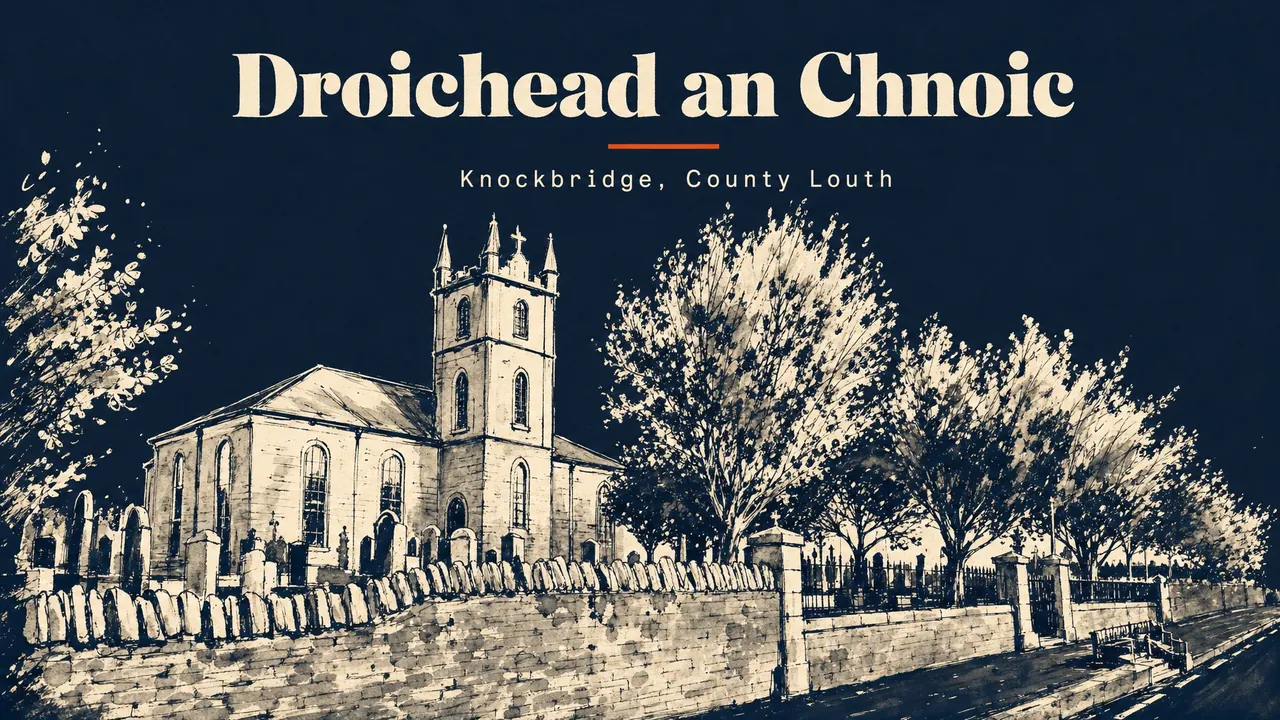
St Mary's, the parish church at the crossroads, has stained-glass windows by Harry Clarke — the greatest Irish stained-glass artist of the twentieth century, the man whose Diseart cycle in Killarney and the Honan Chapel in Cork are pilgrimage sites for design students. His work is in a Knockbridge village church on the road from Dundalk to Tallanstown. There is no admission desk. The door is usually open in daylight. The sapphire and emerald are the same as Killarney; the village is not. If you make the trip to the standing stone, give the church the half hour it asks for on the way back.
Fortescues, Georgian, ruined
Stephenstown
Stephenstown House, just outside the village by the Fane, was built by the Fortescue family in the eighteenth century — a fine three-bay Georgian block in landscaped grounds with a pond, a courtyard, the works. The family fell on hard times; the house went to ruin in the twentieth century. In the 1990s the pond and the courtyard buildings were rescued as a community amenity, with a café, a small visitor centre, and a public walk around the water. The house itself stands beside it as a roofless shell. The walled garden is being recovered. It is the working version of an Irish big-house story — neither restored nor demolished, useful again.
12 Senior Hurling titles, 1927 onward
St Bride's and the hurlers
The parish runs two GAA clubs from the same set of pitches: St Bride's GFC for Gaelic football, founded in 1927 by the parish priest Séamus Quinn, and Knockbridge GAA for hurling. The hurlers have won the Louth Senior Hurling Championship twelve times — Knockbridge is one of the Louth hurling strongholds, a small parish punching well above its weight. A Sunday-afternoon hurling match at the crossroads pitches is the version of the village that you cannot buy a ticket for as a tourist. Show up, lean on the rail, follow the ball.