County Louth Ireland · Co. Louth · Castlebellingham-Kilsaran Save · Share
POSTED FROM
CASTLEBELLINGHAM-KILSARAN
CO. LOUTH · IE

Castlebellingham-Kilsaran
Baile an Ghearlánaigh / Cill Sárain

The Ireland's Ancient East
STOP 04 / 05
Baile an Ghearlánaigh / Cill Sárain · Co. Louth

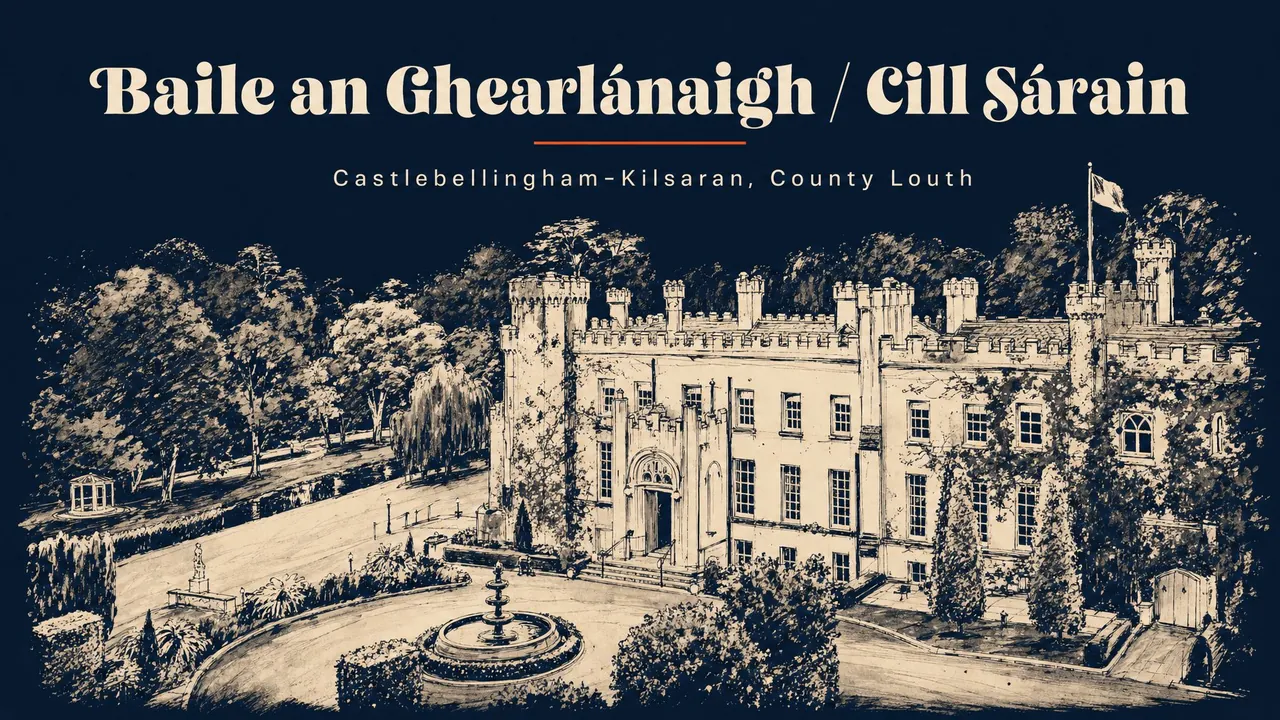
A Bellingham estate village on the old N1, with a castle that became a hotel.

Castlebellingham-Kilsaran is a twin-village on the old Dublin–Belfast road, halfway between Dundalk and Drogheda, just east of the M1 at junction 16. Roughly 1,100 people across the two townlands, a 17th-century castle on the green, a Norman-era ringfort under a field nearby, and a name that travels further as a brand than as a place. Most of the traffic on the M1 goes past now, which is the best thing that ever happened to the place.

The village was Gernonstown from the 14th century — named for an Anglo-Norman family. Around 1710 the surrounding settlement took the name of the Bellinghams, who had bought it from Cromwell, and Castlebellingham it has been since. The estate village you see now is the work of Sir Alan Henry Bellingham in the late 19th century, who laid out the green, built almshouses for widows, and put inset biblical panels and quotations on the village houses — features that are unique in Ireland. Read the upper facades as you walk.

Don't come for nightlife. Come for an afternoon at Bellingham Castle Hotel — formal lunch, walk in the seventeen-acre grounds, follow the Glyde down to the weir — a pint at P.J. Byrne's on Main Street where the Byrnes have been pouring for over a century, and an hour walking the green reading the religious quotations on the houses. If you want a story, drive five minutes south to Dromiskin to see the round tower, or five minutes east to Annagassan to see the Glyde Inn and the Viking longphort site. Castlebellingham is a base. The interesting things are around it.
Population
~1,126 (2016)
Pubs
4and counting
Walk score
Castle gate to the green to the river in fifteen minutes
Founded
Gernonstown from c. 1301; renamed Castlebellingham c. 1710
Coords
53.9000° N, 6.3833° W
01 / 09

At a glance.

Three things every local will eventually mention. Read these and you've already understood more than most day-trippers do.

02 / 09

The pubs.

None of these are themed Irish pubs, because they don't need to be. A few that earn the trip:

P.J. Byrne's

Traditional, regular trade
Pub on Main Street, Byrne family for 110+ years

On Main Street with frontage onto the village core. The Byrnes have been linked to the pub for more than a hundred and ten years. Character bar fittings, open fireplaces, snug areas, music sessions when the room calls for them. The default Castlebellingham pub for a settle-in pint.

Fibber Phelans

Local
Village pub

One of the trio of village pubs. Locals' bar, no fuss, the kind of room where the same chairs hold the same regulars on a Tuesday evening. Music at the weekends.

McBrides

Local
Village pub

The third in the village rotation. Listed in pub directories and consistently open; small, traditional, pours a pint properly. Worth a stop on a walking circuit of the green.

Bellingham Castle bar

Country-house bar
Hotel bar at Bellingham Castle

Inside the castle hotel — dark wood, open fires, the kind of room designed for the half-hour before dinner. Open to non-residents subject to weddings and private events; ring ahead. The pint is more expensive than P.J. Byrne's; the room earns it.

03 / 09

Where to eat.

PlaceTypeLocal note
Bellingham Castle restaurant Hotel restaurant €€€ The proper dinner in the village. Formal dining room in the castle, local produce, a wine list. Frequently busy with weddings — book the dining room in advance and check there is no exclusive event. Lunch is a more relaxed proposition than dinner.
P.J. Byrne's pub kitchen Pub food on Main Street €€ Traditional pub fare in the lounge — soup-and-sandwich at lunch, full plates evenings. Reliable, no nonsense, the version of pub food that built the trade.
M1 Castlebellingham services Service area Opened on the M1 motorway at Castlebellingham in 2010. Useful as a fuel and coffee stop if you are passing through and don't have time for the village. Not a recommendation as such — but it exists, and travellers should know the village is more than the service area.
A note on dinner elsewhere Out of village If the castle is booked out, drive five minutes east to the Glyde Inn at Annagassan — National Pub of the Year 2018, a proper kitchen, a strand outside the window. That is the local move.
04 / 09

Where to sleep.

PlaceTypeLocal note
Bellingham Castle Hotel 17th-century country house, ~28 rooms The headline stay. The Bellinghams' ancestral seat from c. 1690 to 1958, hotel since 1958, Corscadden-owned since December 2012. Seventeen-acre estate on the Glyde, weir, river island, gardens. Heavy wedding trade — book direct, ask which weekends are exclusive use. The rooms in the main house earn their keep.
Bellingham Estate self-catering Cottages on the estate The estate runs a separate self-catering operation in the grounds — useful for families and longer stays. Walking distance to the castle dining room and the village green.
Local B&Bs and lets Around the village and Kilsaran A handful of small B&Bs and short-term lets in and around the two townlands. Search by Castlebellingham or Kilsaran. Quieter than the castle, useful if Bellingham is full or out of budget.
05 / 09

Stories & lore.

The reason to come back. The things every local will eventually tell you about, usually after the second pint.

A family seat for 270 years

The Bellinghams, 1690 to 1958

The Bellingham family came to Louth as Cromwellian planters in the 1650s and built their first house at Gernonstown around then. The Williamite War of 1689–91 levelled it. Sir Henry Bellingham rebuilt around 1690 in the form that the present castle still carries. Sir Alan Henry Bellingham (1846–1921), the Catholic-convert baronet, restored it in the 1880s and remade the village in the picturesque style that survives. The family left in the late 1950s. Dermot Meehan bought the castle from the Irish Land Commission in 1958 and converted it to a hotel; the Corscadden family bought it in December 2012 and have run it since. Two hundred and seventy years of one family is unusual in Irish history — the inset biblical panels on the village houses are an unmissable reminder of what their last decades looked like.

Sir Alan Henry's panels

The picturesque village

Sir Alan Henry Bellingham was a devout Catholic convert who used the village as a kind of devotional canvas. The upper facades of many of the houses around the green carry inset religious panels — biblical scenes set into the stone — and the window sills of others have biblical quotations cut directly into the cut stone. There is also a calvary memorial he commissioned, and a row of charitable almshouses he built for widows of the parish. The combination is unique in Ireland. Most estate villages were built on Anglican lines; this one is one of the few Catholic-restoration estate villages, and the iconography on the buildings is the proof.

A village name on every footpath

Kilsaran Concrete, 1964

In 1964 Patrick McKeown founded a small concrete operation in the village of Kilsaran. Sixty years on, the company he started is Ireland's largest independent concrete and paving manufacturer, employing around 500 people and running plants and quarries the country over. The road surfacing division opened in 1967. The paving division opened at Clonee in 1994. The company headquarters is now in Co. Meath, and the family still run it. Locally the joke is that more Irish people walk on Kilsaran every day than have ever heard of Castlebellingham; only one of those things is exportable.

A monument that changed sides

The 1798 stone

On the village green stands a memorial that has had two lives. It was originally erected to a British officer killed near here during the 1798 Rising — Captain Thomas Bellingham. In the 20th century the inscription was contested; the present plaque also commemorates the local Irish dead of the same Rising. It is one of the few monuments in Ireland that explicitly remembers both sides of 1798 on the same stone. Worth five minutes when you walk the green.

06 / 09

Things to do outside.

Wear waterproofs. Bring a sandwich. Tell someone where you're going if it's the mountain.

Village green and castle gate Short, deliberate. From the village green up to the gate of Bellingham Castle, in along the avenue if the gate is open and there is no wedding, around the castle grounds if access permits, back via the main street reading the religious panels on the upper facades. Best done in clear morning light.
1.5 km loopdistance
30–45 mintime
River Glyde walk East from the village along the river to the weir at the castle island. Flat, dog-walkers, herons, a couple of footbridges. Quiet most days. The kind of walk that does the job before lunch.
3 km returndistance
1 hourtime
Kilsaran townland and ringfort Out the southern road past the original Kilsaran depot, around back-roads in Kilsaran townland, past the motte-and-bailey site that confirms the Anglo-Norman origin of the place. Almost no traffic. Good legs-stretcher. Ask at the castle for directions — the motte is visible from the road but easy to miss.
4 km loopdistance
1–1.5 hourstime
07 / 09

When to go.

There is no bad time. There are different times.

Spring
Mar–May

The estate gardens come on, the river runs full, and the village green is at its best. Castle restaurant runs as usual; book ahead at weekends.

◉ Go
Summer
Jun–Aug

Wedding season at the castle is heavy — exclusive-use weekends are common from June through August. Ring before driving for a meal. Outside the wedding peaks, the village is quiet.

◐ Mind yourself
Autumn
Sep–Oct

October light on the religious panels is what they were carved for. The Glyde turns gold, the wedding diary thins, and the castle dining room is at its calmest.

◉ Go
Winter
Nov–Feb

The pubs stay open, the castle does winter weekends and Christmas trade, but daylight is short. A long Sunday lunch in the castle and a walk on the green is the version that earns its place.

◐ Mind yourself
08 / 09

What to skip.

Honestly? Don't bother.

If a local was sitting beside you, this is the bit where they'd lean in.

×
Turning up at the castle on a wedding day

The castle does heavy wedding trade and many weekends are exclusive-use. Always ring before driving for a meal or a tour. The hotel does not pretend otherwise.

×
Confusing Kilsaran the village with Kilsaran the brand

The cement and paving company is headquartered in Co. Meath, not here. The original Patrick McKeown plant did start in this townland in 1964 — but if you are looking for a tourist attraction with the company name on it, you will not find one. The name is bigger than the place.

×
Stopping only at the M1 service area

The motorway services opened in 2010 and they are useful for fuel. They are not the village. The village is two minutes east of the junction. Drive the extra two minutes.

+

Getting there.

By car

Dublin to Castlebellingham is 1 hour on the M1 to junction 16 (Castlebellingham), then 2 minutes east on the R132. Dundalk is 15 minutes north, Drogheda 20 minutes south. The motorway service area is at the junction itself.

By bus

Bus Éireann route 100/100X (Dublin–Belfast) and route 168 (Dundalk–Drogheda) both stop at Castlebellingham. About 1h from Dublin Busáras, 15 minutes from Dundalk station.

By train

No train. The Castlebellingham station closed in 1976. Nearest station is Dundalk on the Belfast–Dublin Enterprise line, fifteen minutes by car.

By air

Dublin Airport (DUB) is 50 minutes by car straight up the M1. Belfast International (BFS) is 1h. Dublin is the more useful approach.