County Louth Ireland · Co. Louth · Annagassan Save · Share
POSTED FROM
ANNAGASSAN
CO. LOUTH · IE

Annagassan
Áth na gCasán

The Ireland's Ancient East
STOP 03 / 05
Áth na gCasán · Co. Louth

A village of 189 people that was once Dublin's rival.

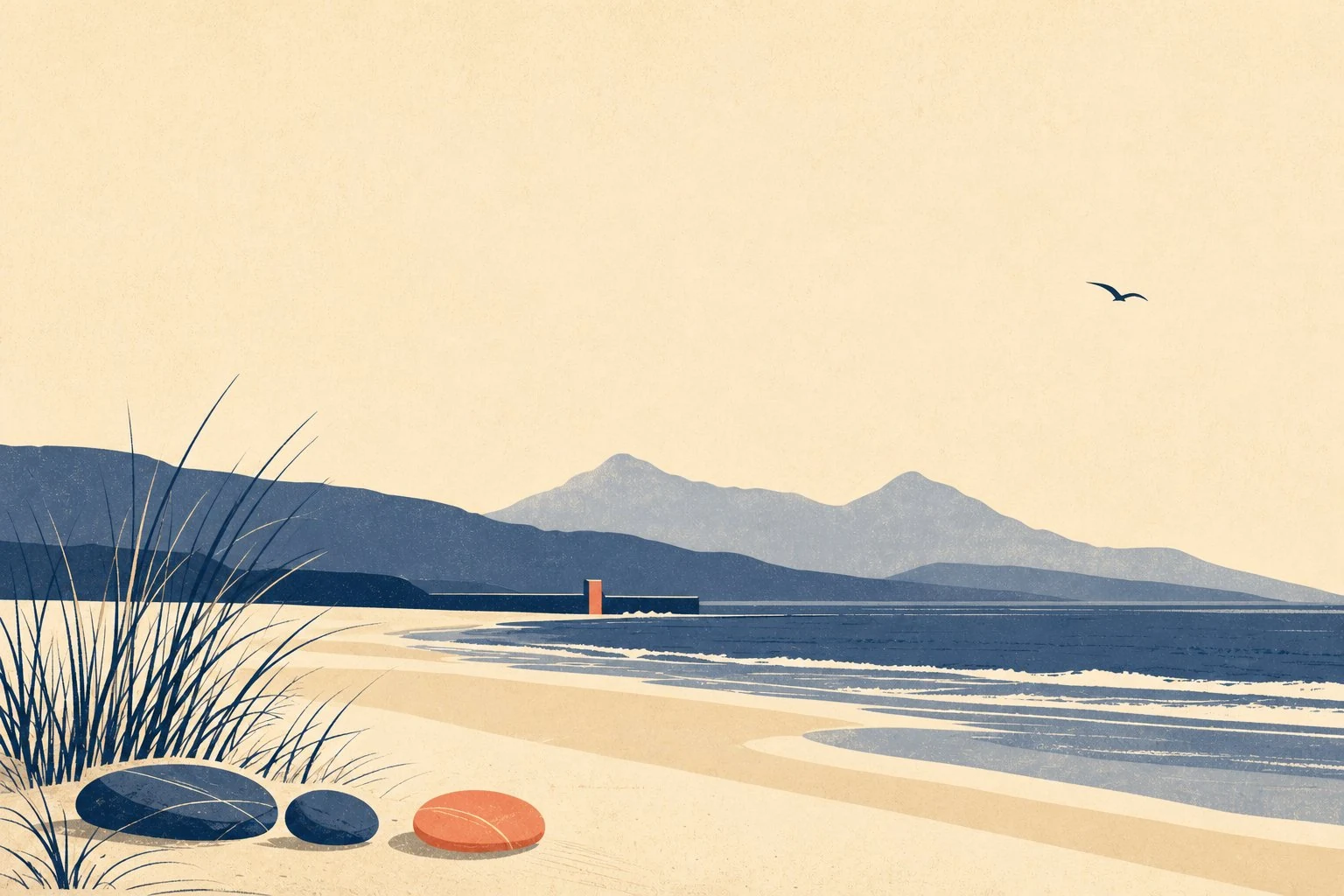
Annagassan is a 189-person village on the southern shore of Dundalk Bay, where the rivers Dee and Glyde finish their journey to the sea. Twenty minutes south of Dundalk, the same north of Drogheda, off the main road and easy to drive past. People who know what was found here in 2010 do not drive past.

In AD 841 the Annals of Ulster record the founding of two Viking longphorts — fortified ship-camps — on the Irish coast. One was Dubh Linn, the black pool, which became Dublin and a city. The other was Linn Duachaill, near a tidal pool above this strand. For more than a thousand years its location was disputed. In 2010 the archaeologist Mark Clinton's team confirmed it on the ground above Annagassan. A defensive ditch and rampart, a double line of straight earthworks where the locals always thought they were. Scaled to its excavated remains, Linn Duachaill was as important as Dublin in the 9th century. Then the tides changed, the access to the sea worsened, and the place was abandoned. Dublin had better water.

Don't come for nightlife. Come for a long lunch in the Glyde Inn, a walk south along the strand to Salterstown pier with the Cooleys ahead and the Mournes beyond, and an hour at the longphort site reading the interpretive panel and looking at a field that was once on the same pages of European history as Dublin. The whole visit is half a day. The story carries the weight.

Population
~189 (2022)
Pubs
1and counting
Walk score
Pier to the river mouth in twenty minutes
Founded
Linn Duachaill — Viking longphort founded AD 841
Coords
53.8833° N, 6.3417° W
01 / 09

At a glance.

Three things every local will eventually mention. Read these and you've already understood more than most day-trippers do.

02 / 09

The pubs.

None of these are themed Irish pubs, because they don't need to be. A few that earn the trip:

The Glyde Inn

The pub of the village
Pub & restaurant on the strand, since 1770

On the beach side of the village, where the Glyde meets the sea. A pub here since 1770 — open during the American Revolution, the Famine, both World Wars. Awarded National Irish Pub of the Year and Irish Food Pub of the Year at the 2018 Irish Pub Awards. The restaurant out the back is called Linn Duachaill in recognition of the longphort up the field. The fire is real and the chowder has been the same chowder for a long time.

Five minutes north in Castlebellingham

Cross-village note

Annagassan is essentially a one-pub village. For a second drink, drive five minutes north to Castlebellingham — P.J. Byrne's on Main Street has been pouring for over a century, and the bar at Bellingham Castle Hotel is the obvious post-dinner room.

Ten minutes north in Dundalk

Cross-town note

For a proper night out — multiple pubs, music, a session — Dundalk is twenty minutes up the R132. The Spotted Dog and Russell's are the obvious targets. The Glyde Inn closes well before that anyway.

A note

Annagassan is a one-bar village by design and choice. The Glyde Inn is the village's social room, dining room, function room, and music venue. Don't expect a second pub crawl. Expect to settle in.

03 / 09

Where to eat.

PlaceTypeLocal note
Linn Duachaill at The Glyde Inn Restaurant on the strand €€ The dining room of the Glyde, named for the longphort. Local seafood, Cooley lamb, a wood-burner in winter. The room looks straight at the river mouth. Lunch and early evening, book Friday and Saturday. The chowder is a meal.
Glyde Inn bar food Pub kitchen If you do not want the full sit-down, the bar does a shorter menu — sandwiches, a daily special, fish and chips. Useful for a walk-and-pint kind of afternoon.
A note on dinner elsewhere Cross-village If the Glyde is full, the next options are Bellingham Castle ten minutes north (formal hotel restaurant) or driving to Dundalk for the Spotted Dog or Rosso. Annagassan does one room properly. Plan it.
04 / 09

Where to sleep.

PlaceTypeLocal note
Self-catering by the strand Cottages and houses Most stays in Annagassan are short-term lets — beachfront cottages, a few houses up the road towards Salterstown. Search by Annagassan or Salterstown. The view of the Cooleys at sunset is what you are paying for.
Bellingham Castle Hotel five minutes north If you want a hotel, the obvious move is Bellingham Castle in Castlebellingham — 17th-century house, formal dining, walking distance to nothing in particular but the kind of stay that pairs well with a Glyde Inn lunch.
Dundalk hotels Hotels twenty minutes north For a chain hotel, Dundalk is twenty minutes up the road and has the Crowne Plaza, Ballymascanlon, and the Carrickdale. Annagassan itself does not run a hotel.
05 / 09

Stories & lore.

The reason to come back. The things every local will eventually tell you about, usually after the second pint.

2010, after 1,169 years

The longphort confirmed

In 841 AD the Annals of Ulster record the founding of Linn Duachaill alongside the founding of Dubh Linn. For most of the next thousand years its location was a guess. From 2005 to 2007 a team led by archaeologist Mark Clinton, working with the National Monuments Service and a geophysicist, surveyed fields above Annagassan and picked up patterns of straight ditches that did not match the round ringforts of the native Irish. In 2010 a confirming dig went in. They found a defensive ditch and an earth rampart, a honestone, ironwork, animal bone — the signature of a Viking ship-camp. Mark Clinton's report sits in the Royal Irish Academy. The site is on private farmland but well-signed from the village; an interpretive panel above the strand walks you through the dig.

Older than the United States

The pub from 1770

The Glyde Inn has been pouring on the strand since 1770. It has stood through the 1798 Rising, the Famine, the Land War, the Civil War, and most of the 20th century without changing very much. The Cassidy family run it now and have for decades. In 2018 the Irish Pub Awards in the RDS named it National Pub of the Year. Locals shrugged — they had always known. A bar this old in a village this small is unusual; it has survived because it is the only one and because it is genuinely good.

A medieval salt-pan

Salterstown and the saltworks

Two and a half kilometres south of Annagassan port is Salterstown — the townland where salt was made by evaporating seawater on a flat shore. The pier there now is a small fishing pier with a rocky beach and good wild swimming when the tide is in. The name (in Irish, Baile na Salainne — the town of the salt) is one of those Norman-era English names that survived intact while half the country reverted to Irish on the road signs. The estuary it sits in has Brent geese in winter and herons all year.

Holidays from Belfast

C.S. Lewis and Salterstown

Clive Staples Lewis — the Belfast-born author of the Narnia books — spent summer holidays as a child and a young man in the Annagassan and Salterstown area. The Lewis family had connections to the Mourne and Cooley coasts, and Lewis is on record describing the view across Dundalk Bay to the Mournes as one of the formative landscapes of his childhood. There is no plaque, no shop, no industry built around it. The light on the Cooleys at sunset is the only reminder, and it is plenty.

06 / 09

Things to do outside.

Wear waterproofs. Bring a sandwich. Tell someone where you're going if it's the mountain.

Annagassan to Salterstown Pier South from the harbour wall along the strand and the Strand Road to Salterstown Pier. Flat, the Cooleys ahead, the Mournes beyond, oystercatchers on the rocks. At low tide you can do the whole thing on the sand. At high tide stick to the road. End at the pier with a flask.
5 km returndistance
1.5 hourstime
The Linn Duachaill site walk From the village up the lane to the longphort site above the strand. The interpretive panel is good. The site itself is a field — the rampart is barely visible above ground but the location matters. Read the panel, look at the line of the river, picture three hundred Viking warriors on a winter morning. It does the job.
1 km loopdistance
40 mintime
Dee estuary bird walk North from the harbour along the river bank to the Dee estuary mouth. Flat, mucky in winter, busy with waders. Brent geese in winter, little egrets year-round, herons always. Bring binoculars and rubber boots.
3 km returndistance
1 hourtime
07 / 09

When to go.

There is no bad time. There are different times.

Spring
Mar–May

The Glyde is open as usual and the strand is empty. The Brent geese are still on the bay through April. The longphort site is best understood in clear light.

◉ Go
Summer
Jun–Aug

Long evenings on the strand, the Glyde Inn full at lunch, swimming at Salterstown pier when the tide is right. Annagassan does not get crowded; bring a picnic.

◉ Go
Autumn
Sep–Oct

The locals' season. Storms rolling up the bay, the Glyde fire lit, the Mournes turning gold across the water. Best time to walk the strand to Salterstown and feel the place.

◉ Go
Winter
Nov–Feb

The Glyde keeps shorter hours; check before driving down. The Brent geese are at their thickest. Wind off the bay is real. A long Sunday lunch is the version of Annagassan that converts people.

◐ Mind yourself
08 / 09

What to skip.

Honestly? Don't bother.

If a local was sitting beside you, this is the bit where they'd lean in.

×
Looking for the longphort to be a museum

It is a field. There is an interpretive panel at the village end. The dig was confirmatory rather than reconstructive — there is no rebuilt Viking ship-camp to walk through. Read the panel, walk the lane, picture the rest. That is the whole site.

×
A second pub in Annagassan

There isn't one. The Glyde is the bar. Settle in at the Glyde or drive five minutes to Castlebellingham for P.J. Byrne's. The village is not pretending to be larger than it is.

×
Driving the strand at low tide

People do this. Cars get stuck. The tides on Dundalk Bay come in fast and the recovery costs more than the trip. Walk the strand. Park in the village.

+

Getting there.

By car

Dundalk to Annagassan is 15 minutes south on the R132. From Drogheda it is 20 minutes north on the same road. From Dublin, M1 to junction 16 (Castlebellingham), then five minutes east on local roads.

By bus

Bus Éireann route 168 runs between Dundalk and Drogheda via Annagassan and the coast villages — nine services on weekdays. About 25 minutes from Dundalk.

By train

No train. The nearest station is Dundalk on the Belfast–Dublin Enterprise line, twenty minutes by car or bus.

By air

Dublin Airport (DUB) is 1h by car. Belfast International (BFS) is 1h 10m. Dublin is the more useful arrival.