County Armagh Ireland · Co. Armagh · Lurgan Save · Share
POSTED FROM
LURGAN
CO. ARMAGH · IE

Lurgan
An Lorgain

The Ireland's Ancient East
STOP 09 / 09
An Lorgain · Co. Armagh

A planted town with a long ridge, a long park, and a longer memory.

Lurgan is a long ridge in north Armagh with a town built along the top of it. The Irish name — An Lorgain — means the shin. Stand at the top of Market Street and look down it, and you see the shape: a straight, wide spine running for nearly a mile, with the streets dropping off either side.

The town was planted by the Brownlows in 1610 and ran on linen for the next three hundred years. Damask, cambric, fine table linen woven on hand looms in front rooms and back kitchens. The power loom arrived in 1855 and the hand-weavers were finished within a generation. The mills came, then the mills went, and what's left is a market town with a Saturday rhythm and a complicated 20th century behind it.

It's a working town, not a tourist town. There's no postcard view, no harbour, no famous chef. What it has is Brownlow House, a park bigger than most villages, a railway station with hourly trains to Belfast and Dublin, and a Main Street that has been there since before Cromwell. Come for an afternoon, walk the park, eat in Cafolla's, get the train somewhere else by tea. Or stay, and let the place tell you about itself slowly.
Population
38,198
Walk score
Main Street end-to-end in 15 minutes
Founded
c. 1610
Coords
54.4684° N, 6.3340° W
01 / 09

At a glance.

Three things every local will eventually mention. Read these and you've already understood more than most day-trippers do.

02 / 09

The pubs.

None of these are themed Irish pubs, because they don't need to be. A few that earn the trip:

The Beehive Bar

Trad sessions, locals
Old town pub

Long-standing town-centre pub. Trad sessions some nights, 80s disco others — phone ahead if you want a specific thing. The staff take requests, which is sometimes a feature and sometimes a warning.

The Carnegie Inn

Old-school
Market Street pub

27 Market Street. The kind of pub where the regulars are on first-name terms with the lounge and the bar both knows them. Quiet pint territory.

The Stables Bar

Family-run, food-led
Bar & restaurant

Old Portadown Road, opened 1972 by the Smyth and McGeown families on the site of an old hitching post. Bar, restaurant, off-licence — the Lurgan equivalent of a one-stop shop.

03 / 09

Where to eat.

PlaceTypeLocal note
Cafolla's Italian café & chipper £ Church Place. Run by the Cafolla family since Giuseppe arrived from Casalattico in 1900. Ice cream made on the premises to a recipe nobody outside the family has seen. The chips are good. The ice cream is the point.
Wee Paddy's Bistro Bistro ££ 2 Church Place. Stews, pies, fish and chips, brownies. Daytime mostly, dinner Fri/Sat. The kind of place that does a Sunday roast you'd phone home about.
The Ashburn Hotel restaurant Hotel dining ££ Lunch and dinner seven days. Not exciting on paper, reliable in practice. Useful if everywhere else is shut on a Monday.
04 / 09

Where to sleep.

PlaceTypeLocal note
The Ashburn Hotel Hotel Three-star, family-run, 13 rooms. The only hotel in town. Walking distance from the station and the park. The function room hosts most weddings in north Armagh, so check before you book a quiet weekend.
05 / 09

Stories & lore.

The reason to come back. The things every local will eventually tell you about, usually after the second pint.

A 400-year landlord story

The Brownlows

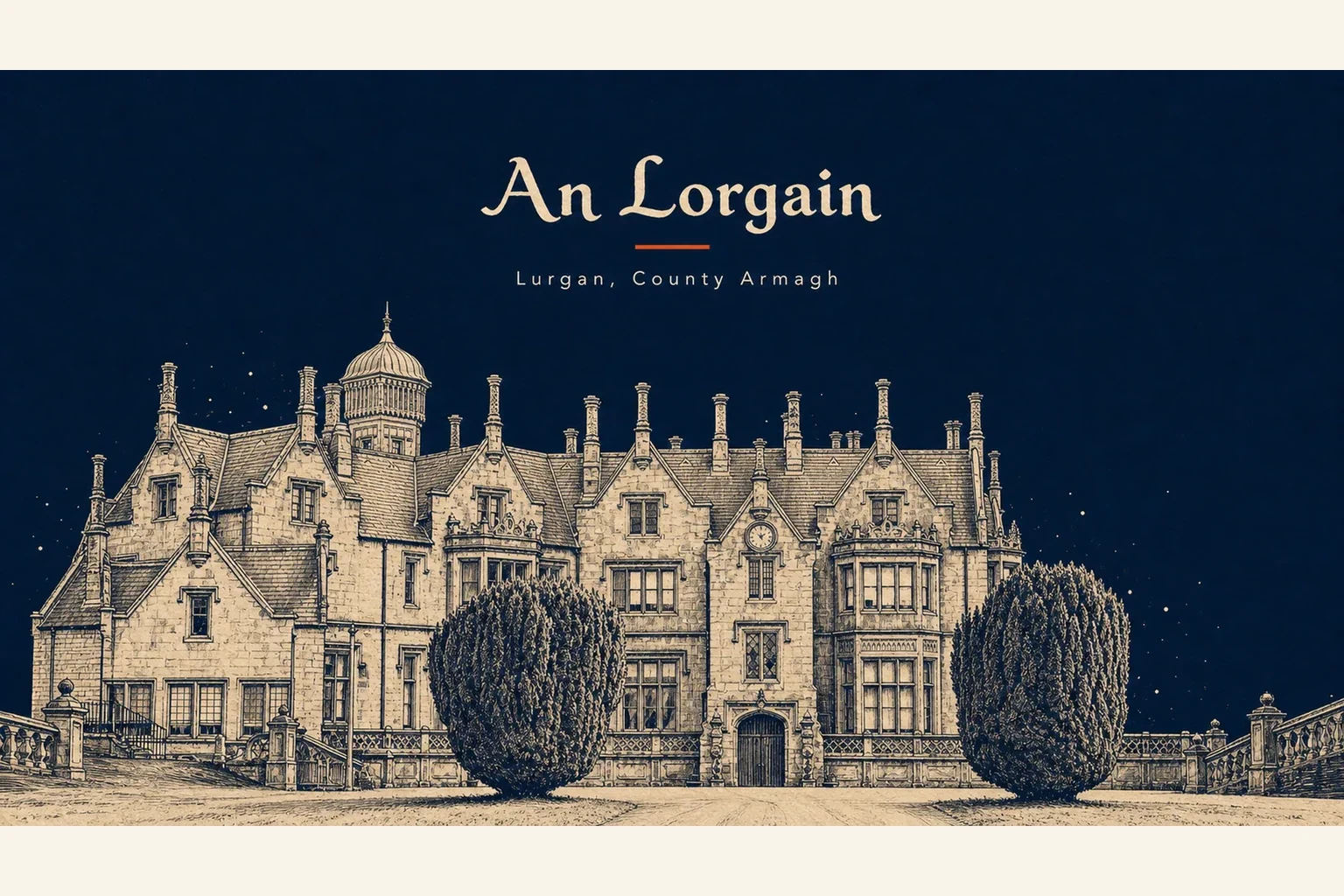
William Brownlow got the grant in 1610 and his descendants ran Lurgan for the next three centuries. The 1st Baron Lurgan, Charles Brownlow, replaced the old house with the present Brownlow House in 1833 — Elizabethan-style, designed by William Henry Playfair of Edinburgh. The Orange Order bought it in 1903. Eisenhower stayed two nights here in 1944, planning D-Day. It's still owned by the local Orange lodge. You can tour it on certain days if you ring ahead.

The greyhound

Master McGrath

A black-brindle greyhound, runt of the litter, almost drowned as a pup. Bought cheap by the 2nd Baron Lurgan, trained by James Galwey down in Waterford. Won the Waterloo Cup — the biggest coursing prize in these islands — in 1868, 1869 and 1871. Queen Victoria asked to see him at Windsor. He died in December 1873 of a burst heart. The statue at the top of High Street, by Samuel Ferris Lynn, went up in 1875. There's a ballad. Half the country still knows the chorus.

The mystic

AE

George William Russell was born on William Street in 1867. Theosophist, painter, poet, agricultural reformer, friend of Yeats, signed his work Æ. The Russells left for Dublin when George was eleven and he never really came back, but the town claims him anyway. A plaque went up. He'd probably have approved and definitely have rolled his eyes.

Famine work

The lake

The 59-acre lake in Lurgan Park was hand-dug during the Famine years to give starving men a wage. One of the largest hand-dug lakes in Ireland at the time. The Famine killed 2,933 people in Lurgan alone — the workhouse was overwhelmed. The lake is the prettiest thing in town. It is also a memorial, even when nobody calls it one.

06 / 09

Things to do outside.

Wear waterproofs. Bring a sandwich. Tell someone where you're going if it's the mountain.

Lurgan Park loop Around the lake, past the bandstand, up to Brownlow House and back. Flat, paved, dog-friendly. Cricket pitch in summer, herons most mornings.
4 kmdistance
50 mintime
Main Street to Park Walk the length of the planned town: Market Street into High Street into Church Place, past the Master McGrath statue, through the gates into the park. Reads the 1610 plan in your feet.
1.5 kmdistance
25 mintime
Oxford Island Six miles north on the shore of Lough Neagh. Nature reserve, hides, the Discovery Centre café. Closest you can get to the biggest lake in these islands without a boat.
5 km of trailsdistance
Half daytime
07 / 09

When to go.

There is no bad time. There are different times.

Spring
Mar–May

The park is at its best — bluebells under the beeches, the lake busy with herons.

◉ Go
Summer
Jun–Aug

Twelfth of July is loud — bonfires the night before, parades the day itself. Worth seeing once. Some prefer to be elsewhere.

◐ Mind yourself
Autumn
Sep–Oct

Park colours, quiet streets, the light low across the ridge. The best season here.

◉ Go
Winter
Nov–Feb

Town goes early-dark and early-quiet. The pubs are warmer for it. Bring a coat — the wind off Lough Neagh has nothing to stop it.

◐ Mind yourself
08 / 09

What to skip.

Honestly? Don't bother.

If a local was sitting beside you, this is the bit where they'd lean in.

×
Looking for "old Ireland" charm

Lurgan is a 17th-century English plantation town that became a Victorian linen town that became a 20th-century Troubles town. None of those eras left thatched cottages. Read it for what it is, not what Bord Fáilte wants.

×
The town centre on Sunday before noon

Most things shut. The park is open. Go there.

×
Driving in on the Twelfth

Roads close, parades route through. Either commit to seeing it or come back on the 13th.

×
Expecting a tourist info office

There isn't one in town. The nearest is in Armagh city. The Brownlow House staff will help if it's open. Otherwise, the internet and your feet.

×
The retail park on the bypass

Same Tesco, Currys and Costa as everywhere else in the UK. You can do that at home.

+

Getting there.

By car

Belfast to Lurgan is 25 miles on the M1 — exit at Junction 10, the Lurgan Interchange, onto the A76. About 30 minutes without traffic.

By bus

Translink Goldline and Ulsterbus services from Belfast Europa, Armagh and Portadown. Frequent through the day.

By train

Lurgan station is on the Belfast–Dublin line. Hourly NIR services to Belfast Lanyon Place (30 min) and Portadown (5 min). Limited Enterprise services to Dublin Connolly stop here — most don't. Change at Portadown for the rest.

By air

Belfast International is 35 minutes by car. Belfast City is 25 minutes. Dublin is 90 minutes south on the M1.