County Carlow Ireland · Co. Carlow · Clonegal Save · Share
POSTED FROM
CLONEGAL
CO. CARLOW · IE

Clonegal
Cluain na nGall

The Ireland's Ancient East
STOP 01 / 03
Cluain na nGall · Co. Carlow

Where the Wicklow Way ends and a goddess temple keeps its lights on.

Clonegal is a one-street village on the Derry river, on the line where Carlow gives up and becomes Wexford. Two hundred people, give or take. A church, a bridge, a pub, a closed shop, a castle. You could walk the whole thing while a kettle boils. Most travellers who arrive here have done so on foot, from Dublin, over six days, and are not in a hurry to walk anywhere else.

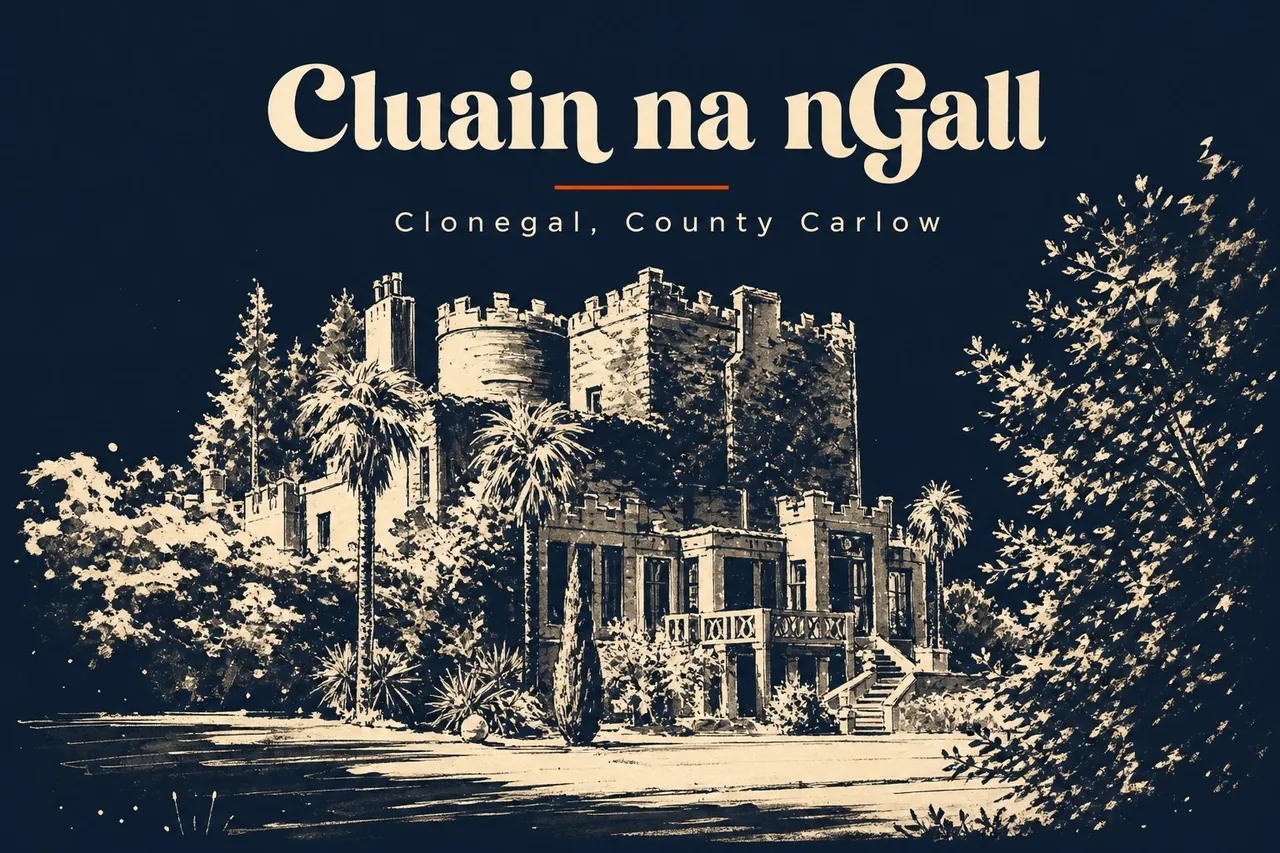
The reason to come is Huntington Castle. Laurence Esmonde built it in 1625 on the foundations of a Franciscan friary, and his descendants — now Esmonde-Robertsons — are still in residence. They open the house for tours, and the gardens, and the yew walk that some authorities call the oldest formal planting in Ireland. In the basement they keep a working temple to the goddess Isis. Olivia Robertson and her brother Lawrence founded the Fellowship of Isis here in 1976; it has grown into a worldwide goddess religion with members across ninety countries. None of that is a sideline. The family takes it entirely seriously and so should you.

The other thing Clonegal is is the southern end of the Wicklow Way. Walkers come down off the hills at Moylisha, cross into Carlow, and arrive on Main Street with the look of people who have not heard their own thoughts in a week. The pub knows. The B&Bs know. There is a finishing-post sign at the bridge and a stamp at the post office and a feeling, on a wet Thursday afternoon in October, that you have walked off the edge of the country.
Population
~200
Walk score
One street, ten minutes end to end
Founded
Castle built 1625
Coords
52.7167° N, 6.6500° W
01 / 07

At a glance.

Three things every local will eventually mention. Read these and you've already understood more than most day-trippers do.

02 / 07

The pubs.

None of these are themed Irish pubs, because they don't need to be. A few that earn the trip:

Osborne's

Walkers, locals, both
Village pub on Main Street

The pub at the end of the Wicklow Way. Pints, a fire, walkers peeling off wet socks, locals not minding. If you have just walked from Marlay Park, this is the room you have been picturing.

03 / 07

Stories & lore.

The reason to come back. The things every local will eventually tell you about, usually after the second pint.

Four hundred years, one family

Huntington Castle

Laurence Esmonde, an Anglo-Norman knight in the service of the crown, built the tower house in 1625 on the site of a Franciscan friary that the friars had abandoned a few decades earlier. His descendants have lived in it ever since — twelve generations and counting, now under the Esmonde-Robertson name. The house is a working family home that opens to the public most of the year. The gardens are older than the house: the yew walk in particular is reckoned to date from monastic times, which would make it among the oldest planted gardens on the island.

A goddess religion in a Carlow basement

The Fellowship of Isis

In 1976, Olivia Robertson and her brother Lawrence Durdin-Robertson — the rector of the local Church of Ireland parish — founded the Fellowship of Isis at Huntington Castle. It is not a coven and not a cult; it is a polytheistic spiritual federation devoted to the divine feminine, and it now has members and centres in something like ninety countries. The temple itself sits in the vaults beneath the castle, decorated by Olivia (a trained painter and a published mystic) over decades. It is open to visitors as part of the castle tour. People travel from California and Tokyo to see it. The village shop sells them ice cream when they're done.

Where Ireland's oldest waymarked walk lays down its boots

The Wicklow Way

The Wicklow Way runs 127 kilometres south from Marlay Park in Dublin to a finishing post on the bridge in Clonegal. Opened in 1980, it was the first long-distance waymarked trail in Ireland and is still the busiest. Walkers typically take six or seven days. The last day off the hills brings them through Moylisha and Aghowle and over the county line into Carlow, and then there is Main Street, and there is Osborne's, and there is the sign. People cry at it more often than you might expect.

A castle that did not become a ruin

The Esmondes and the village

Most Big Houses in Ireland either burned in the 1920s or fell apart slowly through the 20th century. Huntington did neither. The Esmonde-Robertsons stayed, kept the roof on, opened the doors, raised the children, ran the gardens, founded the religion, did the tours. The village around it shrank as villages do; the castle did not. There is an unusual continuity here for an Irish landscape. Walk the avenue under the lime trees on a damp morning and you can feel it.

04 / 07

Things to do outside.

Wear waterproofs. Bring a sandwich. Tell someone where you're going if it's the mountain.

The Wicklow Way (final stage) If you have not done the whole 127 km, the last stage in is the best taste of it: forest tracks down off the hills, a county line crossed, and Clonegal at the end. The official finish is the bridge in the village. A second sign, lower down, marks the post-office stamp.
21 km from Shillelaghdistance
5–6 hourstime
Mount Leinster 20 minutes' drive south. The highest point of the Blackstairs at 795 m, with a road most of the way to a transmitter at the top and a short walk on from there. On a clear day you see five counties. On the days that are not clear you see weather coming at you from Wexford.
6 km returndistance
2.5–3 hourstime
Huntington gardens & yew walk The grounds of the castle: parterre garden, lake, and the yew walk that is older than the house. Open on castle tour days. Slow walk, low-effort, high-reward.
1 km loopdistance
40 mintime
The Derry river towards Kildavin Out the bridge and along the river path north toward Kildavin. Quiet, flat, herons. Bring boots — the path is what the cattle made of it.
5 km returndistance
1.5 hourstime
05 / 07

When to go.

There is no bad time. There are different times.

Spring
Mar–May

Castle reopens at Easter. The yew walk is at its best in May. Wicklow Way walkers are starting to come through.

◉ Go
Summer
Jun–Aug

Castle and gardens fully open. Long evenings. The walkers arriving on Main Street are wearing shorts now and look pleased with themselves.

◉ Go
Autumn
Sep–Oct

The Way is quieter and the woods are in colour. Bring a coat. Castle still open most weekends through October.

◉ Go
Winter
Nov–Feb

Castle is shut. Pub keeps going. If you want a cold walk in by the river and a fire afterwards, this is your season — but plan around the castle being closed.

◐ Mind yourself
06 / 07

What to skip.

Honestly? Don't bother.

If a local was sitting beside you, this is the bit where they'd lean in.

×
Arriving on a day Huntington is closed

The castle is the reason. It opens roughly Easter to the end of October, and not every day even then. Check before you drive — there is no obvious Plan B in the village.

×
Expecting a meal beyond the pub

Clonegal has a pub. It does not have a restaurant strip. If you want a sit-down dinner, eat in Bunclody (10 minutes) or Tullow (20 minutes), or eat what the pub is doing.

×
Driving the Wicklow Way

It is a walking trail. The roads near it are slow and not scenic in a car. Either walk a stage in or treat the village as a destination on its own.

×
Treating the Temple of Isis as a curiosity stop

It's an active place of worship. Visit it the way you'd visit a working church or temple anywhere else — quietly, on the tour, with the family's permission. Not a selfie.

+

Getting there.

By car

Dublin to Clonegal is about 1h 30m via the M11 and M9 — exit at Bunclody and follow the signs. Carlow town is 35 minutes north-west. Enniscorthy 35 minutes south.

By bus

No direct service. Bus Éireann and Wexford Bus run to Bunclody (10 minutes away by road); then taxi or a 7 km walk in.

By train

No station. Nearest is Carlow on the Dublin–Waterford line, then 35 minutes by car.