County Carlow Ireland · Co. Carlow · Clonmore Save · Share
POSTED FROM
CLONMORE
CO. CARLOW · IE

Clonmore
Cluain Mhór

The Ireland's Ancient East
STOP 06 / 06
Cluain Mhór · Co. Carlow

A Norman castle the size of a small farm, and a saint's well still walked to.

Clonmore is a small place in the north-east corner of Carlow, sitting on the road between Hacketstown and Tullow with the Wicklow border close enough to throw a stone over. There is a church, a graveyard, a few houses at the crossroads, and a field with a Norman castle in it. That field is the reason to come.

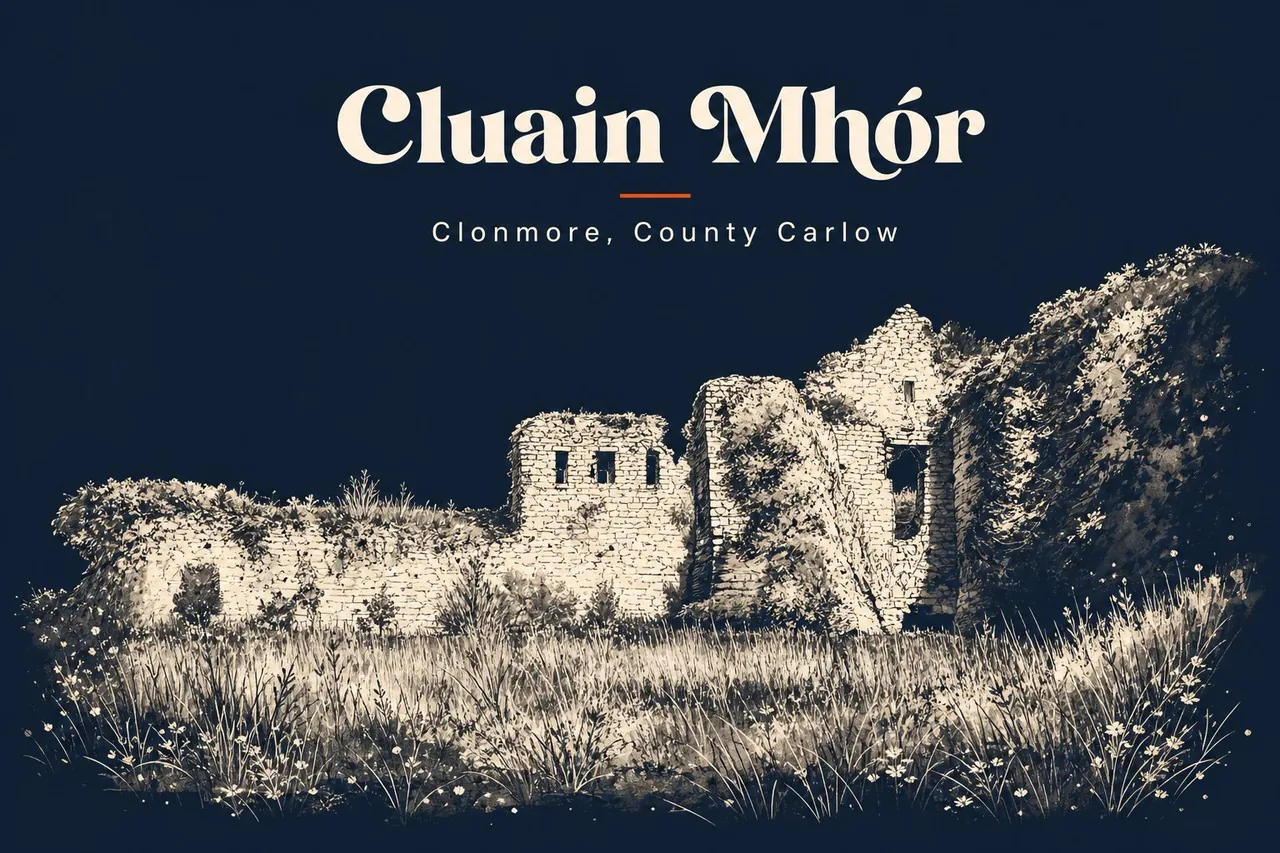
Clonmore Castle was built around 1180 by the Anglo-Normans pushing inland from Leinster — Hugh de Lacy or Raymond le Gros, depending on which historian you trust — and it grew over the next two centuries into one of the largest castle compounds in the country. What remains is roofless and ivy-bound and bigger than you expect: corner towers, a chunk of curtain wall, a keep that has lost its top half. You walk in through a gap in a hedge and the scale lands.

Long before the Normans, this was St Mogue's place — Maedóc of Ferns, who founded a monastery here in the 6th century before moving south to Wexford. The monastic enclosure has gone back to grass but the holy well is still there, and a handful of early cross-slabs survive in the graveyard, and on the saint's pattern day people still walk the rounds. That is the texture of Clonmore: two ruins, fourteen centuries between them, a parish that has quietly held both.
Population
~200
Walk score
A crossroads, a castle field, a holy well
Founded
Monastery c. 6th century; castle c. 1180
01 / 06

At a glance.

Three things every local will eventually mention. Read these and you've already understood more than most day-trippers do.

02 / 06

Stories & lore.

The reason to come back. The things every local will eventually tell you about, usually after the second pint.

The Norman footprint

Clonmore Castle

Built around 1180 in the first wave of Anglo-Norman expansion into Leinster, Clonmore Castle was a substantial piece of work — a stone keep, a curtain wall with corner towers, and an outer bailey that enclosed several acres. By the late medieval period it was held by the FitzEustaces and then by the Eustaces of Baltinglass. Cromwell's forces took it in the 1650s and the site was finally abandoned. The footprint is still legible from the road — corner tower, keep wall, the line of the bawn — and it remains one of the largest castle ruins in Ireland by area.

Maedóc of Ferns, before he was of Ferns

St Mogue

Saint Mogue — Maedóc — was a 6th-century Irish monk who founded a monastery at Clonmore before moving south and ending up as the first Bishop of Ferns. The Clonmore foundation was substantial in its day and produced its own line of abbots and saints. The monastic site itself is gone, but the dedication held: the parish church, the holy well at the edge of the village, and the pattern day all carry his name.

A pilgrimage that never stopped

The pattern day

On St Mogue's feast — kept locally in late January — people still walk the rounds at the holy well: the well itself, the bullaun stones, the old cross-slabs in the graveyard. The rounds are short and the prayers are quiet and there is rarely a crowd. It is the kind of devotion that has outlasted the monastery, the Normans, the Penal era and the Republic, mostly by not making a fuss about itself.

What's left of the monastery

The cross-slabs

Scattered around the old church site are a handful of early-medieval cross-slabs and a granite high cross fragment — incised crosses, a few worn inscriptions, the kind of stones that catch the eye if you know to look for them. They are in situ, mossed over, unlabelled. The National Monuments Service has them on the books. The sheep have them as scratching posts.

03 / 06

Things to do outside.

Wear waterproofs. Bring a sandwich. Tell someone where you're going if it's the mountain.

Clonmore Castle field Park at the church, walk the lane down past the graveyard, and the castle is in the field on your left. Respect the gate — it is a working farm — and stick to the edge. The far corner tower is the angle worth the walk.
1 km loopdistance
30 mintime
St Mogue's well and the graveyard From the village crossroads, the well is signposted on a small lane. Cross-slabs sit around the old church ruins beside it. Bring a torch in winter — the lane has no lights and the well is in under the trees.
500 mdistance
20 mintime
The Wicklow border road The road east toward Aghold and Tinahely climbs gently into the Wicklow foothills. Quiet tarmac, hedgerows, no traffic to speak of. Turn back at the county sign or push on for a pint in Hacketstown.
6 km returndistance
1h 30time
04 / 06

When to go.

There is no bad time. There are different times.

Spring
Mar–May

Bluebells in the lane to the well. Lambs in the castle field. The pattern day has been and gone but the well still gets visitors.

◉ Go
Summer
Jun–Aug

Long evenings make the castle field worth a slow walk-around. Bring midge spray if you cut down toward the river.

◉ Go
Autumn
Sep–Oct

The light on the keep wall in late October is the photograph everyone takes home. Quiet roads, low sun, nobody about.

◉ Go
Winter
Nov–Feb

The pattern day falls in late January and the well sees its small crowd. Otherwise the lanes are wet and the castle field is a bog. Bring boots.

◐ Mind yourself
05 / 06

What to skip.

Honestly? Don't bother.

If a local was sitting beside you, this is the bit where they'd lean in.

×
Expecting a village centre

There isn't one. Clonmore is a crossroads with a church and a graveyard. The castle and the well are the village; the rest is fields.

×
Driving up to the castle

You can't. There is no car park and no signed entrance. Park at the church, walk the lane, find the gap in the hedge. That is the visit.

×
A plan that includes lunch in Clonmore

There is no café and no shop. Eat in Hacketstown or Tullow before or after. Bring a flask if you want a cup of tea at the well.

×
Treating the castle field like a heritage site

It is private farmland with a national monument sitting in it. Stick to the edge, leave gates as you find them, and keep dogs on a lead. The access is goodwill, not a right of way.

+

Getting there.

By car

Tullow to Clonmore is 15 minutes on the R725 via Aghade. Hacketstown is 6 minutes east on the R747. From Dublin allow 1h 30 via the M9 and Tullow.

By bus

No direct bus service to Clonmore itself. Bus Éireann and Local Link both serve Hacketstown and Tullow; you'll need a car or a taxi for the last few miles.

By train

Nearest station is Carlow town (35 minutes by car). Then drive.

By air

Dublin Airport is 1h 45 by car. There is no closer option.