Built into a Norman castle, 1402-1433
Quin Abbey
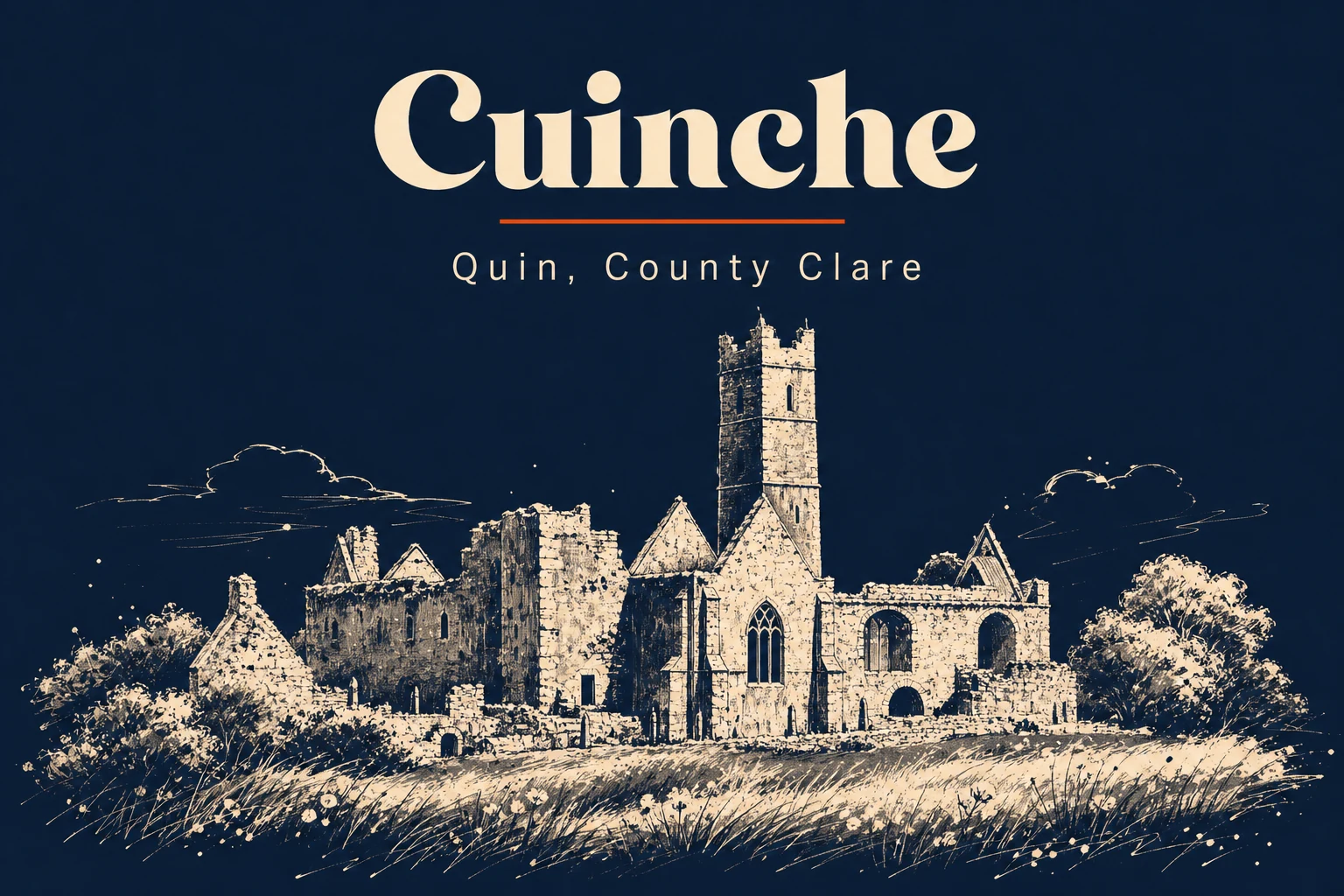
The Franciscan friary was raised by the MacNamara family between 1402 and 1433, built into and around the walls of the Anglo-Norman castle that Thomas de Clare had put up on the site around 1280. The castle's enormous round corner towers were left standing and folded into the friary plan, which is why the ground layout looks unlike a standard friary. The cloister survives intact, the church and domestic ranges are largely complete, and a spiral stair climbs the tower for a view over the valley. Henry VIII confiscated the friary in 1541, but friars kept returning. Cromwellian forces caused destruction around 1650. The community was finally expelled in 1760, though the last friar, Father John Hogan, lived on and was buried in the friary grounds after his death in 1820. It is a National Monument, managed by the OPW, free to enter, and one of the most complete medieval friaries left in Ireland.
Richard de Clare - Norman lord, killed at Dysert O'Dea, May 1318
The de Clares and Dysert O'Dea
Thomas de Clare was granted the lordship of Thomond - roughly modern County Clare - by the English Crown in 1276 and built the castle at Quin around 1280. He died in 1287. His son Richard de Clare carried on the Norman attempt to hold the county, but was killed at the Battle of Dysert O'Dea in May 1318 along with much of his force. The O'Briens of Thomond reclaimed control of Clare, and the Normans never seriously challenged them again. The ruined de Clare castle at Quin passed to the MacNamaras, who handed it to the Franciscans - the friary you see today is built on a Norman defeat.
A tower house of 1467, three kilometres away
Knappogue and the MacNamara castles
The MacNamaras did not stop at the friary. Knappogue Castle, about three kilometres southeast of Quin, is a MacNamara tower house built in 1467 by Sioda MacNamara. It was restored in the 20th century and now runs medieval-style banquets through the summer. Craggaunowen, further east, was built around 1550 by John MacSioda MacNamara, a descendant of the same line; today it is an open-air archaeological museum run by Shannon Heritage, with a reconstructed crannog (a lake dwelling on stilts), a ring fort and an Iron Age trackway. Between the friary, Knappogue and Craggaunowen, this small parish holds three centuries of one family's building.
Born Quin 1840, sparked the West Australian gold rush 1893
Paddy Hannan and the Kalgoorlie gold
Patrick (Paddy) Hannan was born near Quin in 1840 and emigrated to Australia. In June 1893, prospecting with two others in the Western Australian desert, he found gold at a spot that became Kalgoorlie - one of the richest goldfields on earth and the trigger for a rush that built a city. Hannan's name is on Kalgoorlie's main street and a statue there. He is the village's improbable export: a quiet emigrant from a Clare friary village whose pick started one of the great gold rushes of the 19th century.