County Clare Ireland · Co. Clare · Newmarket-on-Fergus Save · Share
POSTED FROM
NEWMARKET-ON-FERGUS
CO. CLARE · IE

Newmarket-on-Fergus
Cora Chaitlín, Co. Clare

The Ireland's Hidden Heartlands
STOP 09 / 09
Cora Chaitlín · Co. Clare

A market town on the Ennis-Limerick road with the O'Briens' Dromoland on its doorstep and the biggest Bronze Age hillfort in Ireland in the trees behind it.

Newmarket-on-Fergus is a working village strung along the old road between Ennis and Limerick, fifteen minutes from Shannon Airport. The M18 takes the through-traffic away to the west now, which is good for the village and means you have to mean to come here. Most people who stop are either flying out of Shannon, playing golf at Dromoland, or chasing the Bronze Age.

The name is the first puzzle. The Irish is Cora Chaitlín, Caitlin's weir, and the older form was Corracatlin - a quiet enough origin. The English Newmarket-on-Fergus is the odd part: the likeliest story is a market that grew up to replace the older one at Bunratty, but the village will happily tell you Lord Inchiquin named it after the English racing town. Nobody is certain, which is the honest answer.

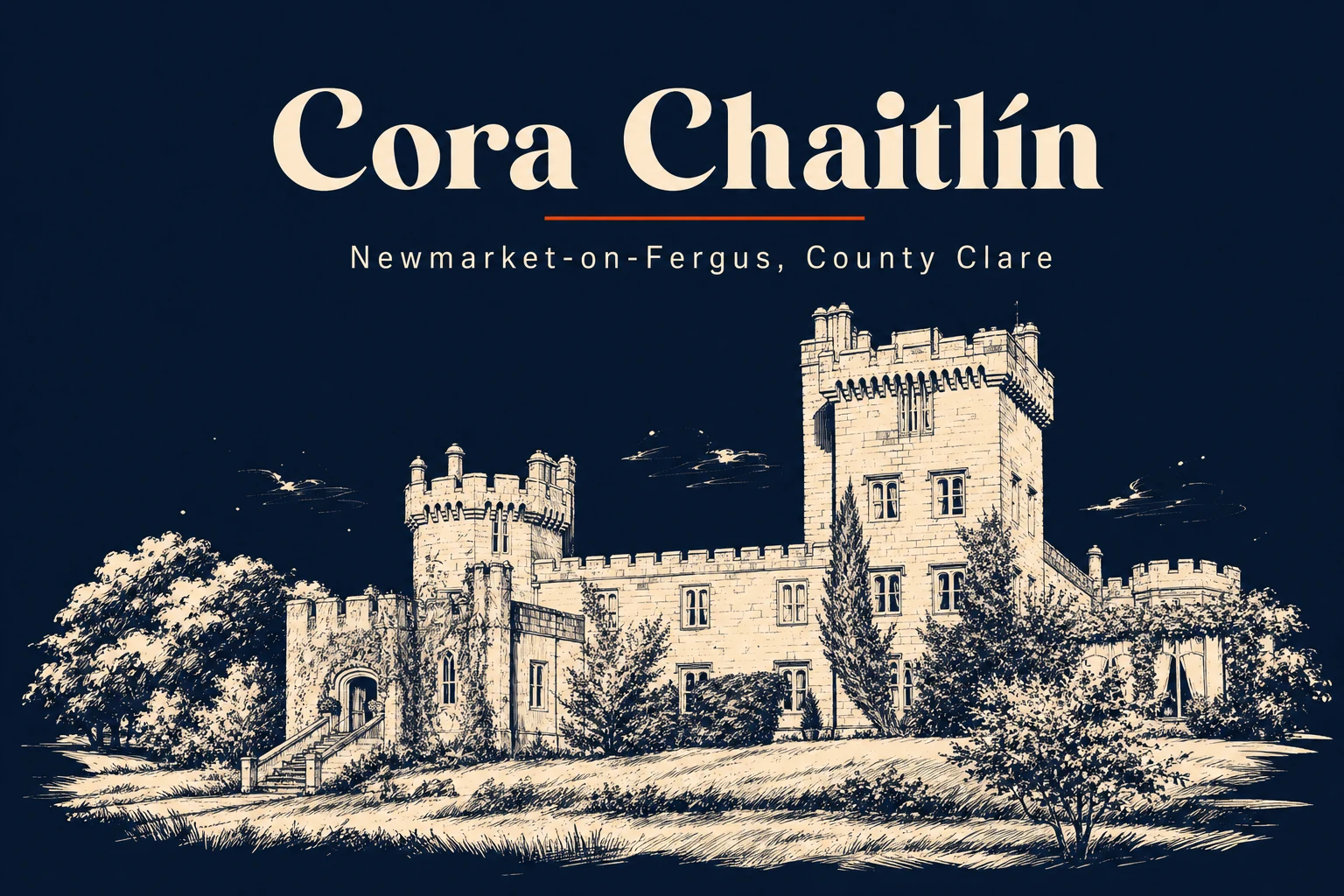
The reason to come is what sits in the trees on the edge of the village. Dromoland was the seat of the O'Briens, Barons of Inchiquin, who trace themselves back to Brian Boru - genuinely one of the old Gaelic royal lines. The castle you see is the Pain brothers' Gothic Revival rebuild, finished around 1835, and it has been a five-star hotel since 1963. Behind it, in the estate woods, is Mooghaun: the largest hillfort in Ireland, three rings of Late Bronze Age rampart, and the spot near its lake where the Great Clare Find - the biggest haul of prehistoric gold in western Europe - came out of the ground in 1854.

The village itself is a hurling village, plain and quiet. Cora Chaitlín has won the Clare senior hurling championship more often than any club in the county. There is a pub or two, a church, the schools, and the GAA grounds. It is not a destination in itself. Use it as a base for Dromoland, the airport, Bunratty and the Mooghaun woods, and take it for what it is.
Population
~1,887 (2022)
Pubs
2and counting
Founded
Corracatlin parish settlement; market town renamed in the 18th century, near the O'Brien seat of Dromoland
Coords
52.7592° N, 8.8869° W
01 / 09

At a glance.

Three things every local will eventually mention. Read these and you've already understood more than most day-trippers do.

02 / 09

The pubs.

None of these are themed Irish pubs, because they don't need to be. A few that earn the trip:

O'Neill's Bar

Open fire, regulars, the real thing
Traditional pub, village centre

The traditional pub in the village - a log fire, a friendly welcome and an old-fashioned bar that has not been gutted and rebuilt to look old-fashioned. The kind of place you stop into for one and stay for the chat. If you want the actual village rather than the castle, this is where it is.

Shannigans Gastro Pub

Food-led, music at weekends
Gastro pub, village

The food end of the village's drinking. A menu that leans on Irish producers, seasonal and a bit more ambitious than standard pub grub, with local musicians in at weekends playing a mix of trad and contemporary. The reliable spot for an actual meal in the village without driving to Dromoland prices.

03 / 09

Where to eat.

PlaceTypeLocal note
Shannigans Gastro Pub Gastro pub, village €€ The main sit-down option in the village itself. Irish ingredients, a seasonal menu, weekend music. Mid-range and dependable - the place to eat if you are staying local and not eating at the castle.
Earl of Thomond Restaurant Fine dining at Dromoland Castle €€€ The flagship dining room at Dromoland, in the castle proper - jacket-and-collar fine dining, a wine list to match, and the prices you would expect of a five-star castle hotel. The destination dinner if the budget is someone else's. Book ahead and dress for it.
04 / 09

Where to sleep.

PlaceTypeLocal note
Dromoland Castle Hotel 5-star castle hotel, on the estate The reason most visitors are here. A genuine castle - the Gothic Revival O'Brien seat - on four hundred and fifty acres, with a championship golf course, spa, fishing, falconry and the Mooghaun hillfort in the grounds. Five-star prices and worth the look even if you are not staying. Booked up well ahead in summer.
The Inn at Dromoland Hotel, edge of Dromoland estate The more affordable bed on the Dromoland estate - a separate hotel by the gates, with access to the grounds and golf without the castle tariff. Useful if you want the location and the green but not the room rate of the main house.
Hunters Lodge Guesthouse / B&B, village A village guesthouse in the heart of Newmarket-on-Fergus, handy for Shannon Airport, Bunratty and the Dromoland and Shannon golf courses. The down-to-earth option - a bed near the airport with a proper breakfast, no castle involved.
05 / 09

Stories & lore.

The reason to come back. The things every local will eventually tell you about, usually after the second pint.

Brian Boru's line, Gothic by 1835, hotel since 1963

Dromoland and the O'Briens

Dromoland was the ancestral home of the O'Briens, Barons of Inchiquin - one of the few native Gaelic families of royal blood still landed into the modern era, direct descendants of Brian Boru, High King of Ireland. Sir Edward O'Brien commissioned the rebuild that gave the house its present castellated Gothic Revival shape; the architects were James and George Pain, pupils of John Nash, and the work was finished around 1835. The estate was sold in 1962 to the American industrialist Bernard McDonough and opened as a hotel in 1963. It now runs as a five-star on four hundred and fifty acres, with a championship golf course laid out by Ron Kirby and J.B. Carr, fishing, falconry and the rest. It is one of the genuine castle hotels in Ireland - a historically significant building, not a folly with bedrooms.

The biggest hillfort in Ireland, and a vanished fortune in gold

Mooghaun and the Great Clare Find

In the woods of the Dromoland estate sits Mooghaun, the most extensive hillfort in Ireland - three concentric stone-and-earth ramparts enclosing several acres of a hilltop, built in the Late Bronze Age, somewhere around 950 to 500 BC. In March 1854, workers building the Limerick-Ennis railway near Mooghaun Lough, a couple of miles from the village, broke open a hidden stone chamber and found the largest hoard of prehistoric gold ever turned up in western Europe - the Great Clare Find: gold collars, bracelets and torcs. Most of it was sold for scrap and melted down before anyone recognised what it was. The surviving pieces are in the National Museum in Dublin and the British Museum. The hillfort itself is on a self-guided trail and free to walk.

Young Ireland leader, born at Dromoland

William Smith O'Brien

William Smith O'Brien, the Young Ireland leader and MP, was born at Dromoland in 1803, a younger son of the O'Brien house. He led the failed 1848 rising - the affair at Ballingarry in Tipperary that history files under the Famine year - and was sentenced to death, commuted to transportation to Van Diemen's Land. He was eventually pardoned and returned to Ireland. The other name the village will give you is Michael D. Higgins, later President of Ireland: born in Limerick, but he spent part of his childhood locally and attended Ballycar National School.

06 / 09

Things to do outside.

Wear waterproofs. Bring a sandwich. Tell someone where you're going if it's the mountain.

Mooghaun Hillfort trail A self-guided trail through the Dromoland estate woodland up to the three ramparts of the hillfort. Free to walk. The fort is overgrown and easy to underestimate from inside it - it is the scale on the map that tells the story. The lake where the gold came out in 1854 is nearby. Boots after rain.
Short loop in Dromoland woodsdistance
45 min - 1 hourtime
Mid Clare Way (Newmarket-on-Fergus trailhead) The village is one of six trailheads on the Mid Clare Way, a long-distance loop that links up with the East Clare Way. You are not walking the whole 148 km, but the local section gives you a proper rural walk straight out of the village. Pick up the waymarked route and turn back when you have had enough.
Stage of a 148 km loopdistance
Half a day per sectiontime
Lough Gash turlough A turlough - a disappearing lake that fills and empties with the water table - on the western edge of the village. Full in winter, often a green hollow in summer. A quiet, distinctly Clare bit of limestone-country hydrology rather than a scenic set-piece. Worth a look if turloughs interest you.
Short, on the village edgedistance
30-45 minutestime
07 / 09

When to go.

There is no bad time. There are different times.

Spring
Mar-May

The Dromoland grounds and the Mooghaun woods are at their best. The village is quiet, the roads are clear, and the airport handy. A good time for golf at Dromoland if the budget allows.

◉ Go
Summer
Jun-Aug

Fifteen minutes from Shannon Airport, so a sensible first or last night in Ireland. Dromoland is busy and books out; the hillfort and Lough Gash stay quiet. Bunratty is ten minutes away for the day.

◉ Go
Autumn
Sep-Oct

Quiet roads, good walking weather on the Mid Clare Way, the golf course less crowded. The hurling championship is in full swing - a Cora Chaitlín county match is the local event of the season.

◉ Go
Winter
Nov-Feb

The village goes quiet. Lough Gash fills and the turlough is at its most dramatic. Dromoland stays open but check what is running. Fine as an airport base; thin as a destination.

◐ Mind yourself
08 / 09

What to skip.

Honestly? Don't bother.

If a local was sitting beside you, this is the bit where they'd lean in.

×
Expecting a tourist village

Newmarket-on-Fergus is a working hurling village with a couple of pubs, not a Wild Atlantic Way postcard stop. The draws are Dromoland, the airport and Mooghaun. The village itself is for living in, not for visiting. Set expectations accordingly.

×
Driving up to Dromoland without a booking

The castle is a private five-star hotel on a gated estate. It is the headline attraction but the gates are not open for casual non-guests to wander the castle. Book a room, a meal, golf or a spa treatment - or walk the Mooghaun trail, which is the genuinely open part.

×
Mooghaun as a dramatic ruin

It is the biggest hillfort in Ireland by extent, but it is a low overgrown earth-and-stone rampart in woodland, not a standing monument. The interest is archaeological and the scale only really lands on a map. Come for the history, not the spectacle.

+

Getting there.

By car

On the R458 / R470, just off the M18 motorway between Ennis and Limerick - the motorway bypasses the village by about a kilometre. Ennis is roughly 13 km north, Limerick about 24 km south, and Shannon Airport ten minutes (8 km) west.

By bus

Bus services run along the Ennis-Limerick corridor through the village, with connections at Ennis and Shannon. Check Bus Éireann and Local Link Clare for current rural timetables, as services are limited.

By train

No station in the village. The nearest railway station is at Sixmilebridge, a few kilometres east, on the Limerick-Ennis-Galway line, with Ennis the main hub.

By air

Shannon Airport (SNN) is the closest in Ireland to any village - about 8 km west, ten minutes by car. That proximity is the main practical reason to stay here.