County Cork Ireland · Co. Cork · Banteer Save · Share
POSTED FROM
BANTEER
CO. CORK · IE

Banteer
Bántír, Co. Cork

The North Cork
STOP 07 / 07
Bántír · Co. Cork

A Duhallow rail village on the Blackwater that produced Ireland's first Olympic champion under its own flag.

Banteer sits on the plain of the Munster Blackwater in the Duhallow corner of north Cork, in the old parish of Clonmeen. It is a small place - 362 people at the 2022 census, maybe eight hundred if you count the farms around it - and it exists, like most Duhallow villages, because roads and a railway met on good grazing land. The name is Bántír, the white or grassy land, which is a fair description of what you drive through to get here.

Two things lift it above the ordinary crossroads. The first is the railway: Banteer station opened in 1853 and is still on the main Cork to Killarney and Tralee line, with services every couple of hours and a branch of the timetable that will carry you to Dublin. The second is Pat O'Callaghan, the doctor from just outside the village who won the Olympic hammer in 1928 and 1932 and was the first man to take gold for an independent Ireland. There is a statue of him in the village and the GAA club still carries the memory.

The community here has worked at the place harder than most. The old 1840 national school is now the Glen Theatre, a small community-run arts centre that won an All-Ireland Pride of Place award in 2007, and the village has a wall of Tidy Towns awards behind it. There is a shop, a pub, a GAA field, an indoor astroturf, a playground and a riverside walk. It will not detain a tourist for a day, but it is a village that looks after itself, which is more than can be said for some.

If you want a meal out, a hotel bed or a supermarket, Kanturk is fifteen minutes north-west and Mallow about twenty minutes south-east on the N72, and both are proper towns. Use Banteer for what it is: a quiet base on a good rail line, with a forest hill, a fishing river and a genuine sporting story behind it.
Population
362 (2022 census; about 800 with the surrounding parish)
Founded
Clonmeen parish village; railway opened 1853
Coords
52.1017° N, 8.9878° W
01 / 07

At a glance.

Three things every local will eventually mention. Read these and you've already understood more than most day-trippers do.

02 / 07

The pubs.

None of these are themed Irish pubs, because they don't need to be. A few that earn the trip:

The village pub

One genuine village local
Local bar

Banteer is a one-pub village. There is a working local bar in the centre that does what a Duhallow village bar does - a pint, the match on the television, the GAA talk - but it is a small place and hours follow village life rather than tourist hours. For a choice of bars and any kind of late food, Kanturk or Mallow are the honest answer.

03 / 07

Stories & lore.

The reason to come back. The things every local will eventually tell you about, usually after the second pint.

Olympic gold 1928 and 1932

Pat O'Callaghan, the Banteer hammer

Patrick O'Callaghan grew up near Banteer and as a boy cycled a thirty-mile round trip to school. He trained as a doctor at the Royal College of Surgeons, then took up the hammer almost as a sideline. In Amsterdam in 1928 he won the Olympic hammer throw - the first athlete ever to win Olympic gold competing for Ireland under the Irish flag rather than the British. He defended the title in Los Angeles in 1932. He was, by every account, a village man who played midfield for the Banteer footballers and lined out with the hurlers as well. The statue raised in the village in January 2007 is the local way of keeping the fact in plain sight: a small Duhallow parish produced a double Olympic champion before most Irish towns had a tarred road.

The last pitched battle of the Confederate Wars

The Battle of Knocknaclashy, 1651

In 1651, near Banteer, an English Parliamentarian force under Roger Boyle, Lord Broghill, met an Irish Confederate army led by Donagh MacCarthy, Viscount Muskerry. Broghill won, and Knocknaclashy is generally reckoned the last pitched battle of the Irish Confederate Wars - the long, ugly conflict that ran through the 1640s and ended in the Cromwellian settlement. There is little to see on the ground today; the interest is in standing on quiet farmland that was once the closing scene of a war.

O'Callaghan country

Clonmeen, the castle and the well

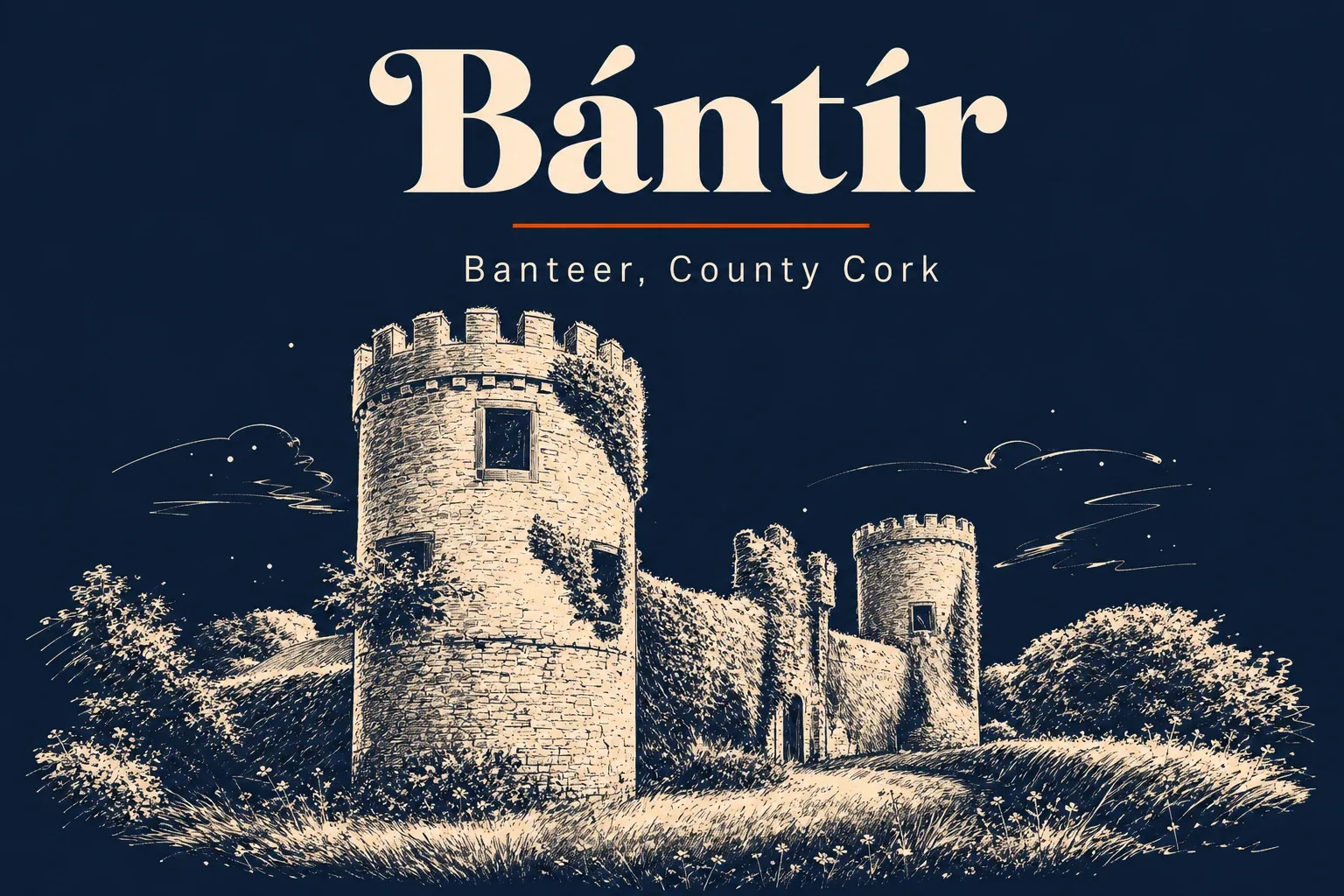
East of the village, south of the Blackwater, are the ruins of Clonmeen - the medieval parish centre, with a ruined church and the remains of Clonmeen Castle. The castle in its later form dates from the 1590s and was a seat of the O'Callaghans, the Gaelic family who held this stretch of the Blackwater. The parish takes its patron from St Furzey, and St Furzey's Well still sits at Clonmeen. Mount Hillary rises over the old monastery and the ford, which is the route the modern forest walk follows.

04 / 07

Things to do outside.

Wear waterproofs. Bring a sandwich. Tell someone where you're going if it's the mountain.

Mount Hillary Loop The local walk. Start in the village and follow the waymarked red route up through the forestry on Mount Hillary above the Blackwater valley. Forest track and some open hill, with views back over Duhallow on a clear day. Boots and a willingness to share the trail with the odd forestry vehicle. Longer routes branch off it for those who want the full half-day.
About 8 km loop (longer red route available)distance
2 to 3 hourstime
Pondfield and riverside amenity walk The community-built Pondfield development and playground sit at the edge of the village with a short, flat amenity walk - the project that won a Tidy Towns wildlife award in 2001. Not a hike, but a clean leg-stretch if you are waiting on a train.
Short, in the villagedistance
20 to 30 minutestime
05 / 07

When to go.

There is no bad time. There are different times.

Spring
Mar-May

The Blackwater valley greens up and the Mount Hillary forest is at its best for walking before the midges. Trout fishing opens on the river.

◉ Go
Summer
Jun-Aug

Long evenings, GAA in full swing at the field, and the easiest time to use the rail line for a base-and-explore trip into Killarney or Cork.

◉ Go
Autumn
Sep-Oct

Good light on the forest and the river, quiet trails, and the village settled back into itself after the summer.

◉ Go
Winter
Nov-Feb

Short days and wet forestry tracks. The pub, the Glen Theatre and the trains keep going, but there is little reason to make the trip in deep winter unless something is on at the theatre.

◐ Mind yourself
06 / 07

What to skip.

Honestly? Don't bother.

If a local was sitting beside you, this is the bit where they'd lean in.

×
Expecting a destination

Banteer is a village of a few hundred people. There is a pub, a shop, a station, a theatre and a forest walk, and that is genuinely the list. Come for a quiet base or a specific reason - the rail line, the walk, a show at the Glen - not for a day of sightseeing.

×
A dramatic castle visit at Clonmeen

Clonmeen Castle is a ruin in a field on private farmland, not a visitor attraction with a car park and a tearoom. Admire the history, but do not expect a guided tour, and respect the land.

×
Looking for the battlefield

Knocknaclashy 1651 was fought near here, but there is no monument trail or interpretive centre. It is ordinary farmland now. The story is worth knowing; there is little to photograph.

+

Getting there.

By car

Banteer is just off the N72 between Mallow and Kanturk. Mallow to Banteer is about 20 km, 25 minutes. Kanturk is about 13 km, 15 minutes north-west. Cork city is roughly an hour south.

By bus

Local Link Cork runs limited rural services through the Duhallow area; check current timetables. For most visitors the train is the better public option.

By train

This is the village's real asset. Banteer station, open since 1853, is on the Mallow to Tralee line. Trains run roughly every two hours: east to Mallow (change for Cork and the Dublin line) and west to Millstreet, Rathmore, Killarney and Tralee. A small village with a working intercity-connected station is unusual and worth using.