County Cork Ireland · Co. Cork · Kilcorney Save · Share
POSTED FROM
KILCORNEY
CO. CORK · IE

Kilcorney
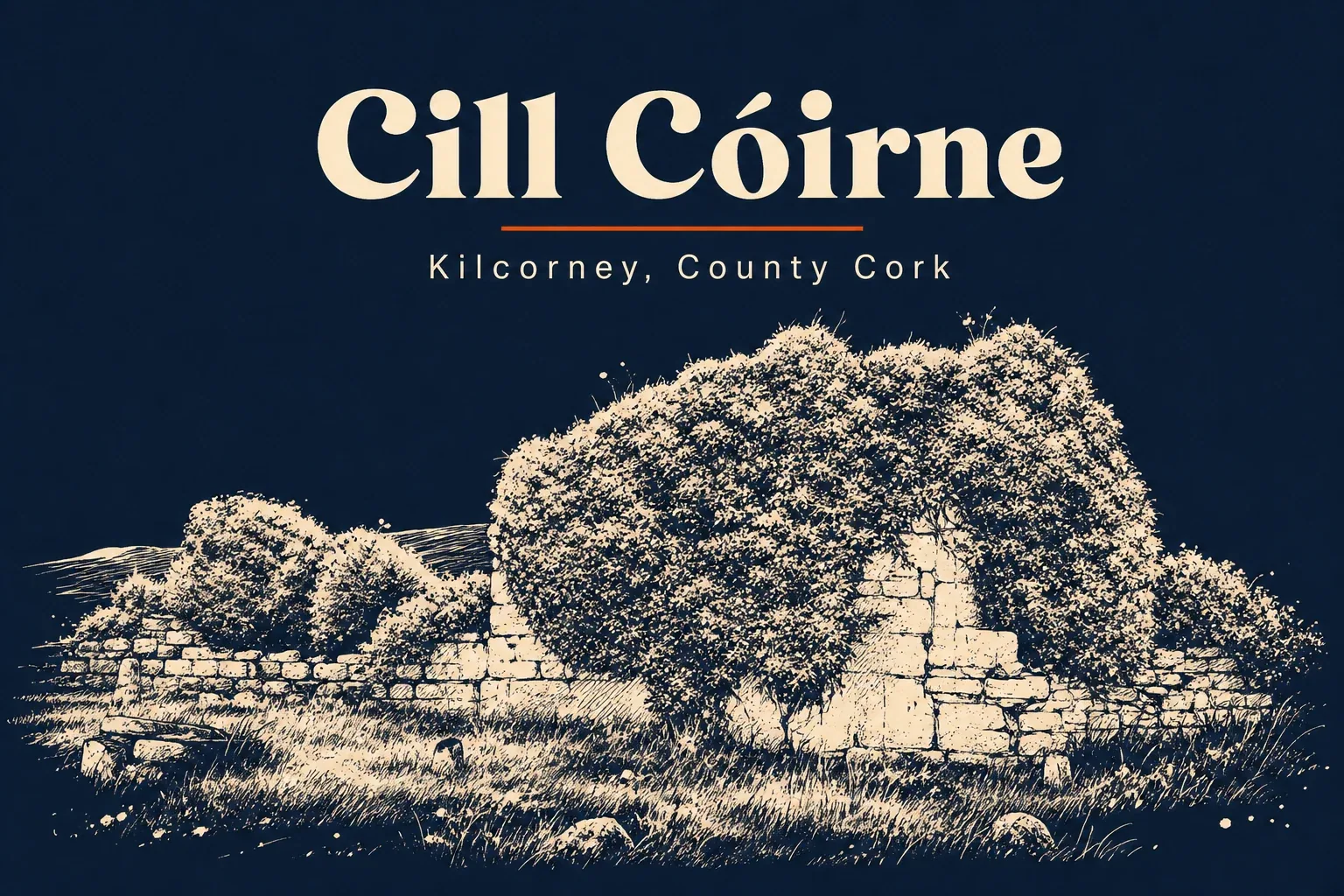
Cill Cóirne, Co. Cork

The North Cork
STOP 07 / 07
Cill Cóirne · Co. Cork

A scattered upland parish under Mushera, on the old Butter Road between Cork and Kerry. One pub, a strong GAA streak, and a holy-well pilgrimage that still draws a crowd on midsummer.

Kilcorney is not a village in the way most people mean the word. It is a scattered upland parish in the barony of Muskerry West, sitting in the high ground south of Millstreet where north Cork starts climbing toward the Boggeragh Mountains. There is a church, a national school, a community centre, a single pub, and a few hundred people spread across townlands with names like Crinaloo, Horsemount and Stonefield. The name is Cill Cóirne - usually read as the church of the stone fence or weir.

Mushera is the thing you see first and remember longest. Musheramore rises to 644m on the parish's southern edge, the highest of the Boggeraghs, and it sets the tone for the place - exposed, quiet, more bog and rough pasture than soft green. The old Butter Road from Cork to Killarney crossed the mountain here, and the Kerryman's Table, a flat resting-stone dated 1747, still sits on the slope at the exact midpoint between the two cities. Drovers stopped here to rest butter firkins on the long haul to the Cork Butter Exchange.

The history that touches Kilcorney is mostly its edges. In 1651 the Battle of Knocknaclashy was fought a few miles north toward Dromagh and Kanturk, on the borders of the parish - the last pitched battle of the Irish Confederate Wars, where Lord Broghill's Parliamentarians broke Lord Muskerry's army. A church was burnt in Kilcorney in the aftermath. What is left now is the older, slower thing: the hill, the holy well, the GAA pitch, and the same families farming the same townlands.

Use Kilcorney for what it is - a base for the mountain and a slice of unhurried north Cork. Millstreet, seven kilometres west, has the shops, the train and the Green Glens Arena. Macroom is seventeen kilometres south. Do not arrive expecting a streetscape. Arrive expecting a road, a pub, and a view.
Population
~305 (2006 ED)
Pubs
1and counting
Founded
Medieval civil parish, barony of Muskerry West; church burnt after 1651
Coords
52.1120° N, 8.9870° W
01 / 07

At a glance.

Three things every local will eventually mention. Read these and you've already understood more than most day-trippers do.

02 / 07

The pubs.

None of these are themed Irish pubs, because they don't need to be. A few that earn the trip:

Healy's Bar

Craic agus ceoil, community local
Village pub, Kilcorney (Curraraigue, Banteer post)

The one pub, and the social centre of the parish. Tagline is Craic agus Ceoil and it means it - music nights, fundraisers and community events through the year. Opens late afternoon on weekdays, midday at weekends. If you want a pint in Kilcorney, this is it; if you want choice, drive the seven kilometres to Millstreet.

03 / 07

Stories & lore.

The reason to come back. The things every local will eventually tell you about, usually after the second pint.

1747, midway Cork to Killarney

The old Butter Road and the Kerryman's Table

For most of the eighteenth and nineteenth centuries, butter from Kerry and west Cork moved east to the Cork Butter Exchange along a network of butter roads. One of them climbed over Mushera through Kilcorney. The Kerryman's Table, a large flat rock on the mountain's slope, was set up in 1747 as a resting and collecting point - placed, the story goes, exactly midway between Killarney and Cork City, twenty-five miles in either direction. Drovers rested firkins of salted butter here before the last push to market. The stretch of the route over Mushera is now part of the waymarked Duhallow Way, and you can still walk the line the drovers walked.

Midsummer pilgrimage, 24 June

St John's Well on Mushera

On the slope of Mushera, at the edge of the forestry, is one of three holy wells on the mountain all dedicated to St John. The pilgrimage falls on St John's feast, 24 June, and it still pulls a crowd - an evening Mass, the Millstreet Pipe Band, and pilgrims paying the rounds at the well: seven each of the Our Father, Hail Mary and Gloria on the knees, three circuits of the well with a decade of the rosary, water carried home in bottles. The grotto you see is a 1950s rebuild; the well and its pattern day are far older. The pattern, with its vendors and entertainment, ran until about 1940 before the modern Mass took over.

Knocknaclashy, July 1651

The last battle of a long war

On the northern borders of the parish, toward Dromagh and Kanturk, the Battle of Knocknaclashy was fought in July 1651. Viscount Muskerry marched north with around three thousand men, hoping to relieve the siege of Limerick, buoyed by a prophecy that the Irish would win a great battle. Lord Broghill's Parliamentarian force, outnumbered but better trained and stronger in cavalry, intercepted and broke them in open country. Muskerry escaped; hundreds of his men did not, and Broghill had most prisoners killed. It was the last pitched battle of the Irish Confederate Wars. A church in Kilcorney was burnt in the aftermath.

04 / 07

Things to do outside.

Wear waterproofs. Bring a sandwich. Tell someone where you're going if it's the mountain.

Musheramore summit The big one. Musheramore is 644m, the highest of the Boggeraghs, with a long arc of view on a clear day from the Derrynasaggarts to the Galtees. Open moorland and bog - boots, a map and respect for the weather, which comes in fast off the mountain. The northern slopes follow an old bog road that is part of the Duhallow Way.
8-10 km returndistance
3-4 hourstime
The Old Butter Road / Duhallow Way The waymarked Duhallow Way follows the line of the old Cork-Killarney butter road over Mushera, past the Kerryman's Table. You can do a stretch as an out-and-back without committing to the full long-distance route. Quiet, rough underfoot, and historically the most interesting walk in the parish.
Variable, several kmdistance
1-3 hourstime
St John's Well loop A short walk to the holy well at the forestry edge on Mushera's slope. Worth it for the setting and the rounds-worn ground around the well, busiest by far on the 24th of June. Combine with a stretch of the butter road for a fuller morning.
Shortdistance
30-45 minutestime
05 / 07

When to go.

There is no bad time. There are different times.

Spring
Mar-May

The bog and pasture green up and the Mushera walking is at its best before the midges. Long, clear days on the mountain when the weather behaves.

◉ Go
Summer
Jun-Aug

Midsummer is the time to be here - the St John's Well pilgrimage on the 24th of June is the one day the parish fills. Longest evenings for the hill.

◉ Go
Autumn
Sep-Oct

Good walking light and the heather on Mushera turning. Quiet roads, GAA championship season for Dromtarriffe down the road.

◉ Go
Winter
Nov-Feb

Short days and serious weather on the mountain - Mushera is not a casual winter outing. The pub keeps going. Most else closes in on itself.

◐ Mind yourself
06 / 07

What to skip.

Honestly? Don't bother.

If a local was sitting beside you, this is the bit where they'd lean in.

×
Looking for a village centre

There is not really one. Kilcorney is a scattered rural parish - a church, a school, a pub and townlands, not a street of shops. If you want a high street, that is Millstreet, seven kilometres west.

×
Mushera in bad weather

Musheramore is 644m of exposed bog and moor, and the cloud comes down without warning. This is a navigation-and-boots mountain, not a stroll. If the top is in cloud, walk the butter road low down instead and save the summit for a clear day.

×
Confusing it with the Clare Kilcorney

There is a Kilcorney in the Burren, Co. Clare, famous for a cave and a turlough. This is not that one. This Kilcorney is upland north Cork under Mushera. Set your map accordingly.

+

Getting there.

By car

On minor roads in the high ground between Millstreet and Macroom, off the R582. Cork City is about 38 km southeast; Millstreet 7 km west; Macroom 17 km south. You need a car - this is rural north Cork and the roads are narrow and hilly.

By bus

No village service. The nearest useful public transport is at Millstreet. Local Link covers parts of rural Duhallow but does not run into the parish on a tourist schedule - check current timetables before relying on it.

By train

Millstreet station, 7 km west, is on the Mallow-Killarney line (Dublin-Cork-Tralee services call there). From the station you still need a car or lift to reach Kilcorney.