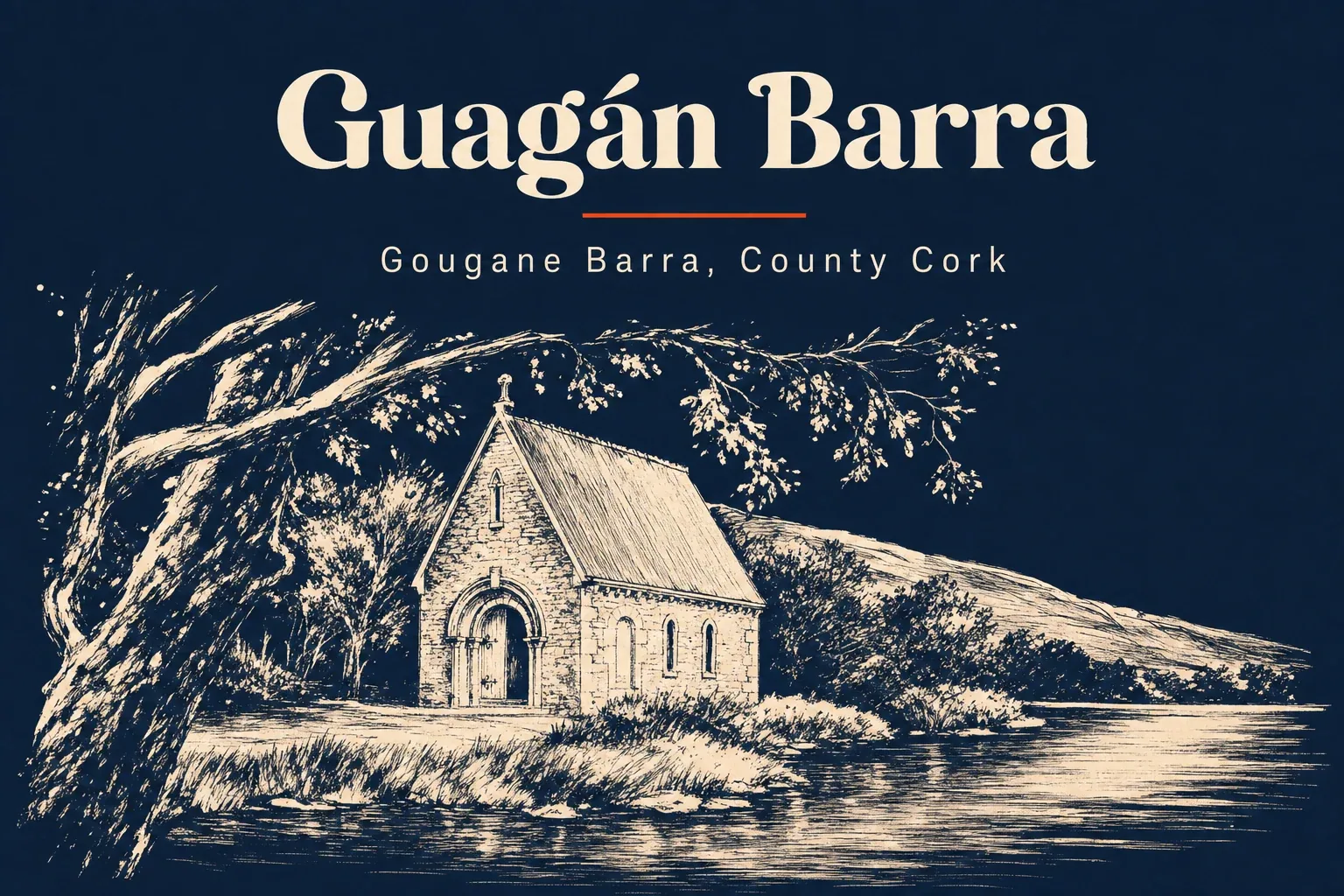
Guagán Barra · Co. Cork
A lake, an island, an oratory, and a river that flows to Cork city. No settlement, just what matters.
Gougane Barra is not a town. It's a mountain lake with an island in it and a man's choice to live alone on that island in the 6th century. St Finbarr came here and built a hermitage. He lived in silence - or as much silence as you can have when the mountains are listening. He stayed until he didn't, then moved to what's now Cork city to found the monastery that became the city itself. The river that runs out of this lake - the River Lee - goes straight there. Geography and piety arranged into one continuous line.
What you see now: the lake, dark and high in the mountains. An oratory on the island, built in 1901-1902 in careful Romanesque revival by the O'Brien family. A causeway connects it to the shore. You can walk out there. The forest park surrounds the whole thing - state-managed, full of trails, the Shehy Mountains folded into the view. There's a hotel, genuinely old-fashioned, family-run, that books out months ahead. There's a car park. There's silence. That's the settlement.
The Pattern Day - September 25, the feast of St Finbarr - brings pilgrims who haven't forgotten. An outdoor mass on the island. The rest of the year is quieter, which may be the point. Come for the lake, the weight of the mountains, the fact that a river draining that small body of water eventually powers a city. Or come for the Pattern, when the pilgrims remember why they came in the first place.