County Cork Ireland · Co. Cork · Kealkill Save · Share
POSTED FROM
KEALKILL
CO. CORK · IE

Kealkill
An Chaolchoill, Co. Cork

The Wild Atlantic Way
STOP 07 / 07
An Chaolchoill · Co. Cork

A crossroads village 10km north of Bantry that sits in the middle of one of the densest Bronze Age ritual landscapes in West Cork - a five-stone circle, a stone pair, a radial cairn, and more besides - with a 16th-century O'Sullivan Beare tower house down the road.

Kealkill is not a detour you make casually. It is about 10km north of Bantry, a crossroads village wedged into the high country where the road climbs toward the Shehy Hills and the Pass of Keimaneigh. The village proper is a scatter of houses around the junction - a church, a shop, a school, a GAA club called St Colum's, two pubs. There is no supermarket and no pretence about being anything other than what it is.

The reason to come is what is in the fields around it. Kealkill sits in the middle of one of the densest concentrations of Bronze Age ritual monuments in West Cork. The five-stone circle on Maughanclea Hill is the headline, but it is not alone: there is Breeny More with its four boulder burials a kilometre to the south-east, the Maughanasilly stone row a couple of kilometres north, and the castle down by the river. You could spend a full day here and only walk a few miles.

The other anchor is Carriganass Castle, a 16th-century tower house built by the O'Sullivan Beare clan and tied to Donal Cam O'Sullivan, who held the Munster forces at Kinsale and then marched the length of Ireland in the winter of 1602. The community restored it and you can walk the ruin for nothing.

Use Kealkill as a threshold. The Coomhola Valley opens to the west, the Beara-Breifne Way passes through on its way north, and the R584 climbs to Gougane Barra and the Pass of Keimaneigh. Bantry has the shops, the food and the beds. Kealkill has the stones and the quiet.
Population
A small upland village, roughly 300 in the wider area
Pubs
2and counting
Walk score
Crossroads to the stone circle in twenty minutes uphill
Founded
Pre-historic ritual landscape; village around the church and crossroads
Coords
51.7508° N, 9.3803° W
01 / 07

At a glance.

Three things every local will eventually mention. Read these and you've already understood more than most day-trippers do.

02 / 07

The pubs.

None of these are themed Irish pubs, because they don't need to be. A few that earn the trip:

Collins Bar

Family-run country local
Village pub, at the crossroads

A no-frills country pub in the middle of the village, family owned and run. A good pint of stout on tap and live music from local players some evenings. The kind of bar where the welcome is the point. One of the two pubs in Kealkill.

The village's second pub

Local
Traditional pub

Kealkill has two public houses. Collins Bar is the one most often named by visitors; the second is a traditional village bar. Between them they cover a small place. If you want a wider choice, Bantry is 10km south.

03 / 07

Stories & lore.

The reason to come back. The things every local will eventually tell you about, usually after the second pint.

Bronze Age, around 1500 BC

The stone circle on Maughanclea Hill

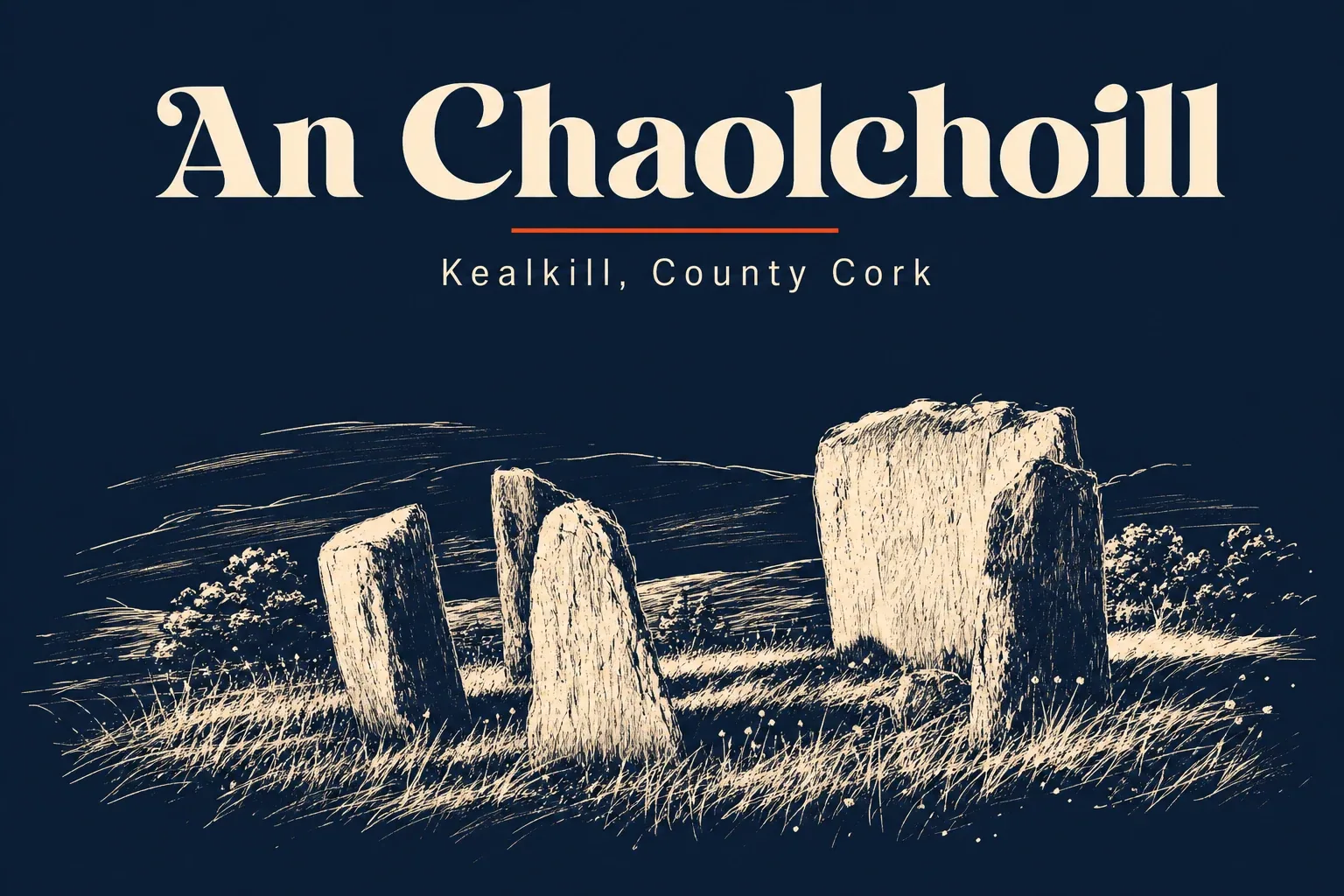
On the slopes of Maughanclea Hill above the village, at 120 to 150 metres overlooking Bantry Bay, sits a small axial five-stone circle - about 2.8 by 2.4 metres, modest by any measure. What makes it unusual is the company it keeps. Five metres to the north-east stand a pair of stones, one now 4.3 metres tall (it was over five before it leaned and was re-erected). Two metres beyond that are the kerbed remains of a radial cairn that once had eighteen small upright stones set around its rim. A 1938 excavation found two shallow ditches crossing under the circle and no burials or datable finds. It is real Bronze Age archaeology on open hillside, not reconstruction, and it is far less visited than the bigger southern circles.

O'Sullivan Beare, 1541 onward

Carriganass Castle and Donal Cam's retreat

Carriganass is a tower house built around 1541 by the chieftain Dermot O'Sullivan Beare, set at the eastern end of the clan's West Cork territory above the Ouvane river. A bawn wall was added about forty years later. The castle's famous occupant was Donal Cam O'Sullivan, who commanded the Munster forces at the Battle of Kinsale in 1601 and, after the fall of Dunboy, led roughly a thousand followers on the long winter march to Leitrim in 1602 - only a handful reached the end. The O'Sullivans were dispossessed and the castle passed to the Barretts, who held it until the 1930s when the O'Sullivans bought it back. In 2002 the family gave it to the community, and the Carriganass Development Association restored the ruin. It is the best surviving of the four O'Sullivan Beare castles, and it is free to walk.

Breeny More and Maughanasilly

A landscape of stones

The stone circle is the start, not the end. A kilometre south-east, overlooking Bantry Bay, is Breeny More: a circle with two entrance stones, an axial stone and four boulder burials, aligned north-east to south-west on the solstices. Two and a bit kilometres north, on the eastern slopes of Knockbreteen above Lough Atooreen, is the Maughanasilly stone row - five standing stones and one fallen, set up around 1600 to 1500 BC and read by some as a lunar and equinox observatory. Together with the circle and cairn, they make Kealkill a place where Bronze Age people clearly thought something important happened, again and again.

19 April 1922

The first shots of the Civil War

Kealkill has one grim footnote in modern Irish history. On Wednesday 19 April 1922, in the village, two anti-Treaty Republican IRA volunteers were killed - recorded as among the first fatalities of the Irish Civil War, months before the conflict is usually said to have begun. It is a quiet crossroads now, but the memory sits in the place.

04 / 07

Things to do outside.

Wear waterproofs. Bring a sandwich. Tell someone where you're going if it's the mountain.

Kealkill stone circle Signposted up Maughanclea Hill from the crossroads. A short, steep walk to the circle, the stone pair and the cairn, with Bantry Bay opening below and the Shehy Hills behind. Boots in wet weather - it is open hillside and the ground holds water. The best single half-hour in Kealkill.
Short uphill from the villagedistance
30 to 45 minutes returntime
Carriganass Castle On the Ouvane river just north of the village, restored and free to walk. Read the tower house, the bawn, and the O'Sullivan Beare story. Easy underfoot, good for an unhurried look. Combine with the stone circle for a half-day.
Roadside, a few minutes north of the villagedistance
30 minutestime
Beara-Breifne Way (Kealkill section) The waymarked Beara-Breifne Way - the modern walking route that follows Donal Cam O'Sullivan's 1602 march - passes through Kealkill on its way north. You can walk a stretch toward Glengarriff or the hills. Check the route map locally; this is upland country and weather moves fast.
Long-distance route, walk a stretchdistance
Half a day or moretime
Coomhola Valley The Coomhola Valley opens west of the village - a wild, sparsely settled mountain valley with stream-side lanes and genuine walking country toward the Shehy Hills. No facilities. Bring what you need and tell someone where you are going.
Quiet valley roads westdistance
Half a daytime
05 / 07

When to go.

There is no bad time. There are different times.

Spring
Mar-May

Lambs in the fields, wildflowers on the hill, clear days for the climb to the circle. The valley is alive and the light is sharp.

◉ Go
Summer
Jun-Aug

Long days and the settled spells that make the open hillside walking easiest. The stone circle sits in full light with Bantry Bay below.

◉ Go
Autumn
Sep-Oct

Honest weather and fast-moving cloud. Autumn light on the stones and the Shehy Hills is the picture you came for. Probably the best month.

◉ Go
Winter
Nov-Feb

Cold and exposed on the hill, with serious wind off the high ground. The stones are still there but the weather is the story. Short days; come prepared.

◐ Mind yourself
06 / 07

What to skip.

Honestly? Don't bother.

If a local was sitting beside you, this is the bit where they'd lean in.

×
Expecting a village with cafes or a supermarket

Kealkill is a crossroads, not a resort. It has two pubs, a shop, a church and a school, and that is the honest list. Food, coffee and beds are in Bantry, 10km south. Bring what you need for the hill.

×
Confusing the various stone sites

There is the five-stone circle on Maughanclea Hill, the stone pair and cairn beside it, Breeny More a kilometre south-east, and the Maughanasilly stone row a couple of kilometres north. They are different sites. Ask locally or carry a map so you reach the one you mean.

×
Walking the hill or the Coomhola Valley without checking the weather

This is high, exposed country and the weather changes quickly. A clear morning can close in by afternoon. Come early, wear boots, and wait for a stable day if the cloud is down.

+

Getting there.

By car

From Bantry it is about 10km north - take the R584 toward the Pass of Keimaneigh and turn for Kealkill, well signposted. From Cork city it is roughly 75km west, around 1h 30m, via Bandon and Bantry. Glengarriff is a short drive to the west.

By bus

Bus Eireann route 236 stops near Kealkill, linking the area with Bantry. Services are limited and rural - check current Bus Eireann and TFI Local Link timetables before relying on them. Bantry is the main bus hub for the area.

By train

There is no railway in West Cork. The nearest mainline station is Cork (Kent), about 75km east, on the Dublin line. From Cork you continue west by bus or car.

By air

Cork Airport (ORK) is the nearest, roughly 1h 30m by road. Kerry Airport (KIR) at Farranfore is a similar distance to the north-west. Both have a hire-car desk, which you will want out here.