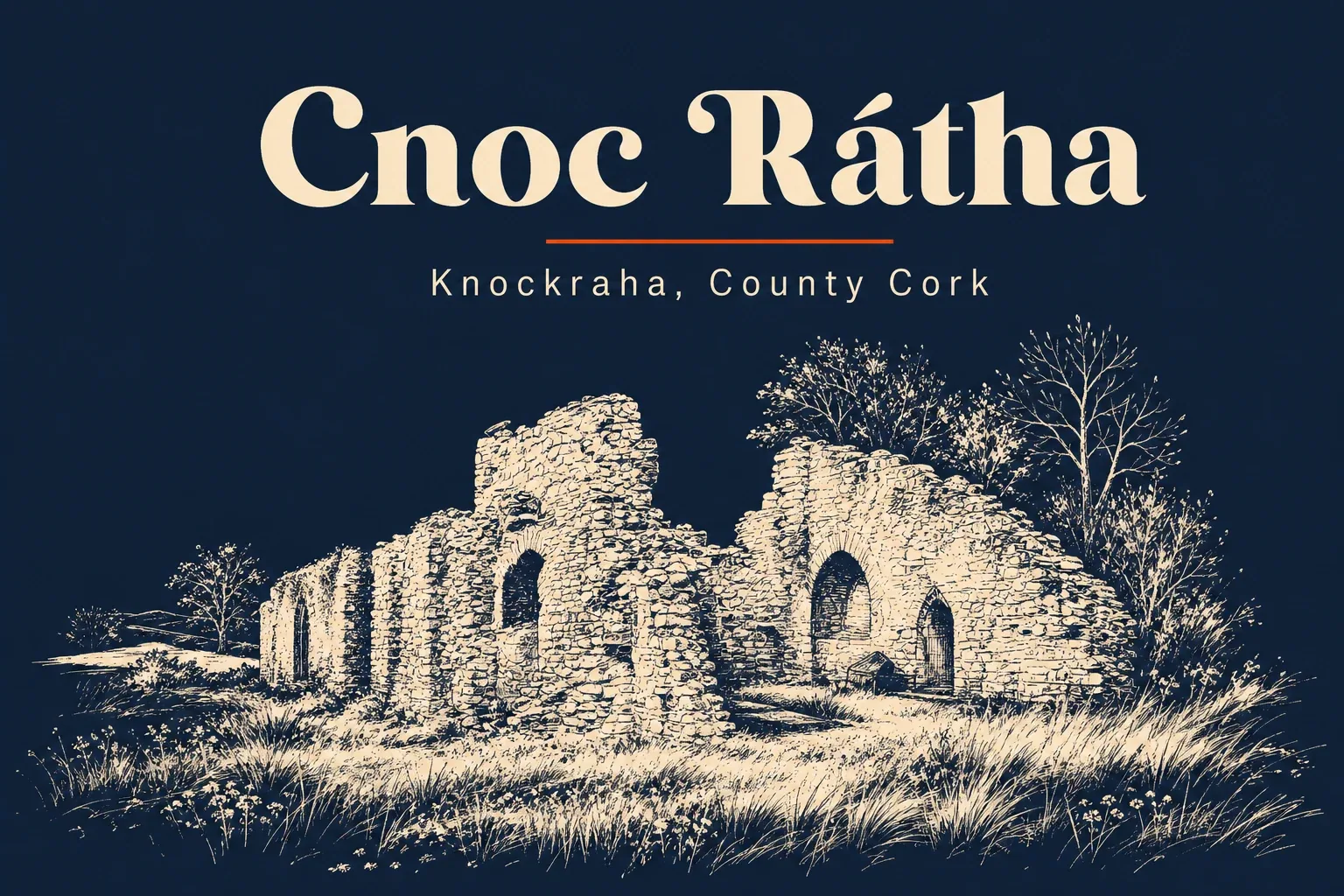
Cnoc Rátha · Co. Cork
A quiet East Cork hill village with one pub, an early church site, and a War of Independence story darker than anywhere this peaceful has a right to be.
Knockraha sits on high ground between Cork city to the west and the harbour towns to the south, overlooking the lower Lee valley. It is the kind of place you would pass without stopping, except that the views make you slow down. The village is agricultural - scattered houses, working land, a national school, a community centre, the GAA - and quiet in the way rural East Cork is quiet. The name, Cnoc Rátha, means the hill of the forts, after a ring of raths that stood on the high ground locals call Carthy's Hill.
A kilometre north of the village is Kilquane, an early church site and graveyard. Tradition holds it was founded by St Cuan - Kilquane means the church of Cuán - and the monastic origins are reckoned to run back well over a thousand years. It is the older, quieter spine of the place, the reason there has been a settlement on this hill for as long as there has.
And then there is the other history, the one that does not announce itself. During the War of Independence Knockraha was a vital base for the IRA's Cork No. 1 Brigade - E Company, 4th Battalion, under Captain Martin Corry, who later sat as a Fianna Fáil TD for decades. The parish hid two bomb factories, a string of safe houses, and a prison improvised inside a crypt at Kilquane that the Volunteers nicknamed Sing Sing. Prisoners and informers held there did not always leave. The story is not in the brochures, but the village has now told it on its own terms, with a marked trail. You feel it in the place: practical people who have lived a long time with what happened here.
Come for the trail and the views, not for nightlife. There is one pub, one church site, one hill, and a long memory. That is the entire offer, and it is enough for an afternoon.