County Cork Ireland · Co. Cork · Liscarroll Save · Share
POSTED FROM
LISCARROLL
CO. CORK · IE

Liscarroll
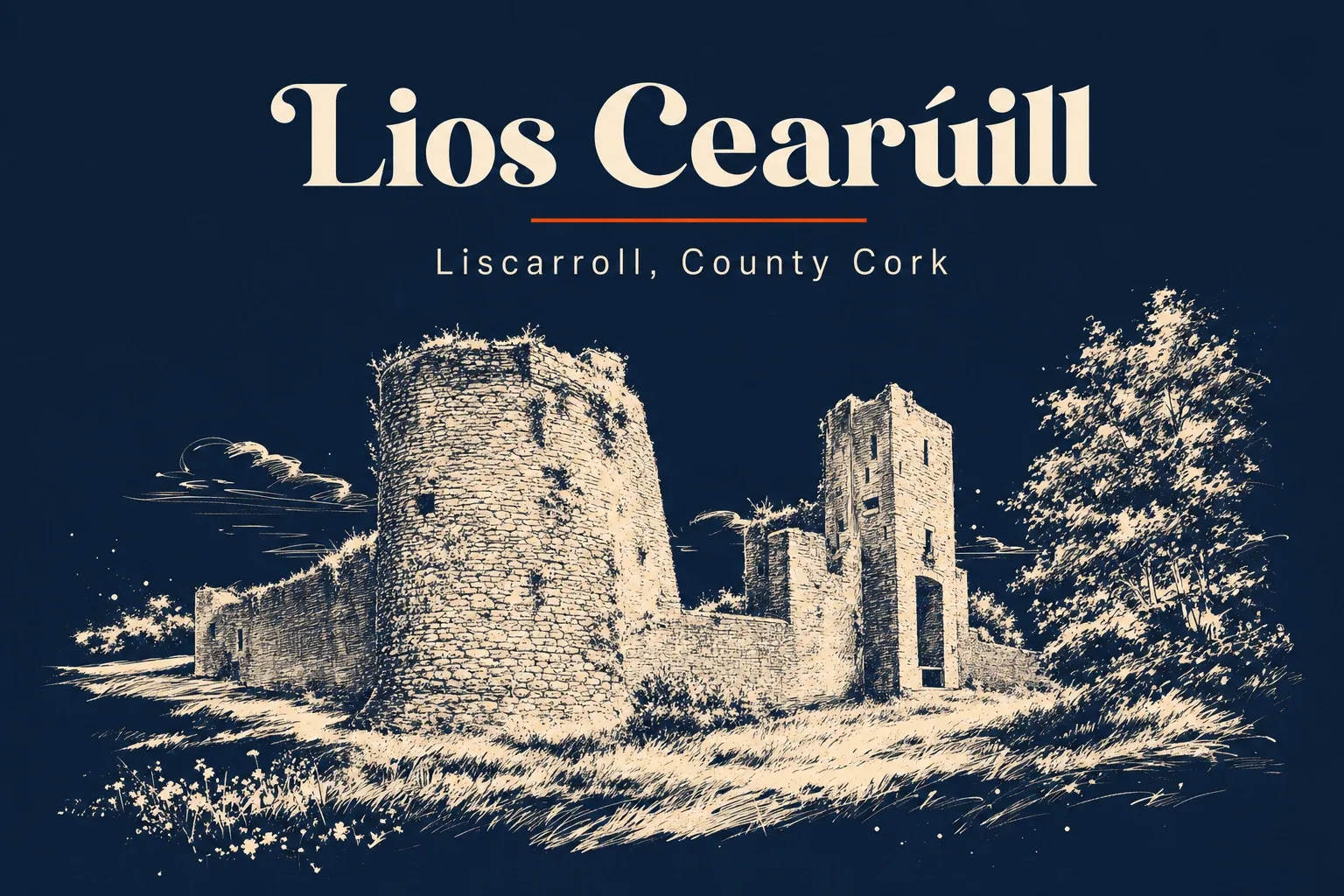
Lios Cearúill

The North Cork
STOP 04 / 04
Lios Cearúill · Co. Cork

A castle that forgot to stay small. The village still hasn't caught up.

Liscarroll Castle is one of the largest Anglo-Norman castles in Ireland — three round towers, a massive curtain wall, footprint comparable to Trim in Meath. Then you arrive and find a village of three hundred people, a church, two farms, and not much else.

The castle is why you're here. It dominates everything — the landscape, the conversation, the whole geometry of the place. Built by the de Barry family in the late 13th century, it's exactly what you think a Norman stronghold should look like. Except no one's paying attention. It's free to walk around, undervisited, and honest in a way famous ruins aren't.

In 1642, during the Confederate Wars, a major Catholic army was defeated here by English Royalist forces — one of Munster's biggest engagements of that conflict. The fields remember. The castle doesn't care. It's been standing for eight hundred years. It'll stand for another thousand. The village will probably stay at three hundred.

Come for the castle. It's worth the diversion. There's nothing else here — that's not a complaint, it's just true. Newmarket, eight kilometers south, has the pubs and the shops. This place has the walls, the silence, and the sense that you've accidentally stumbled into a place the tour operators forgot.
Population
~300
Founded
c. 1260 (de Barry)
Coords
52.2517° N, 8.8333° W
01 / 04

At a glance.

Three things every local will eventually mention. Read these and you've already understood more than most day-trippers do.

02 / 04

Stories & lore.

The reason to come back. The things every local will eventually tell you about, usually after the second pint.

Scale and silence

The castle

Liscarroll Castle is massive. Three round towers, a curtain wall that covers acres, stonework that assumes it will outlive empires. The de Barry family built it to control the territory. It worked. It still controls the territory — the village has grown around it, inside the old precinct, smaller and smaller with each generation. The castle doesn't notice. It's been here since c. 1260. It will be here long after.

Confederate Wars, 1642

The battle

A major engagement of the Irish Confederate Wars. A Catholic army was defeated here by English Royalist forces — one of the biggest military actions in Munster during that conflict. The fields are flat and good for dairy farming now. No monument. No plaques. Just fields and a castle that watched it happen.

Three hundred people

The village

The village is barely a village. A church, a few houses, farms spreading north toward Newmarket. The real world is eight kilometers south, where the shops are. This place is pure — it's the castle and the land and the people who live quiet lives. No tourism infrastructure. No compromise. If you come here, you're either lost or you meant to be.

03 / 04

When to go.

There is no bad time. There are different times.

Spring
Mar–May

Lambs, green fields, the castle walls in clear light.

◉ Go
Summer
Jun–Aug

Long days to walk the precinct. Less likely to rain.

◉ Go
Autumn
Sep–Oct

Low light is best light for castle walls.

◉ Go
Winter
Nov–Feb

The fields are muddy. The castle is colder. But it's also emptier.

◐ Mind yourself
+

Getting there.

By car

Newmarket is 8km south. Liscarroll is signposted north. There's a car park near the castle.

By bus

Bus Éireann runs through Newmarket. You'll need a car from there.

By train

Cork city is 40km south. Rent a car.