County Cork Ireland · Co. Cork · Milford Save · Share
POSTED FROM
MILFORD
CO. CORK · IE

Milford
Áth an Mhuilinn, Co. Cork

The North Cork
STOP 07 / 07
Áth an Mhuilinn · Co. Cork

A creamery village at the top of Cork where the Deel runs under a six-arch bridge and the milk has been the story since 1887.

Milford is a small north Cork village right on the Limerick border, sitting where the River Deel is crossed by a substantial six-arch stone bridge. The Irish name, Áth an Mhuilinn, means the ford of the mill, and that is the whole village in three words: there was a ford, there was a mill, and a settlement grew up around them. It is in the townland and parish of Kilbolane, in the barony of Orrery and Kilmore, at the very top of the county on the R515 between Charleville and Newcastle West. Two hundred and sixty-four people at the 2022 census. It is a working farming village, not a destination, and it does not pretend otherwise.

The thing that made Milford is the creamery. The old mill on the Deel became a dairy factory in 1887, one of the earliest creameries in the country, and the model spread from here to every parish around. The Black and Tans burned it twice in 1920 and the company was awarded ten thousand pounds in compensation - a reminder that this quiet place was not outside the War of Independence. The creamery is still part of what the village is. The rhythm here is the milking and the farming calendar, not the tourist season.

What you will find is a village that has won at Tidy Towns and looks it: two pubs, a Catholic church, a primary school, a Garda station, a tennis court, and the castle out the road. The river runs trout and pike. There is no reason to make a special journey unless north Cork farming country and a good Anglo-Norman ruin are your interest - but if you are passing between Charleville and the Limerick foothills, it is a clean, cared-for stop with a real pint in it.
Population
264 (2022 census)
Pubs
2and counting
Founded
Mill and ford settlement; village grew around the creamery from 1887
Coords
52.3408° N, 8.8556° W
01 / 07

At a glance.

Three things every local will eventually mention. Read these and you've already understood more than most day-trippers do.

02 / 07

The pubs.

None of these are themed Irish pubs, because they don't need to be. A few that earn the trip:

Collins Bar

Farmers and neighbours
Village local, Kilbolane

In the centre of the village. One of Milford's two pubs and the one a stranger is most likely to find open. Straightforward country bar - the farming community gathers here, the Guinness is poured right, and no fuss is made of anyone. There is a second pub in the village; between them they are the social life of the place.

03 / 07

Stories & lore.

The reason to come back. The things every local will eventually tell you about, usually after the second pint.

1887 - the mill that became a dairy factory

The creamery on the Deel

The old corn mill on the River Deel was turned over to butter in 1887, making Milford one of the first creameries in Ireland. The Milford Dairy Factory worked from the start, and similar creameries soon opened in every surrounding parish - the village had stumbled into a model that reshaped Irish dairying. It also dragged the village into the War of Independence: the Black and Tans attacked the creamery twice in 1920, and the company was later awarded ten thousand pounds in compensation. The creamery also brought electric lighting to Milford in 1918, years ahead of most rural villages. The dairy is still the spine of the place.

De Cogan stronghold, slighted by Cromwell

Kilbolane Castle

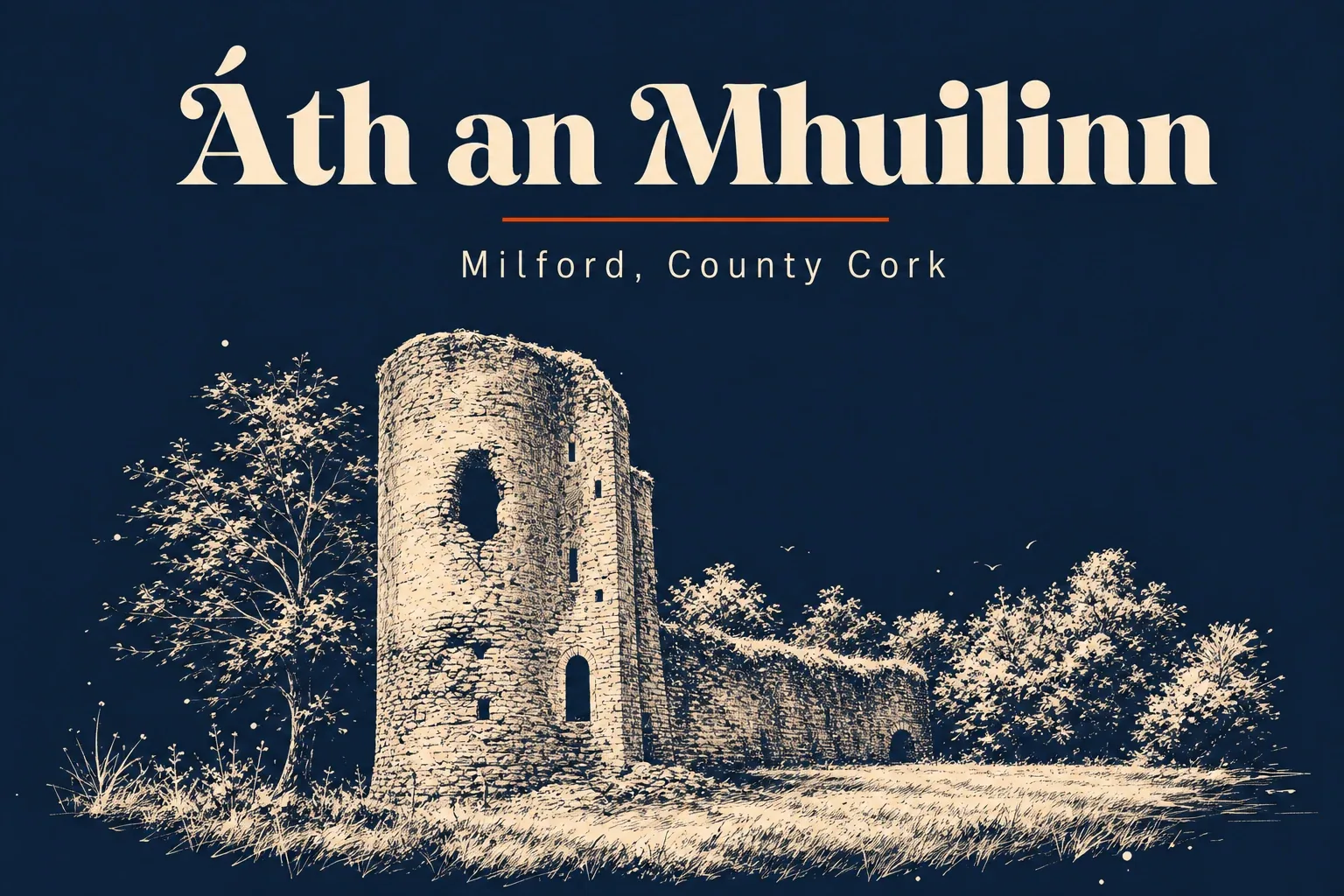
Half a kilometre from the village stands Kilbolane Castle, an Anglo-Norman fortress said to have been raised by the De Cogans soon after Strongbow's arrival. It later became a seat of the Earls of Desmond. The plan was square with a circular tower at each of the four angles; two of those towers survive in fair condition, and the whole thing was once moated. Cromwell's forces partially destroyed it. It is not open to the public, but it is plainly visible from the roadside - a genuine medieval ruin in a field, which is more than many bigger places can show.

1926 - five Milford teachers lost

The Drumcollogher fire

On a September night in 1926 a travelling cinema show in a packed loft in Drumcollogher, just over the Limerick border, caught fire and killed forty-eight people in one of the worst disasters of its kind in Ireland. Five of the dead were teachers from Milford and its schools. It is a thread that ties this small Cork village to the well-known tragedy a few miles north, and it is still remembered here.

04 / 07

Things to do outside.

Wear waterproofs. Bring a sandwich. Tell someone where you're going if it's the mountain.

The Deel bridge and village Walk the village street to the six-arch bridge over the River Deel and back. The bridge is the set piece - substantial cut stone over a trout-and-pike river. A short, honest stroll through a Tidy Towns village; you will see the church, the creamery, and the bones of the place in half an hour.
1.5 km loopdistance
30 mintime
Out to Kilbolane Castle A short walk or drive out the road to view Kilbolane Castle. The castle is half a kilometre from the village and not open, so this is a look-from-the-roadside affair. Quiet lane, farmland, a four-cornered Norman ruin at the end of it. Boots if it has rained.
1 km each waydistance
30 min returntime
05 / 07

When to go.

There is no bad time. There are different times.

Spring
Mar-May

Calving season in dairy country, the Deel valley greens up, and the village is at its best before the Tidy Towns judging settles in. Quiet roads, long light building.

◉ Go
Summer
Jun-Aug

Long evenings for the bridge and the castle, the village in full Tidy Towns bloom. Still no crowds - this is not a tourist village - but the most pleasant time to pass through.

◉ Go
Autumn
Sep-Oct

The farming year winds down, the light goes sharp over the Deel, and the pubs are easy. A good month for a quiet look at the castle.

◉ Go
Winter
Nov-Feb

Short days and damp border-country weather. The pubs and the creamery keep going regardless, but there is little to do outdoors and the castle lane will be muddy.

◐ Mind yourself
06 / 07

What to skip.

Honestly? Don't bother.

If a local was sitting beside you, this is the bit where they'd lean in.

×
Expecting to get inside Kilbolane Castle

You cannot. The castle is on private land and not open to visitors. It is viewed from the roadside only. Come for the view of it, not a tour of it, and you will not be disappointed.

×
Treating Milford as a day out in itself

It is a small working farming village of a few hundred people - two pubs, a church, a school, a castle out the road. That is the whole of it, honestly told. Fold it into a north Cork drive between Charleville and the Limerick villages rather than making a special journey.

×
Looking for shops and services

There is little here beyond the basics. Charleville, ten minutes east, is the town for shopping, food and anything the village does not stock. Plan accordingly.

+

Getting there.

By car

Milford is on the R515, the old Charleville to Newcastle West road, at the extreme north of Co. Cork on the Limerick border. Charleville is about 10 km east; Newcastle West is roughly 25 km north-west. Cork city is about an hour south via the N20 and Charleville. The roads are minor but good.

By bus

There is no direct bus to Milford. Bus Éireann route 320 (Cork to Limerick via Mallow and Charleville) serves Charleville; from there you would continue to Milford by local transport. Local Link covers parts of north Cork - check current rural routes.

By train

The nearest station is Charleville, on the Cork to Limerick to Dublin main line, about 10 km east. From there it is car or local transport to Milford.