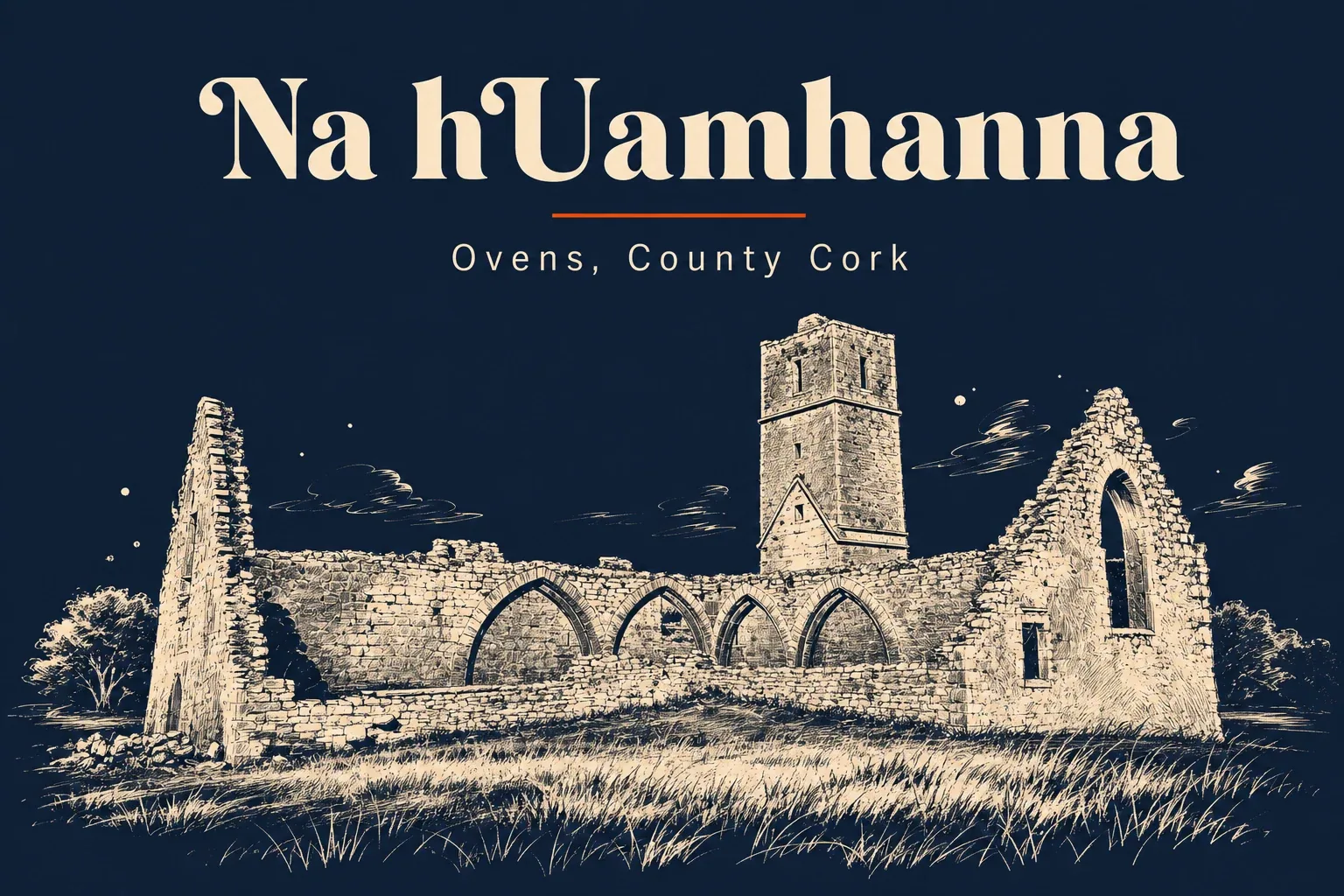
Na hUamhanna · Co. Cork
A commuter village on the N22 west of Ballincollig, named after the limestone caves under it, and the birthplace of a Confederate general.
Ovens sits about five kilometres west of Ballincollig on the N22, the Cork to Killarney road, on the limestone shelf where the river Bride runs down to meet the Lee. It is a commuter village now - houses, a primary school, a GAA club, a couple of bars on the main road - and most of the traffic through it is people going somewhere else. That is honest about what the place is.
The name tells you the one genuinely odd thing about it. Na hUamhanna means the caves, and there is an actual cave system in the limestone by Ovens bridge. Smith's eighteenth-century history of Cork described passages eighteen feet high; centuries of silt and rubble have since filled them to a few feet, and they are mostly flooded. You do not go in. The parish itself, Ovens and Farran, is a union of the older parishes of Athnowen, Desertmore and Aglish, and the fields around hold the usual mid-Cork scatter of ringforts, souterrains, standing stones and fulacht fiadh sites.
The reason a few people make a deliberate stop here is Patrick Ronayne Cleburne, born at Bride Park Cottage in 1828, who became one of the best generals the Confederacy produced before he was killed at Franklin in 1864. There is no museum and no real trail - the house is private - but if you know the story, driving the lanes around Ovens with it in your head is the visit.
Otherwise, treat Ovens as a door rather than a destination. Kilcrea Friary, the fifteenth-century Franciscan ruin that is one of the best in the county, is a short run south-west toward Aherla and Farran. Cork city is twenty-odd minutes east, Blarney is up the road, and the N22 will carry you west into Macroom and the Gaeltacht. Stop for a feed on the main road, look the caves up rather than down, then keep going.