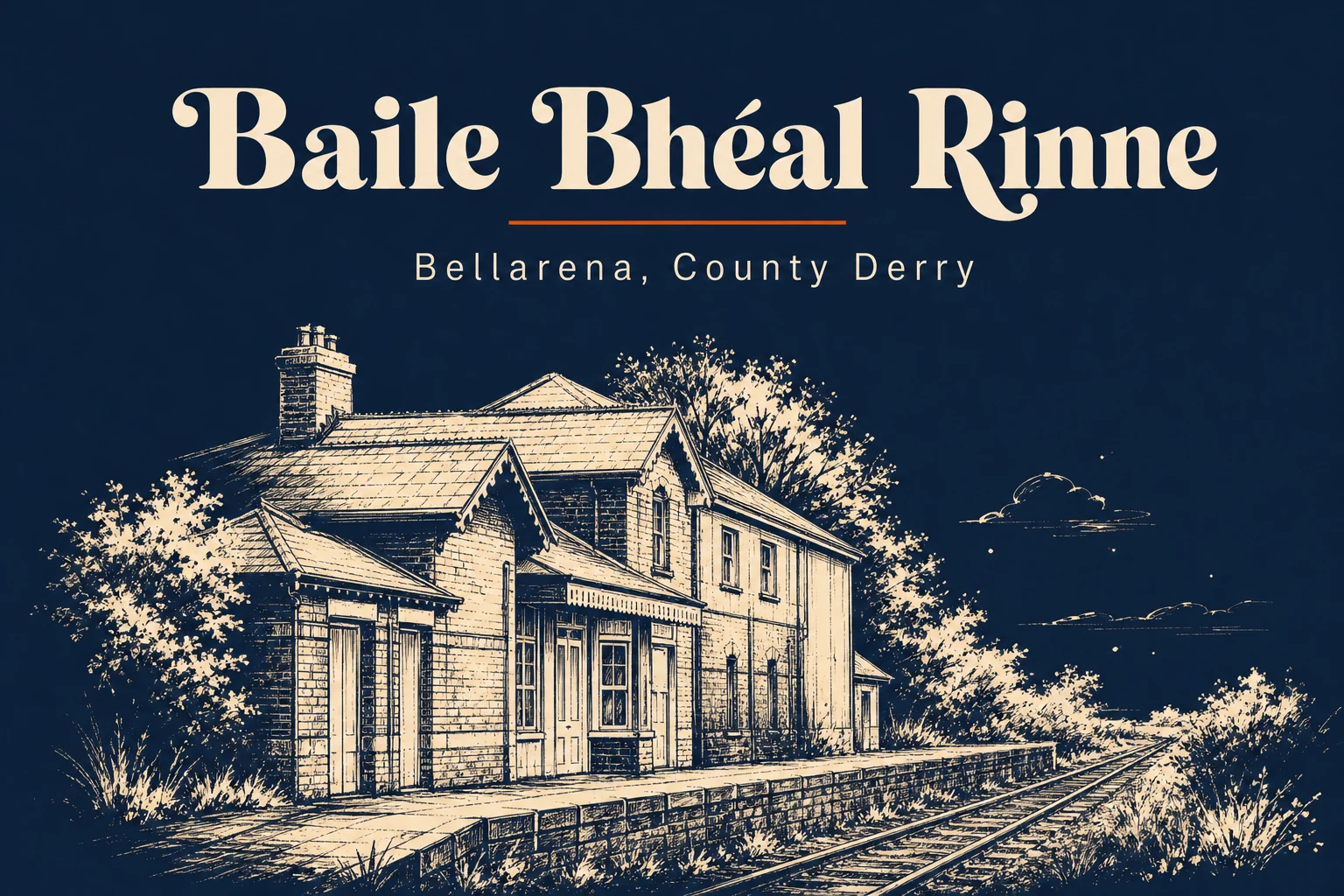
Baile Bhéal Rinne · Co. Derry
A request-stop station, a basalt cliff, and seven miles of strand to the west.
Bellarena is not a village in the usual sense. There is no main street, no square, no clutch of pubs around a crossroads. There is a railway station, a Georgian manor behind its gates, a scatter of farms on the flat ground between the mountain and the Roe estuary, and the long line of Binevenagh holding the eastern horizon. The 2021 census counted 341 people. Most of them you will not see.
What you came for is the geography. Binevenagh is the western full-stop of the Antrim basalt - the same lava field that built the Giant's Causeway, here ending in a cliff line over the Magilligan lowlands. To the west, the lowlands run out into seven miles of strand. To the south, the Roe meets Lough Foyle in mudflats that the geese know better than anyone. Stand at the station car park on a clear day and the whole arrangement is laid out for you in one slow turn of the head.
The way to use Bellarena is as a hinge. Train in from Belfast or Derry, walk up Binevenagh, drive west to the strand, eat in Limavady or Castlerock, come back for the late train. It is not a place that asks you to stay. It is a place that asks you to look.