County Derry Ireland · Co. Derry · Castlerock Save · Share
POSTED FROM
CASTLEROCK
CO. DERRY · IE

Castlerock
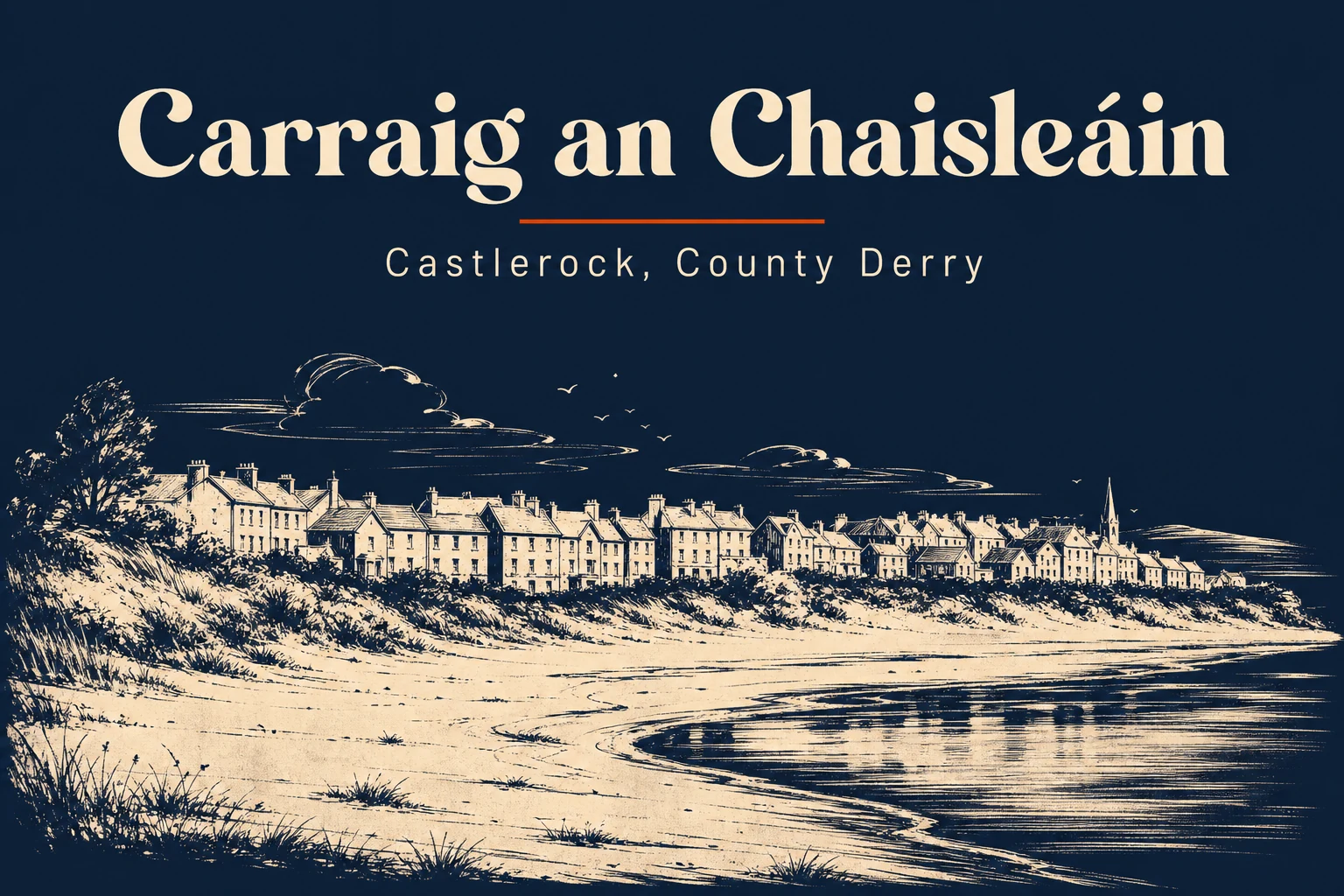
Carraig an Chaisleáin

The Causeway Coast
STOP 03 / 06
Carraig an Chaisleáin · Co. Derry

A two-mile strand, a temple on a cliff, and the longest railway tunnel in the North.

Castlerock is a small Causeway-Coast resort village at the mouth of the River Bann, between Coleraine and Downhill. Edwardian terraces face the sea. A station, a strand, a couple of pubs, a chocolate shop, and a links course laid out by Ben Sayers in 1908 and rewritten by Harry Colt in 1925. That's most of it. The big news sits on the cliff above.

Mussenden Temple is the reason coaches come. Frederick Hervey, 4th Earl of Bristol and Bishop of Derry from 1768 to 1803 — the Earl-Bishop, in local shorthand — built it in 1785 as a clifftop library. He named it for his cousin Frideswide Mussenden. She died the year it was finished, and the library became a memorial. The temple has lost over thirty feet of cliff since then; the National Trust spent the late 1990s bolting the headland together so the rotunda doesn't fall into the sea. The Earl-Bishop's main house, Downhill, sits nearby — built from 1775, gutted by fire in 1851, restored by John Lanyon, abandoned after the Second World War. The shell is still there. It is one of the more melancholy ruins in Ireland.

Most visitors do Mussenden in forty minutes — park, photograph, leave. That's not the trip. The trip is: train into Castlerock station, walk the strand at low tide, climb the Bishop's Gate path through the Black Glen, come up onto the demesne from below, find the temple from the back. Then a pint somewhere on Main Street, then the late train back. It works as a half-day from Belfast and a full day from Derry. Don't drive it if you can avoid driving it. The road is the road. The line is the line.
Population
1,155 (NISRA 2021)
Walk score
Seafront to station in eight minutes
Founded
Railway station opened 18 July 1853
Coords
55.1583° N, 6.7733° W
01 / 09

At a glance.

Three things every local will eventually mention. Read these and you've already understood more than most day-trippers do.

02 / 09

The pubs.

None of these are themed Irish pubs, because they don't need to be. A few that earn the trip:

The Marine Inn

Local, conversational
Village pub

On Main Street. The pub the regulars are in. Pub food at the standard you'd expect. Don't order the cocktails.

The Golf Hotel

Golfers, walkers, trains
Hotel bar

Main Street, two minutes from the station. The bar runs all day; the food is sensible; the conversation tilts toward weather and the wind on the fourth.

Bertha's Bar

Quiet, neighbourly
Sea Road local

Sea Road, away from the main drag. Properly small. Properly local. Worth the two-minute walk if the others are full.

03 / 09

Where to eat.

PlaceTypeLocal note
Costello's Restaurant Seafood-leaning bistro ££ On Main Street. Fish off the boats at Greencastle and Kilkeel, hake and sea bass in particular. Booking sensible at weekends.
The Chocolate Manor Chocolatier & café £ Geri Martin's chocolate workshop on Circular Road. Lunch is light — soups, sandwiches, a cake or six — and the truffle-making classes run Tuesday to Sunday. The Mussenden Sea Salt the menus name comes from a Coleraine producer harvesting off Downhill Strand.
Castlerock Golf Club kitchen Clubhouse food ££ Open to non-members. Sandwiches and a hot lunch with the view across the dunes to the Bann mouth. Phone first if you want dinner.
04 / 09

Where to sleep.

PlaceTypeLocal note
The Golf Hotel Hotel The hotel in the village. Twelve rooms, on Main Street, two minutes from the station and five from the beach. Honest rather than glamorous. Decent breakfast.
Castlerock Holiday Park Caravan park Touring and static pitches a five-minute walk from the strand. Books up in July and August. Not for everyone; brilliant if it is for you.
Self-catering on Sea Road Self-catering A handful of cottages and apartments along Sea Road and Circular Road, mostly through Airbnb and the local agents. If the village is full, Portstewart and Coleraine are ten and fifteen minutes away by train.
05 / 09

Stories & lore.

The reason to come back. The things every local will eventually tell you about, usually after the second pint.

A clergyman with a temple habit

The Earl-Bishop

Frederick Hervey, 4th Earl of Bristol and Church of Ireland Bishop of Derry from 1768 to 1803, was the kind of clergyman who built rotundas. He travelled Italy obsessively — there are Bristol hotels named after him across Europe — and came home with the Temple of Vesta in his head. Mussenden Temple, finished 1785, was meant as a summer library for his cousin Frideswide Mussenden. She died that same year. The temple stayed; the library became a memorial; the inscription around the dome is from Lucretius — pleasant to watch the storm from a place of safety.

A palace, a fire, a slow ruin

Downhill House

Construction on Downhill House began in 1775. Michael Shanahan was the architect — same man who probably designed the temple. The Earl-Bishop filled it with paintings by Correggio, Dürer, Murillo, Rubens and Tintoretto. Most were saved when fire devastated the house in May 1851. John Lanyon's son rebuilt it in the 1870s. It limped through to the Second World War and then nobody had the money. The roof came off in the 1950s. What's left is a Georgian shell on a cliff with the wind running through every empty window.

How the railway got through

The Great Blast

The Coleraine and Londonderry Railway needed to get past the Downhill headland in 1845. They blew it. The Great Blast of October 1845 is how the two tunnels east of Castlerock came to exist — Castlerock Tunnel at 668 yards, Downhill Tunnel at 301. Castlerock is still the longest operational rail tunnel in Northern Ireland. The station opened 18 July 1853 to a Charles Lanyon design. The line out the other side runs along Downhill Strand; on a calm evening, the carriages and the breakers are at the same eye level.

Stannis on the strand

Dragonstone

HBO filmed on Downhill Strand in 2013, with Mussenden Temple standing in for Dragonstone above. The scene is the burning of the Seven from series two — Melisandre, Stannis, the seven idols going up in flames at the water's edge. The temple is a National Trust building and was not on fire. Everything else was real. The film crews come and go; the strand returns to itself within a week.

Older than the temple, and thatched

Hezlett House

Two minutes east of the demesne, Hezlett House is a single-storey thatched cottage built around 1691, probably as a parsonage for the rector of Dunboe. Cruck-framed, which is rare in the North at that date. The Hezlett family lived there from 1761 until the National Trust took it on in 1976. It's older than every other building you'll see in the area by a century.

06 / 09

Things to do outside.

Wear waterproofs. Bring a sandwich. Tell someone where you're going if it's the mountain.

Castlerock Strand Out from the seafront, west toward the Mussenden cliff, back the same way. Best at low tide. Watch the river current at the Bann mouth — strong on the ebb.
4 km returndistance
1 hourtime
Bishop's Gate & the Black Glen Up the lane behind the village, in through the Bishop's Gate, down the Black Glen — a sheltered wooded valley with a pond dug in the 1840s — and onto the demesne. The walk most people miss because the car park is on the other side.
3 km loopdistance
1–1.5 hourstime
Mussenden Temple cliff path From the demesne car park along the cliff edge to the temple, then on to Downhill House ruins. Free if you walk in. You only pay if you drive in past the gate.
2 km returndistance
45 mintime
Downhill Strand Pick up the strand at the foot of the cliff and walk west toward Magilligan. Train on one side, dunes on the other, and the temple watching from above. Tide-dependent.
6 km returndistance
1.5 hourstime
07 / 09

When to go.

There is no bad time. There are different times.

Spring
Mar–May

Bluebells in the Black Glen in late April and early May. The strand is empty. The temple has the light to itself.

◉ Go
Summer
Jun–Aug

July and August fill the caravan park and the demesne car park. Come by train. Walk in. Avoid weekends if you can.

◐ Mind yourself
Autumn
Sep–Oct

The locals' season. Big skies, low light, the temple at its most photographable. The chocolate shop fires up for Christmas.

◉ Go
Winter
Nov–Feb

Storm-watching country. Most things shut early. The trains still run. The wind off the strand will rearrange you.

◐ Mind yourself
08 / 09

What to skip.

Honestly? Don't bother.

If a local was sitting beside you, this is the bit where they'd lean in.

×
Driving up to the demesne car park to see Mussenden in twenty minutes

You’ll pay, you’ll queue, and you’ll miss the better walk. Park in the village, take the Black Glen up. Same temple, free, ten times the day.

×
The legend that Castlerock Golf Club was a James Braid course

It wasn’t. Ben Sayers laid out 18 holes in 1908; Harry Colt rewrote it in 1925. Both were better than Braid at this kind of links anyway.

×
Day-tripping from Belfast just for the temple

It’s ninety minutes by car each way for a forty-minute photograph. Either stay a night, or build it into a Causeway Coast loop with Portstewart, Portrush and the Giant’s Causeway.

×
Expecting a sit-down dinner past nine

It’s a small village. The Marine Inn and the Golf Hotel both stop serving food early. Eat at seven or drive to Coleraine.

+

Getting there.

By car

Belfast to Castlerock is 1h 15m on the M2 / A26 via Coleraine. Derry is 50 minutes via the A2. The village is signposted off the A2 between Coleraine and Limavady.

By bus

Translink Ulsterbus services run Coleraine–Castlerock several times daily. Limited Sundays.

By train

NI Railways Belfast–Derry line stops in Castlerock — the station is in the village, four minutes’ walk from the seafront. About 2 hours from Belfast Lanyon Place, 30 minutes from Derry. Hourly most of the day. The line through Castlerock and Downhill tunnels onto the strand is the scenic one.

By air

Belfast International (BFS) is 1h 15m by car. City of Derry (LDY) is 35 minutes. Dublin is 3 hours.