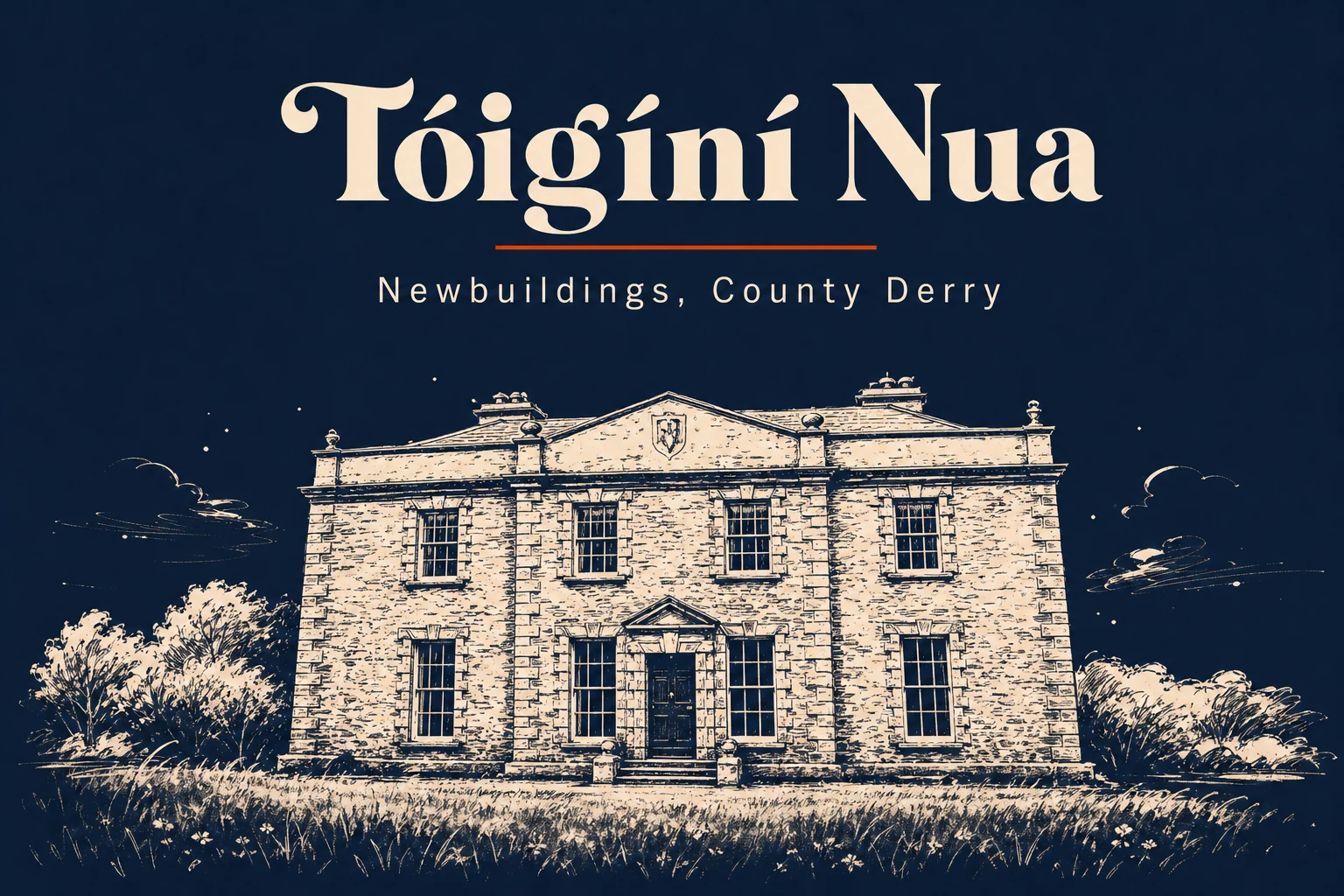
Tóigíní Nua · Co. Derry
A Plantation estate village that became a Derry suburb. The Foyle does the rest.
Newbuildings is a Derry commuter village strung along the A5, three miles south of the city walls. The 2021 census put the population at 2,829. If you came expecting an old estate village with a square and a market cross, you came to the wrong place - most of what you see was built between 1965 and 2005, when Derry needed somewhere for its young families to go and the cheap land was here on the west bank of the Foyle.
The original Plantation grant was to the Worshipful Company of Goldsmiths of London, one of the twelve livery companies that carved up County Londonderry in the 1610s. The village stayed a few houses and a church for three hundred years. Then the housing estates arrived. The demographic that arrived with them is the part of the story you don't get from a brochure: Newbuildings is overwhelmingly Protestant and unionist, a small island of one community on the edge of a majority-nationalist city. The Eleventh Night bonfire is built here. The kerbstones, in places, are painted.
What's actually worth a visit is just up the road and across the river. Prehen House, the 1740 Georgian seat of the Knox family, sits in its parkland on the east bank of the Foyle. In November 1761 Mary Anne Knox left it for Dublin in a coach and never came home - an obsessive suitor named John MacNaghten ambushed the carriage on the road to Strabane and shot her dead while aiming for her father. He was hanged at Strabane in December, the rope broke on the first drop, and he climbed back up the ladder rather than be called 'half-hanged' for the rest of history. The crowd was over a thousand strong. He is still called Half-Hanged MacNaghten.
Stay one bus stop. Walk Prehen Wood. Get back on the 6a to Derry. That's the visit.