County Derry Ireland · Co. Derry · Claudy Save · Share
POSTED FROM
CLAUDY
CO. DERRY · IE

Claudy
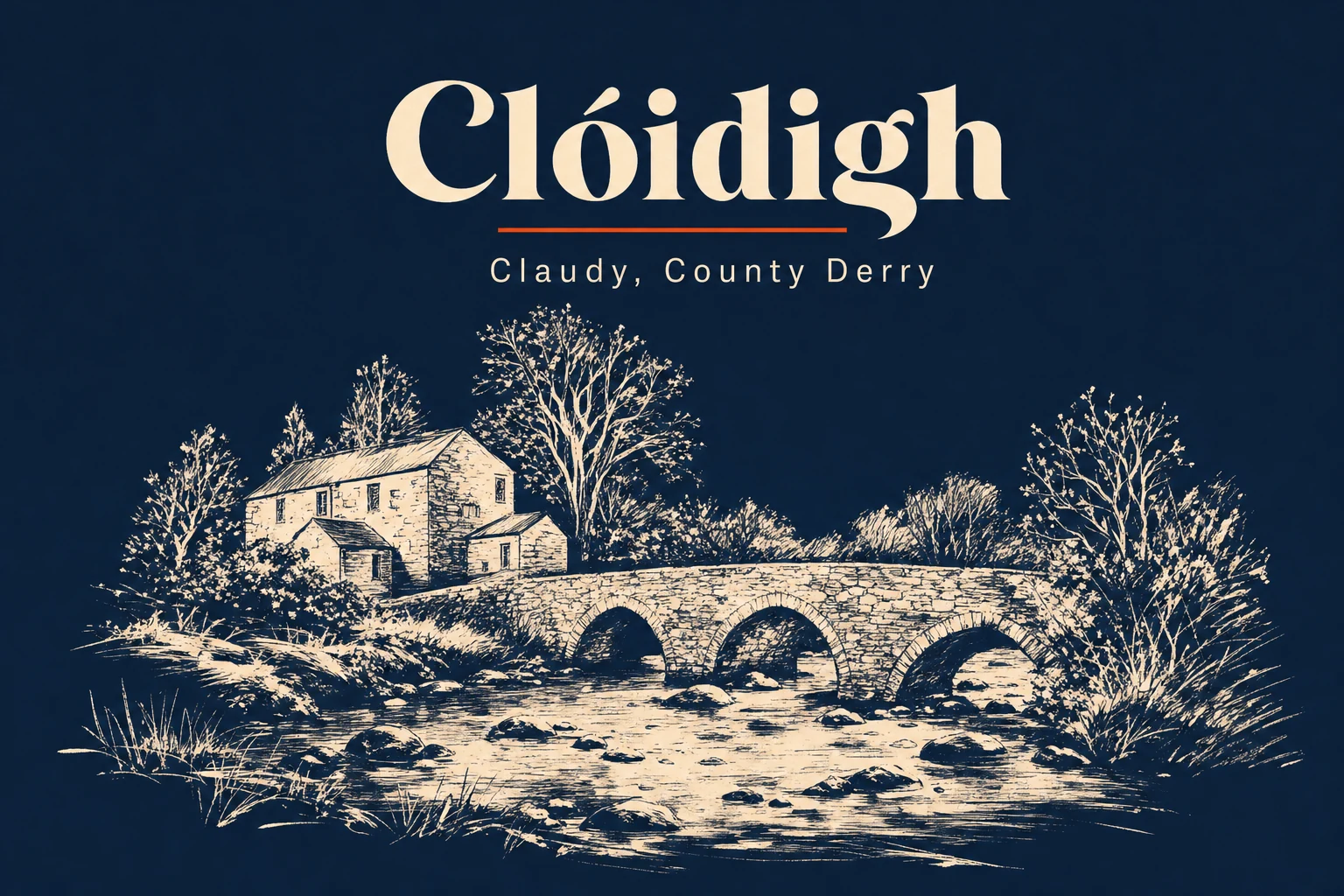
Clóidigh

The Sperrins & Faughan Valley
STOP 03 / 06
Clóidigh · Co. Derry

A Main Street, a river, and a memorial that names the morning the village can't forget.

Claudy is a small village on the A6 between Derry and Dungiven, sat at the place where the Glenrandal flows into the Faughan. A Main Street, a couple of churches, two primary schools and a college, a few shops. The Sperrins rise behind it. Derry city is twelve minutes down the road. Most days that's the shape of the place — rural service centre, river valley, parish.

And then there is the morning of 31 July 1972. Three car bombs went off in quick succession on Main Street and Church Street, mid-morning on a Monday. Nine civilians were killed, including three children. A telephone warning had been attempted from Dungiven but the lines were down — an earlier IRA bomb had destroyed Claudy's telephone exchange. The Provisional IRA never publicly admitted responsibility; a 2010 Police Ombudsman report concluded that the RUC believed a local Catholic priest, Father James Chesney, to be the IRA's South Derry Brigade quartermaster and director of operations, and that senior officers, the Northern Ireland Office and the Catholic hierarchy colluded in moving him to a parish in Donegal rather than prosecuting him. The bombing has the shorthand name 'Bloody Monday'. Nobody has ever been charged.

What you notice if you stop is how ordinary the village still is. Children on bikes. The post office. A bronze figure on Main Street by the sculptor Elizabeth McLaughlin, a kneeling girl, the names cast underneath. The community holds an ecumenical service every year on the anniversary. Locals will talk about it if you ask, and they won't if you don't, and either way is fine.

The reason most people come through Claudy is to go somewhere else — Ness Country Park for the waterfall, Learmount Forest for the walks, the Sperrins for the long view. That's honest. Treat the village as the doorway it is, but stop on Main Street for ten minutes. Read the names. Then drive on.

Population
~1,336 (2011 census; 2021 figure not yet published)
Walk score
Main Street top to bottom in five minutes
Coords
54.9131° N, 7.1583° W
01 / 07

At a glance.

Three things every local will eventually mention. Read these and you've already understood more than most day-trippers do.

0
02 / 07

Where to eat.

PlaceTypeLocal note
Dart Mountain Cheese Artisan cheesemaker & tour €€ Kevin and Julie Hickey have been making cheese at the foot of Dart Mountain since 2009 — Sperrin Blue, Tirkeeran, Kilcreen, the lot. Multiple World Cheese Awards and Great Taste Awards. Tours include a six-cheese tasting. Not in the village itself but the nearest food destination worth driving to.
0
03 / 07

Stories & lore.

The reason to come back. The things every local will eventually tell you about, usually after the second pint.

The bombing

Bloody Monday, 1972

On 31 July 1972, three car bombs detonated in Claudy in quick succession — two on Main Street, one on Church Street. Nine civilians were killed: Kathryn Eakin (9, who had been cleaning the windows of her family's shop), Patrick Connolly (15), William Temple (16), Arthur Hone (38), Joseph McCluskey (39), Rose McLaughlin (52), Elizabeth McElhinney (59), David Miller (60) and James McClelland (65). Thirty were injured. Two of the bombers had driven on to Dungiven to phone a warning, but the local telephones there were out of order — an earlier IRA bomb had destroyed Claudy's own telephone exchange. By the time the first phone call got through, the first bomb had already gone off. The Provisional IRA never publicly admitted responsibility. A 2010 Police Ombudsman report concluded that the RUC believed Father James Chesney, a local Catholic priest, was the South Derry Brigade's quartermaster and director of operations, and that senior officers colluded with the Northern Ireland Office and the Catholic hierarchy to move him to a parish in the Republic rather than pursue charges. No one has ever been prosecuted for the bombing. The bronze memorial on Main Street, a kneeling girl by sculptor Elizabeth McLaughlin, stands at the spot where the first bomb went off.

4 January 1969

Burntollet Bridge

Three miles down the road towards Derry, on the Faughan, a People's Democracy civil rights march from Belfast was ambushed at Burntollet Bridge by a loyalist crowd of around 300, including off-duty members of the Ulster Special Constabulary. Stones, iron bars and nail-spiked sticks. The marchers were on the final day of the walk to Derry, having stopped overnight in Claudy. The attack is read as one of the events that pushed Northern Ireland into the Troubles proper. Civil rights veterans have campaigned for years for a plaque at the bridge. There still isn't one.

Clóidigh

The strong-flowing one

The Irish name Clóidigh means the strong-flowing one, or the one who washes — a reference to the rivers that meet here. The Glenrandal joins the Faughan at the foot of the village. Tradition has it that St Patrick founded a church at Cumber, the parish that contains Claudy, in the fifth century; an archbishop's visitation in 1397 records a parish church already long established on the same site. The current Church of Ireland building dates to 1757, with a small bell turret on the western gable. Older still: a Late Neolithic ritual site was uncovered during quarry works on the Glenshane Road, with a roundhouse and an isolated cremation burial dated to roughly 2,500–3,000 BC. People have been living at this river junction for a long time.

When the A6 left town

The bypass

For most of the twentieth century the A6 — the main road between Belfast and Derry — ran directly up Main Street. Lorries, coaches, the lot. The 25.5 km Dungiven-to-Drumahoe dualling, a £220m scheme delayed by Covid and finally opened to traffic on 6 April 2023, routed through traffic onto a new road north of the village. There's a new park-and-ride at Claudy off the dual carriageway. The village is quieter now than it has been in living memory. Locals are split on whether that is a relief or a slow problem. Footfall is down. So is noise.

04 / 07

Things to do outside.

Wear waterproofs. Bring a sandwich. Tell someone where you're going if it's the mountain.

Ness Country Park Four and a half kilometres north-west of the village. The Burntollet river cut a new channel through rock after the last ice age and left Ness Falls — a thirty-foot drop, said to be the highest waterfall in Northern Ireland. Bluebells in spring, woodland colour in autumn, toilets and a car park year-round. Adjoins Ervey Wood Nature Reserve.
4.5 km of woodland trailsdistance
1–2 hourstime
Learmount Forest 118 hectares on the foothills of the Sperrins above the Faughan, with Learmount Castle — a Tudor-Gothic house built in 1830 onto an older 1710 building — visible from the paths. Mixed pine and deciduous, fifteen-plus tree species, some over a hundred years old. Trails climb 200 metres to the slopes of Meeny Hill.
4 km of trailsdistance
1–2 hourstime
The Faughan riverbank The Faughan flows past the foot of the village. Short stretches of riverside walking either side of the bridge. Salmon and sea trout in season; the river is well-known to local anglers. Not a waymarked trail — pick your way and turn back.
Variabledistance
30–60 mintime
05 / 07

When to go.

There is no bad time. There are different times.

Spring
Mar–May

Bluebells at Ness, lambs in the fields above the village, the Faughan running clean. The annual ecumenical service for the bombing is held on 31 July, but the village is at its softest in May.

◉ Go
Summer
Jun–Aug

Long evenings, the Sperrins at their greenest, the rivers low enough to wade. The bombing anniversary on 31 July is marked quietly — visitors are welcome at the service but it is not a tourist event.

◉ Go
Autumn
Sep–Oct

Learmount Forest in colour is the reason to come. The cheese at Dart Mountain is at its best after the summer milk. Quiet roads now the bypass has the traffic.

◉ Go
Winter
Nov–Feb

The Sperrin roads ice over; the village shuts down early; the daylight is gone by four. If you are passing through to Derry, the city has more to keep you for an evening.

◐ Mind yourself
06 / 07

What to skip.

Honestly? Don't bother.

If a local was sitting beside you, this is the bit where they'd lean in.

×
Treating the bombing memorial as a photo stop

It is a memorial to nine civilians murdered in 1972, three of them children. Read the names. Don't pose with it. Don't add it to a Troubles tour itinerary.

×
The Cliffs of Moher visitor-centre logic for Ness

Ness Waterfall has a small free car park and a path. There is no turnstile, no ticket, no gift shop. Don't go looking for the official entrance — you are already at it.

×
Driving the old A6 expecting it to be busy

The A6 dualling has finished. The road through the village is quiet. If you wanted main-road convenience you should have stayed on the dual carriageway above.

×
Treating Claudy as a destination on its own

Honest answer: most visitors stop for half an hour. Pair it with Ness, Learmount, Dart Mountain, or run on into Derry city. A stay-over makes more sense in Derry, twelve minutes down the road.

+

Getting there.

By car

On the A6, twelve minutes (12 km) east of Derry city, twenty minutes (20 km) west of Dungiven. The bypass takes through traffic past the village; turn off for Main Street if you want the village itself.

By bus

Translink Goldline and local services run between Derry and Belfast along the A6, with Claudy stops on Main Street. Roughly hourly during the day. Journey to Derry is around 25 minutes.

By train

No train. Nearest station is Derry-Londonderry (Waterside), then bus or taxi to Claudy.

By air

City of Derry Airport (LDY) is 25 minutes by car. Belfast International is 1h 15m. Belfast City is 1h 30m.